



Japan, Korea compete for dominance in naval arms
Apr 20, 2026, 11:40 am


As Japan secures its largest arms export deal since World War II and signals a shift from a “war-restricted nation” to a major global defense exporter, South Korea is responding by deploying lithium-ion battery-powered submarines — the only such technology in the world — to disrupt the Middle East’s naval balance.
With both countries positioning defense industries as a core engine of national growth, their rivalry is intensifying beyond Asia into the global naval defense market, evolving into what analysts describe as a full-scale “spear and shield” competition.
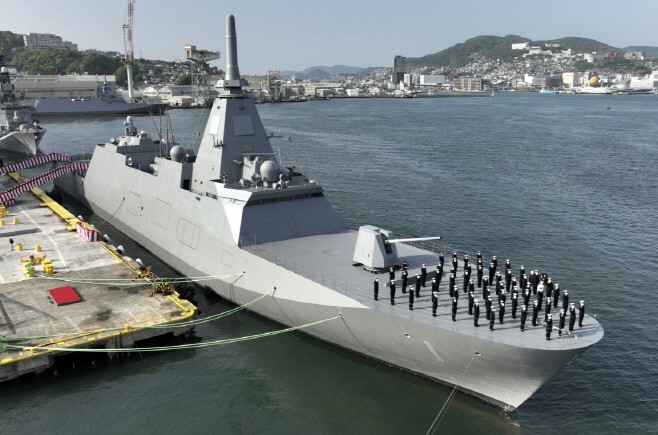 |
| The first ship of the Mogami-class multi-role frigate, Mogami, built at the Nagasaki shipyard of Mitsubishi Heavy Industries and commissioned into the Japan Maritime Self-Defense Force on April 28, 2022. The vessel measures 133 meters in length and 16.3 meters in width, with a top speed exceeding 30 knots (about 56 km/h). It is powered by a combined diesel and gas turbine (CODAG) system with an output of approximately 70,000 horsepower. / Mitsubishi Heavy Industries |
Japan secures landmark frigate deal with Australia
On April 18, a landmark moment in Japan’s defense industry unfolded. The Japanese government and Mitsubishi Heavy Industries were selected as the final contractor for Australia’s next-generation frigate program, Project SEA 3000, securing a deal to supply 11 vessels.
Valued at up to $15 billion, the contract represents Japan’s largest defense export since easing arms export restrictions in 2014.
The export model — an upgraded version of the 4,800-ton Mogami-class frigate — is designed for multi-role operations, including anti-submarine, anti-air, anti-surface, and mine warfare missions, in addition to routine surveillance.
A key factor in its selection was its advanced stealth design and automation systems, which reduce crew requirements to around 90 — roughly half that of conventional warships.
The project also demonstrates strategic flexibility in production. The first three ships will be built at a shipyard in Nagasaki, Japan, while the remaining eight will be constructed locally in Henderson, Western Australia.
Shinjiro Koizumi described the deal as reinforcing the quasi-alliance between Japan and Australia and strengthening regional security cooperation in the Indo-Pacific.
Choi Young-jae, a Tokyo-based correspondent of AsiaToday, noted that the agreement reflects a clear departure from Japan’s traditionally cautious stance on military technology transfer, highlighting a more proactive export strategy.
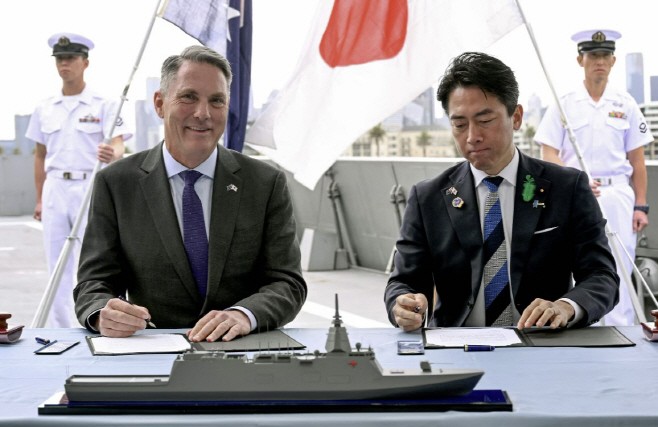 |
| Richard Marles (left) and Shinjiro Koizumi sign a contract for the supply of Mogami-class frigates in Melbourne, Australia, on April 18. /AFP-Yonhap |
Japan reshapes state for arms exports
Japan is not stopping at securing major defense contracts — it is restructuring its state apparatus to expand arms exports.
The Japanese government is moving to establish a centralized, cross-ministerial command system to oversee defense exports, bringing together senior officials from foreign affairs, defense, and economic ministries. It is also set to effectively abolish key restrictions under its long-standing “Three Principles on Transfer of Defense Equipment,” which had limited exports to five non-combat categories such as rescue, transport, surveillance, and mine-clearing.
With these changes, Japan will be able to export fully armed systems — including fighter jets, missiles, and warships — and expand sales channels through bilateral defense agreements. The reforms also allow jointly developed weapons, such as the next-generation fighter program with the UK and Italy, to be exported to third countries.
Analysts say this marks a fundamental shift: Japan is moving beyond “finding weapons to sell” to actively redesigning its national framework to support arms exports.
Sanae Takaichi described the move as “a growth strategy for Japan’s economy,” emphasizing efforts to integrate security and economic policy while revitalizing the country’s defense manufacturing sector.
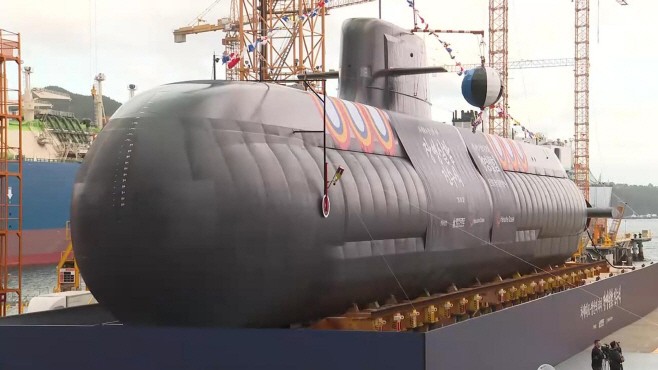 |
| A 3,600-ton-class next-generation submarine (Jangbogo-III Batch-II, first vessel Jang Young-sil) launched on Oct. 22, 2025, at Geoje by Hanwha Ocean. Equipped with lithium-ion batteries, it offers extended operational endurance and enhanced stealth, and features 10 vertical launch system (VLS) tubes, making it one of the world’s most advanced diesel submarines. / Hanwha Ocean |
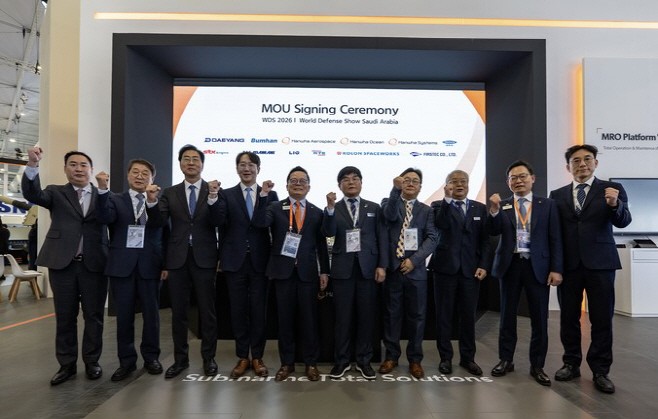 |
| An MOU for joint entry into the Saudi and Middle East markets was signed in Riyadh on Feb. 11, led by Hanwha Ocean (CEO Eo Sung-cheol, fifth from left). / Hanwha Ocean |
Most Read
-
1
U.S. Treasury Secretary Bessent publicly warns ove..

-
2
Celltrion’s Omlyclo gains ground in major European..

-
3
Hyundai Motor Group breaks ground on integrated st..

-
4
Russia faces warning signs over prolonged war econ..

-
5
U.S. strikes 3 Iranian oil tankers, Iran vows reta..

-
6
S. Korea seeks redemption from World Cup setback w..

-
7
Trump makes $1 trillion bet ahead of midterm elect..

PEOPLE







-
Address : In-Young Bldg., 34, Uisadang-daero 1-gil, Yeongdeungpo-gu, Seoul
Copyright by ASIATODAY CO., LTD. All rights resereved