



Emptying war coffers may put Putin’s political survival at risk
Jun 02, 2026, 01:46 pm


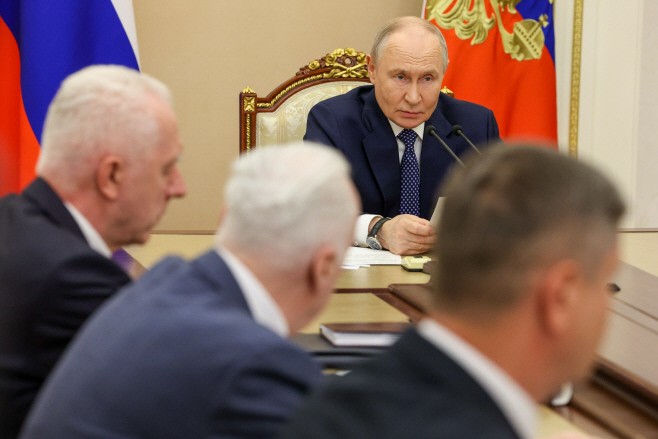 |
| Russian President Vladimir Putin discusses support for the families of victims of the Starobelsk terrorist attack and the ongoing investigation during a government meeting held at the Kremlin in Moscow on the 1st (local time). / Photo via Russian Presidential Press and Information Office, TASS, Yonhap News |
Senior officials from the Russian Ministry of Finance and the Central Bank have warned President Vladimir Putin that spending on the war in Ukraine has reached unsustainable levels and recommended cutting the defense budget, Bloomberg News reported on the 1st (local time).
Russia's cumulative budget deficit from January to April 2026 stood at 5.88 trillion rubles (124.068 trillion won), exceeding the annual plan by about 50 percent, yet the Ministry of Defense is demanding up to 3 trillion rubles (63.3 trillion won) in additional funding. The Financial Times (FT), a British daily, analyzed that war failure and financial pressure could escalate into fractures within the Russian elite and power risks for Putin.
Russia's 4-Month budget deficit hits 5.88 trillion Rubles, exceeding annual plan by 50%
According to Russian Ministry of Finance data compiled by Bloomberg, the Russian government's budget deficit has expanded rapidly since the beginning of this year. The cumulative deficit for January 2026 was 1.63 trillion rubles, but it swelled to 3.45 trillion rubles in February, 4.58 trillion rubles in March, and 5.88 trillion rubles in April. Bloomberg assessed that this represents 2.5 percent of gross domestic product (GDP), exceeding the annual plan by about 50 percent.
The monthly deficit continued at 1.63 trillion rubles in January, 1.82 trillion rubles in February, 1.123 trillion rubles in March, and 1.3 trillion rubles in April. This means the government surpassed the 2025 annual cumulative deficit of 5.63 trillion rubles in just four months.
The cumulative deficit as of July 2025 was 4.62 trillion rubles (with a monthly deficit of 1.24 trillion rubles), demonstrating that the pace of the widening deficit has accelerated sharply within a year. Bloomberg reported that about 500 trillion rubles (10.55 trillion won) was withdrawn from the National Wealth Fund, the sovereign wealth fund, during the first two months of this year, leaving the balance reduced by about 60 percent compared to pre-invasion levels.
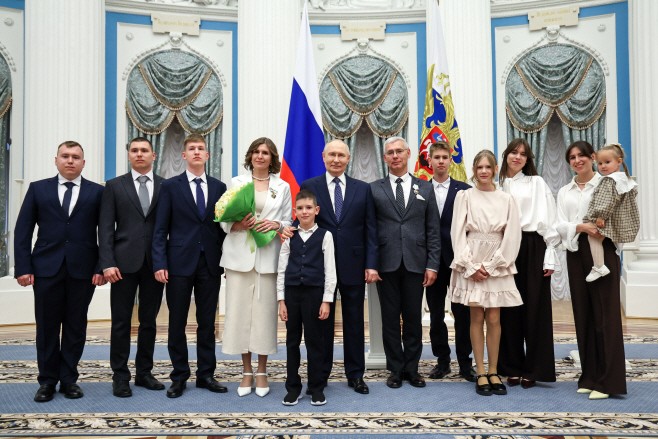 |
| Russian President Vladimir Putin (center) takes a group photo with Olga Vlasova (fourth from left) and her children during an award ceremony for the Russian 'Mother Heroine' medal and 'Order of Parental Glory' held at Catherine Hall in the Kremlin, Moscow, on the 1st (local time) to mark International Children's Day. / Photo via Russian Presidential Press and Information Office, TASS, Yonhap News |
Russian Ministry of Finance and Central Bank recommend cutting defense budget; Ministry of Defense demands additional 3 trillion rubles
Officials from the Russian Ministry of Finance and the Central Bank have proposed cutting the defense budget to the Kremlin, warning that current projected defense spending levels could dangerously widen the budget deficit. However, Bloomberg reported that the Ministry of Defense and certain factions within the Kremlin are resisting, arguing that cutting defense spending would damage the economy since many companies rely on military contracts.
Two sources familiar with the Russian government told Bloomberg that the Ministry of Defense is demanding additional funding of up to 3 trillion rubles this year.
Putin instructed the Ministry of Finance to look for room to cut from other budget sectors before touching defense spending, Bloomberg reported. When compiling the 2026 budget, there were already projections that a funding gap of 1.2 trillion to 1.5 trillion rubles (25.3 trillion to 31.64 trillion won) could arise in the defense sector in the second half of the year; however, Bloomberg reported that the budget at the time assumed a decline in second-half defense spending, keeping in mind the possibility of ending the war following the summit between U.S. President Donald Trump and Putin held in Alaska, USA, last August.
Finance Minister Anton Siluanov said in an interview with the Russian economic newspaper Kommersant on the 27th of last month, "A certain degree of restraint is necessary in public spending," adding, "Reserves are not infinite. Fiscal vulnerability cannot be tolerated amidst the major global transformations."
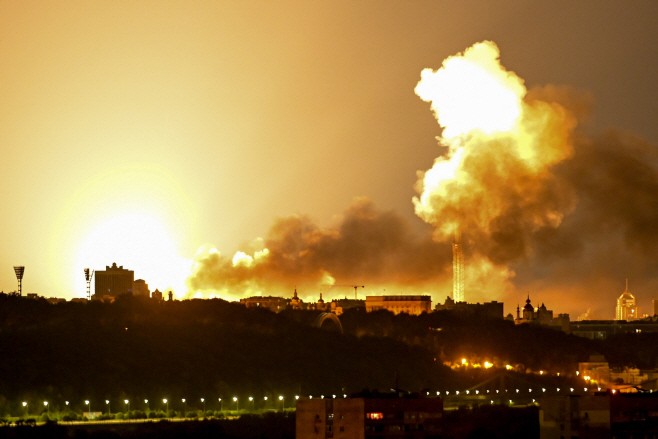 |
| An explosion occurs in Kyiv, Ukraine, following a Russian drone and missile attack on the 2nd (local time). / Photo via AFP, Yonhap News |
US and Israel war with Iran oil boom fails to stop structural fiscal problems in Russia; Growth forecast downgraded to 0.4%
The Russian government failed to prevent fiscal deterioration despite a surge in oil prices driven by the US and Israel war with Iran. Government officials told Bloomberg that oil prices must exceed $100 per barrel for at least a year to meaningfully improve the economy, adding that temporary windfall revenues from rising oil prices do not solve structural problems in growth, inflation, and the banking sector.
Bloomberg analyzed that a strong ruble reduced export revenues, further intensifying pressure on public finances. The Ministry of Economic Development downgraded its 2026 GDP growth forecast in May from the previous 1.3 percent to 0.4 percent, and the economy contracted in the first quarter of this year for the first time in three years.
Government spending from January to April this year rose by about 16 percent year-on-year, while state procurement spending surged by 41 percent, and Russia is also considering imposing a windfall tax on certain commodity producers and banks, Bloomberg reported.
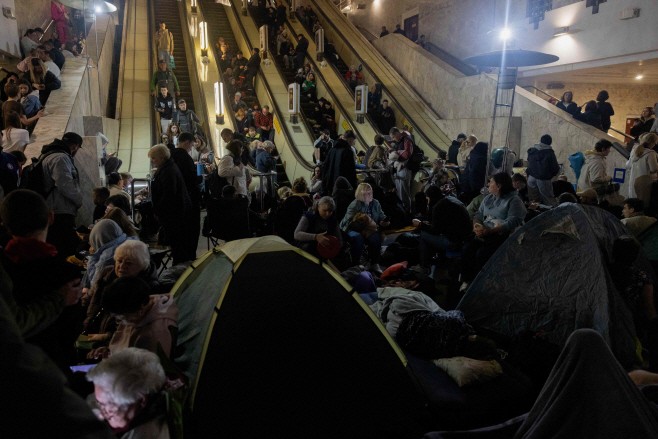 |
| Ukrainian citizens take shelter in a Kyiv subway station to escape Russian airstrikes on the 2nd (local time). / Photo via AFP, Yonhap News |
FT "Failure in Ukraine war could lead to Putin's ouster"
The FT pointed to the omission of the tank and heavy equipment parade due to concerns over drone attacks during the Victory Day event on the 9th of last month, assessing it as a symbolic scene demonstrating not only that the 'special military operation' failed to subjugate Ukraine but also that the Russian capital itself was exposed to danger.
The FT analyzed that failure in the Ukraine war could lead to the ouster of 73-year-old Putin, citing historical precedents such as the public unrest and constitutional monarchy movement following the defeat in the Russo-Japanese War in 1905, the Russian Revolution following the failure in World War I, the ouster of Soviet Communist Party First Secretary Nikita Khrushchev due to the failure of the Cuban Missile Crisis in 1964, and the collapse of the Soviet Union resulting from the prolonged war in Afghanistan.
However, the FT noted that power transition through public protests or elections is unlikely and that fractures within the elite represent the most realistic path, while projecting high barriers to an actual power shift as the current ruling elites are all loyalists and war beneficiaries who are placed on Western sanction lists.
Alexander Gabuev, director of the Carnegie Russia Eurasia Center under the US think tank Carnegie Endowment for International Peace, assessed to the FT, "The current ruling elites are all handpicked loyalists and beneficiaries of the current confrontation."
Ha Man-joo
Most Read
-
1
Celltrion’s Omlyclo gains ground in major European..

-
2
Trump demands rates fall below 1% as Fed hikes for..

-
3
Trump makes $1 trillion bet ahead of midterm elect..

-
4
Iran resumes ballistic missile production, assembl..

-
5
Samsung Electronics, Mistral AI to jointly develop..

-
6
Trump warns countries not helping U.S. must pay re..

-
7
Apple launches first foldable, 1 million won prici..

PEOPLE






HEADLINE NEWS
- Trump to roll out ‘unprecedented welcome’ for Xi with B-2 bombers, F-22 fighters
- S. Korea, U.S., and Japan form united front on Taiwan and economic coercion..
- Trump administration moves to impose sweeping sanctions on International Cr..
- Xi to make state visit to U.S. Sept. 23-25, dispelling rumors over his heal..

-
Address : In-Young Bldg., 34, Uisadang-daero 1-gil, Yeongdeungpo-gu, Seoul
Copyright by ASIATODAY CO., LTD. All rights resereved