



Pyongyang high-level meeting foreshadows brutal purge of elite factions
Jul 13, 2026, 09:20 am


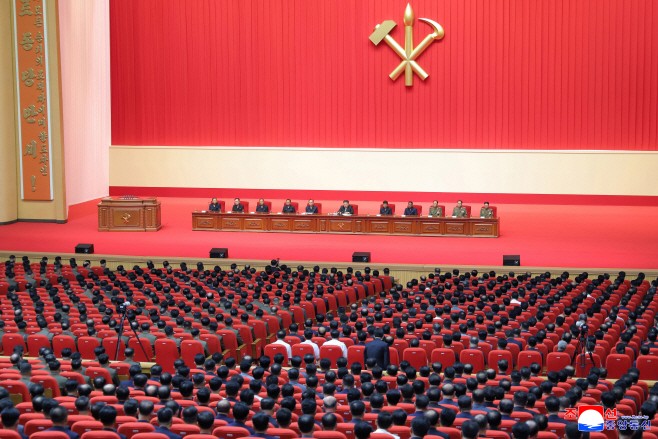 |
| North Korean leader Kim Jong-un attends a rare joint meeting of the ruling party, government, and military on July 10, the Korean Central News Agency reported on July 11. / Photo by Yonhap News |
North Korea’s recent public condemnation of Pak Hui-chol, the vice director of the General Political Bureau of the People’s Army, for massive corruption during a rare joint meeting of the party, government, and military signals an impending bloody purge comparable to the downfall of former administrative department chief Jang Song-thaek, analysts say.
Experts on July 12 noted that the primary objective of this joint meeting was to penalize a figure holding immense power within the military's organization department. The move appears focused on tightening leader Kim Jong-un’s grip on the military, reaffirming the loyalty of high-ranking officials, preventing factionalism, and clamping down on abuses of power.
The decision also carries economic motives. As Pyongyang moves to upgrade ties and reactivate economic exchanges with China, it seeks to root out systemic corruption, illicit enrichment, and bribery beforehand to ensure maximum efficiency in its economic reforms.
What stands out is the striking resemblance between the charges leveled against Pak and those brought against Jang Song-thaek, who was executed during the early years of Kim’s rule. Both were accused of undermining Kim Jong-un’s monolithic leadership system and disrupting state finances, heightening expectations of a widespread political purge.
Jang was executed on charges of factionalism, disrupting economic projects, creating chaos in state finances, and selling off state resources cheaply. Meanwhile, Pak is accused of abusing his personnel authority for embezzlement, illicit wealth accumulation, bribery, trafficking in offices, and unfair appointments. Crucially, he reportedly plundered state funds, materials, and housing units, thereby hindering the establishment of the party’s monolithic military command system.
The purge of Pak was set in motion during last month’s Plenary Meeting of the Central Committee of the Workers' Party. North Korean media previously reported that Pak had been handed over to judicial authorities for corruption, alongside the reinstatement of Jo Yong-won as the head of the powerful Organization and Guidance Department after just a three-month hiatus.
"The recent return of Jo Yong-won to the Organization and Guidance Department indicates a bloody purge on the horizon, mirroring the Jang Song-thaek affair," said Cho Han-bum, a distinguished research fellow at the Korea Institute for National Unification. "The public denunciation of Pak during this joint meeting also brings to mind the Shimhwajo (deepening group) incident."
Both the Jang Song-thaek downfall and the Shimhwajo incident represent sweeping purges carried out by Kim Jong-un and his late father Kim Jong-il to solidify their power. After taking power in 2012, Kim Jong-un publicly executed Jang, then considered the regime's number-two figure, as a warning. In the late 1990s, Kim Jong-il operated a secret apparatus called the Shimhwajo to deflect blame for the arduous march famine and consolidate power following the death of Kim Il-sung, resulting in countless deaths and imprisonments.
"While North Korea outwardly boasts of military achievements, they seem to fall short of Kim Jong-un’s expectations, causing deep frustration," Cho added. "This will not end with the punishment of Pak alone."
Although North Korean state media did not disclose the specific sentence handed down to Pak, experts believe he has likely faced capital punishment. In December 2013, Jang Song-thaek was stripped of all titles and expelled from the party during a Political Bureau meeting before being arrested on the spot. Four days later, he was executed by anti-aircraft guns immediately after a special military tribunal under the Ministry of State Security found him guilty of treason.
"Given that Pak was transferred to judicial authorities during last month's plenary session and this follow-up joint meeting was convened, a summary execution may have already taken place," said Kwak Gil-sup, head of One Korea Center and a former North Korea analyst at the National Intelligence Service. "He was likely executed in front of cadres to serve as a stark warning."
Mok Yong-jae
Most Read
-
1
Celltrion nears additional contract with major U.S..

-
2
"Aren't those foreigners on welfare?": M..

-
3
U.S. weighs dropping MOAB, world's most powerful n..

-
4
Houthis launch successive attacks on Saudi airport..

-
5
Saudi Arabia, Iran hold first diplomatic talks to..

-
6
Saudi airport in Riyadh struck again, leaving at l..

-
7
Five ASEAN countries welcome Myanmar coup leader

PEOPLE





HEADLINE NEWS

-
Address : In-Young Bldg., 34, Uisadang-daero 1-gil, Yeongdeungpo-gu, Seoul
Copyright by ASIATODAY CO., LTD. All rights resereved