



Khamenei's two-day funeral: Three sons spotted, successor Mojtaba absent
Jul 06, 2026, 10:26 am


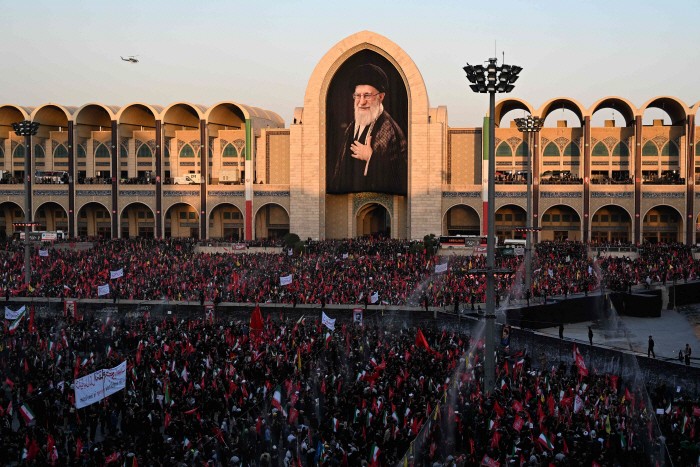 |
| Crowds gather at the Grand Mosalla to mourn Iran’s Supreme Leader Ayatollah Ali Khamenei, who was killed in a U.S.-Israeli airstrike. On July 5 (local time), the second day of the funeral, memorial prayers were held before the casket as massive crowds poured into Tehran to pay their final respects. Khamenei, who had ruled the Islamic Republic since 1989, died at the age of 86 in an airstrike launched on February 28, the first day of the war between Iran and the U.S.-Israeli alliance. / Courtesy of AFP, Yonhap |
During the ongoing national funeral period for Iran's former Supreme Leader Ayatollah Ali Khamenei, three of his sons—Mostafa, Meysam, and Masoud Khamenei—were broadcast on state television on July 5 (local time), while the newly appointed Supreme Leader Mojtaba Khamenei remained out of public sight, Reuters reported.
Iranian state media aired footage of Mostafa, Meysam, and Masoud offering funeral prayers behind the casket of their late father, which was placed at the Imam Khomeini Grand Mosalla in Tehran. However, Mojtaba, who succeeded his father to the top leadership post, did not attend the ceremony.
According to internal sources, Mojtaba sustained injuries in the very same airstrike that killed his father on February 28, and is currently undergoing medical treatment for facial damage and leg injuries. Reuters noted that no official appearances or photographs of the new leader have been made public since the incident.
Iranian authorities have declared a week of national mourning to honor the deceased leader. The previous day, tens of thousands of soldiers, seminary students, and ordinary citizens formed long lines to pay their respects before the remains of Ayatollah Ali Khamenei and five of his family members—including his daughter, son-in-law, daughter-in-law, and granddaughter—which were placed in an outdoor viewing area. Due to the massive influx of mourners, authorities extended the hours of the farewell ceremony until 10 p.m.
High-ranking government officials, including Iranian President Masoud Pezeshkian and Parliament Speaker Mohammad Bagher Ghalibaf, also attended the July 5 event.
Iran's transport authorities announced that subway rides on central lines leading to the funeral venue surpassed 7 million trips between the night of July 4 and the morning of July 5.
The authorities plan to hold a massive funeral procession through central Tehran on July 6, before transporting the remains by land on July 7 to Qom, the religious center of Shia Islam.
The procession will then travel by air on July 8 to the neighboring country of Iraq, passing through the Shia holy cities of Najaf and Karbala, before returning to Mashhad, Iran, on July 9 for final burial.
The Iranian government stated that it will provide transportation, logistics, and accommodations to handle the millions of mourners expected to visit during the funeral period.
Meanwhile, U.S. President Donald Trump stated in an interview with Axios that peace negotiations have been temporarily paused for a week out of consideration for Iran's funeral ceremonies.
Lee Jeong-eun
Most Read
-
1
Celltrion’s Omlyclo gains ground in major European..

-
2
Trump demands rates fall below 1% as Fed hikes for..

-
3
Trump makes $1 trillion bet ahead of midterm elect..

-
4
Iran resumes ballistic missile production, assembl..

-
5
Samsung Electronics, Mistral AI to jointly develop..

-
6
Trump warns countries not helping U.S. must pay re..

-
7
Apple launches first foldable, 1 million won prici..

PEOPLE





HEADLINE NEWS
- Trump to roll out ‘unprecedented welcome’ for Xi with B-2 bombers, F-22 fighters
- S. Korea, U.S., and Japan form united front on Taiwan and economic coercion..
- Trump administration moves to impose sweeping sanctions on International Cr..
- Xi to make state visit to U.S. Sept. 23-25, dispelling rumors over his heal..

-
Address : In-Young Bldg., 34, Uisadang-daero 1-gil, Yeongdeungpo-gu, Seoul
Copyright by ASIATODAY CO., LTD. All rights resereved