



Lee expands diplomatic horizons with NATO defense ties, Mongolian supply chains
Jul 06, 2026, 09:13 am


 |
| / Joint Press Corps of Cheong Wa Dae |
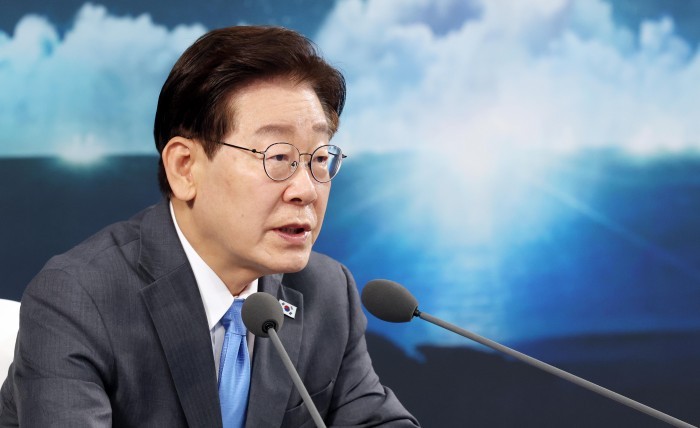
President Lee Jae-myung will embark on a five-day, four-night overseas tour starting July 7, which includes attending the NATO summit and paying a state visit to Mongolia. Coming just three weeks after his trip to Europe last month, this tour is expected to signal a full-scale push for national interest-driven pragmatic diplomacy, focusing on expanding the export foundation for South Korea's defense industry at NATO and strengthening cooperation on critical minerals and food security in Mongolia.
According to Cheong Wa Dae on July 5, President Lee will attend the NATO summit in Ankara, Türkiye, from July 7 to 8, marking his first participation since taking office following an official invitation from the alliance. Since Russia's invasion of Ukraine, NATO has been broadening its security ties by deepening cooperation with four Asia-Pacific partners (AP4): South Korea, Japan, Australia, and New Zealand. Defense cooperation stands out as the centerpiece of discussions between South Korea and NATO during this summit. Facing prolonged warfare and regional instability, NATO member states—which account for 55% of global military spending—have been ramping up their defense budgets. This shift is unlocking new export channels for South Korea's defense sector, which possesses both high-tech capabilities and robust manufacturing capacity.
However, for South Korean defense products to successfully secure a long-term foothold in the European market, meeting NATO's weapon system standards and operational criteria remains a critical hurdle. Given the premise of joint military operations, NATO member countries place heavy emphasis on the interoperability of weapons, ammunition, communications, and maintenance frameworks. Ensuring South Korean hardware is designed and upgraded to meet these specifications will further open the doors to export opportunities.
Cheong Wa Dae views the summit as a pivotal opportunity to broaden discussions on supply chain cooperation and the standards required to penetrate the NATO market. Wi Sung-lac, director of national security, noted during a briefing, "This will serve as a launchpad to enter the world's largest defense market under NATO and build a resilient defense supply chain." Following the summit, President Lee will travel to Mongolia on July 9 at the invitation of Mongolian President Ukhnaagiin Khürelsükh. This marks the first state visit by a South Korean president to Mongolia in 15 years, since the Lee Myung-bak administration in 2011. Cheong Wa Dae expects the visit to elevate bilateral relations to a stage of substantive practical cooperation.
While Mongolia's market size is relatively modest with a population of 3.51 million, the entry of South Korean consumer goods is surging rapidly on the back of the growing popularity of K-culture. Korean convenience store chains such as CU and GS25 have already surpassed 700 outlets nationwide, and E-mart operates four locations in Ulaanbaatar. Driven by rising demand for Korean food, beauty, and household products, South Korea's exports to Mongolia expanded to 660 million dollars last year. The government plans to expand this economic engagement into strategic sectors like critical minerals and food security. Rich in mineral resources and strategically situated at the crossroads of Northeast and Central Asia, Mongolia is highly valued as a partner for diversifying supply chains.
Director Wi added, "Mongolia maintains traditional friendly ties with North Korea, having been the second country to establish diplomatic relations with the regime after the Soviet Union. We therefore look forward to establishing a partnership that contributes to achieving peace on the Korean Peninsula."
Park Young-hoon
Most Read
-
1
Trump shares map on social media labeling Strait o..

-
2
Kia Sportage outperforms Mazda CX-5 in German auto..

-
3
Houthis launch successive attacks on Saudi airport..

-
4
U.S. deploys carrier, 10,000 more troops to Middle..

-
5
Trump rejects Iran's offer to open Strait of Hormu..

-
6
N. Korea conducts first swarm attack drill with dr..

-
7
U.S.-China summit falls short on substance as Trum..

PEOPLE





HEADLINE NEWS
- Seoul dismisses Ukraine's claim of 'S. Korean support for Russia' as "inaccurate and inappropriate"
- S. Korea, Japan race to develop nuclear-powered submarines
- Henri Kagan, Kenso Soai win Nobel Prize in Chemistry for uncovering how mol..
- Vance says Alaska LNG cooperation will move forward with Seoul's current or..

-
Address : In-Young Bldg., 34, Uisadang-daero 1-gil, Yeongdeungpo-gu, Seoul
Copyright by ASIATODAY CO., LTD. All rights resereved