



Myanmar junta eyes ASEAN return amid regional embrace
Jun 23, 2026, 01:25 pm


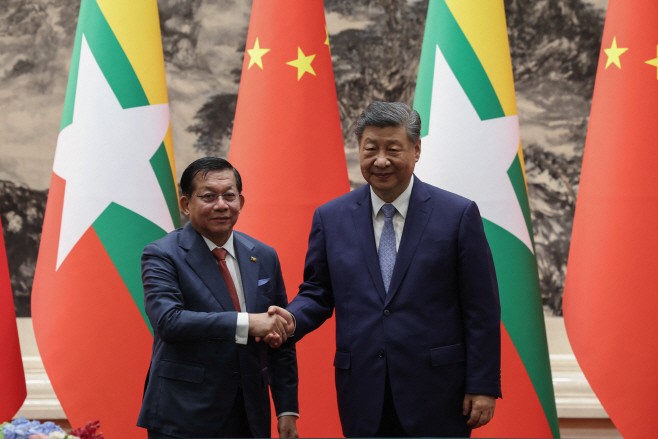 |
| Myanmar President Min Aung Hlaing (left) and Chinese President Xi Jinping / Yonhap News via Reuters |
The leader of Myanmar's military junta has secured a critical stepping stone to break free from diplomatic isolation and plot a return to the ASEAN (Association of Southeast Asian Nations) Summit, following consecutive and welcoming visits to China and India. However, regional experts express profound concern that these high-profile receptions could provide the junta with a pretext to intensify its brutal military crackdown on the ongoing civil war.
According to a report by the South China Morning Post (SCMP) on June 23, Chinese President Xi Jinping met with Myanmar's President Min Aung Hlaing at the Great Hall of the People in Beijing on June 16, effectively delivering a political endorsement to the military-led administration. To General Hlaing—the mastermind behind the military coup who assumed the presidency following an election earlier this year that faced widespread international condemnation as fraudulent—President Xi reaffirmed immediately following the welcoming ceremony that Beijing would "continue the long-standing 'Pauk-Phaw' (fraternal) friendship between the two nations and deepen comprehensive strategic cooperation." "Pauk-Phaw" is a traditional Burmese term denoting a unique, close-knit relationship between the two neighbors.
Since ousting the democratically elected government led by Nobel Peace Prize laureate Aung San Suu Kyi in February 2021, Myanmar's military has faced severe diplomatic isolation from Western nations as well as the 11-member ASEAN bloc. ASEAN has consistently barred junta leaders from its high-level summits due to the regime's failure to implement the "Five-Point Consensus" agreed upon shortly after the coup. The consensus mandates an immediate cessation of violence, the initiation of constructive dialogue among all stakeholders, and the unhindered delivery of humanitarian aid. The recent state visit to Beijing, however, provided the junta with a crucial lever to fracture this isolation.
China's deep diplomatic and economic engagement with Myanmar is rooted in their shared 2,200-kilometer border and the China-Myanmar Economic Corridor. During the bilateral summit, the two nations signed 18 wide-ranging agreements covering trade, cross-border transit, and disaster relief, while also pledging to crack down on transnational border crimes. President Xi reportedly sought firm security guarantees from the junta to reopen key trade routes and safeguard Chinese personnel operating on critical infrastructure projects, including the Kyaukphyu deep-sea port and the Muse-Mandalay railway.
Analysts note that this narrow logic of asset protection complicates the prospects for a broader peace rather than advancing it. Sai Kyi Zin Soe, a researcher at the University of Sydney, pointed out that China's intervention follows a highly self-serving pattern, exerting pressure on warring factions to halt hostilities only when Chinese infrastructural and economic interests are directly threatened. A clear case in point occurred in April when the Myanmar National Democratic Alliance Army, bowing to immense pressure from Beijing under a ceasefire agreement, withdrew from Lashio and handed control of the city back to the junta. "This is not genuine peace mediation," Zin Soe observed. "It is a selective investment protection mechanism applied precisely where Chinese assets are in jeopardy."
This selective intervention raises alarming concerns that Beijing's backing has handed the junta the confidence to escalate its military campaigns against resistance forces. Zin Soe evaluated that China's explicit support has emboldened the military regime to expand its operations, which the junta can now conveniently disguise as actions aligned with the newly signed security cooperation pacts. "As long as China’s backing is framed through that lens, the junta will double down on a military approach rather than pursuing a political settlement," he warned. Since the coup, Myanmar has been plunged into a full-scale civil war, with resistance forces and ethnic armed organizations successfully seizing control of vast swaths of national territory.
Strategic calculations also explain why China extended a far more lavish diplomatic reception to the Myanmar leader compared to India. Zin Soe noted that while New Delhi hosted the Myanmar leader with relative discretion, Beijing orchestrated a "full protocol event," sending a direct and unmistakable signal to the military leadership that China—not India—remains their indispensable partner. The rivalry between China and India over Myanmar is fundamentally geopolitical and geostrategic. Because roughly 80% of China's crude oil imports pass through the Malacca Strait, an overland corridor through Myanmar leading to the Kyaukphyu port in Rakhine State serves as a vital strategic alternative for Beijing should adversarial powers blockade the strait.
Conversely, some analysts argue that China’s grand reception does not automatically equate to a substantive political blank check. Twee Twee Thein, an associate professor at Curtin University in Australia, described Beijing’s backing as "largely symbolic," noting that "red-carpet diplomacy" does not signal an absolute guarantee of political survival. During the meetings, President Xi voiced support for "peace and reconciliation through dialogue and lasting stability in northern Myanmar." Dr. Thein interpreted this rhetoric as a directive that effectively shifts the entire burden of conflict resolution back onto Myanmar. Far from curbing the bloodshed, she warned that such statements might push Min Aung Hlaing to intensify crackdowns in volatile border conflict zones, as the regime now has "a greater incentive to manufacture a facade of stability rather than actually achieving genuine peace."
Jung Ri-na
Most Read
-
1
Trump shares map on social media labeling Strait o..

-
2
Kia Sportage outperforms Mazda CX-5 in German auto..

-
3
Houthis launch successive attacks on Saudi airport..

-
4
U.S. deploys carrier, 10,000 more troops to Middle..

-
5
Trump rejects Iran's offer to open Strait of Hormu..

-
6
N. Korea conducts first swarm attack drill with dr..

-
7
U.S.-China summit falls short on substance as Trum..

PEOPLE






HEADLINE NEWS
- Seoul dismisses Ukraine's claim of 'S. Korean support for Russia' as "inaccurate and inappropriate"
- S. Korea, Japan race to develop nuclear-powered submarines
- Henri Kagan, Kenso Soai win Nobel Prize in Chemistry for uncovering how mol..
- Vance says Alaska LNG cooperation will move forward with Seoul's current or..

-
Address : In-Young Bldg., 34, Uisadang-daero 1-gil, Yeongdeungpo-gu, Seoul
Copyright by ASIATODAY CO., LTD. All rights resereved