



Day after Russian sub leaves Cam Ranh, U.S. nuclear carrier docks in Danang
Jul 31, 2026, 10:52 am


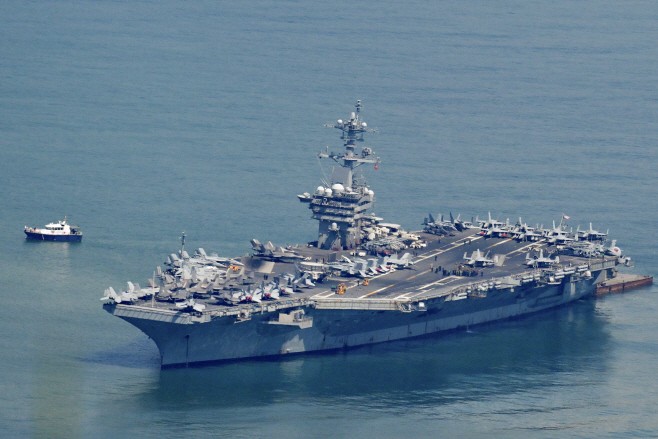 |
| The USS George Washington, a U.S. Navy nuclear-powered aircraft carrier, docks in Danang, central Vietnam on the 30th (local time). / AFP-Yonhap |
The USS George Washington (CVN-73), a U.S. Navy nuclear-powered aircraft carrier, docked in Danang, central Vietnam on the morning of the 30th. It is the fourth U.S. carrier visit since the normalization of U.S.-Vietnam diplomatic relations in 1995, coming at a time when the U.S. has concentrated its carrier strength in the Middle East amid its war with Iran.
According to the U.S. Navy and Vietnamese daily Tuoi Tre on the 30th (local time), the George Washington, flagship of Carrier Strike Group 5, arrived in Danang that day along with the cruiser Robert Smalls and destroyer Shoup, anchoring in waters near Tien Sa Port. A Nimitz-class carrier homeported in Yokosuka, Japan under the U.S. 7th Fleet, it carries a crew of about 6,000 including its air wing, and roughly 90 aircraft such as F-35Cs and F/A-18s. It is also the only aircraft carrier the U.S. Navy has forward-deployed overseas. The ships are scheduled to remain until the 3rd of next month.
This is the first time the George Washington has entered a Vietnamese port. The carrier hosted a Vietnamese delegation aboard in international waters in 2010, and held similar events off the Vietnamese coast in 2011 and 2012. This marks the fourth U.S. carrier port call in Vietnam, following the Carl Vinson in 2018, the Theodore Roosevelt in 2020, and the Ronald Reagan in 2023.
Carl Thayer, emeritus professor of politics at the University of New South Wales in Australia, said this port call is "a signal that U.S.-Vietnam engagement has not stopped despite the Iran war and the diversion of other U.S. military assets to the Middle East." He added that it also shows the two countries' defense cooperation has withstood "Trump's tariffs and other issues."
Defense exchanges between the two countries have picked up noticeably in recent months. Last month, acting U.S. Navy Secretary Hung Cao, who is Vietnamese-American, visited Vietnam and met with Communist Party General Secretary and State President To Lam, among others. On the 23rd, U.S. Secretary of State Marco Rubio and Vietnamese Foreign Minister Le Hoai Trung met on the sidelines of the ASEAN foreign ministers' meeting in the Philippines and agreed to maintain the pace of defense and security cooperation. The two countries upgraded their relationship to a Comprehensive Strategic Partnership — Vietnam's highest diplomatic tier — in September 2023.
Bui The Giang, a former Vietnamese ambassador to the United Nations, described the port call as a routine, low-key event reflecting the maturity of bilateral relations. "There is nothing at all sensitive about this visit from Vietnam's perspective," he said, calling it "simply a regular port call taking place in the context of an upgraded relationship." Indeed, the itinerary during the stay centers on exchange events such as ship tours, a U.S. Navy band performance, and a friendly volleyball match.
The George Washington entered the South China Sea via the Luzon Strait on the 22nd (local time) after two clashes between China and the Philippines in the sea this month. Thayer said he expects China to closely watch the port call but not publicly criticize Vietnam, limiting its response to routine military signaling such as shadowing the carrier strike group with ships and aircraft. He noted this contrasts with China's harsher criticism and pressure toward the Philippines, suggesting Beijing "has been treating Vietnam carefully because it does not want to push Vietnam into America's arms."
The foundation of Vietnam's defense policy is the so-called "Four Nos" principle laid out in its 2019 defense white paper: no military alliances; no siding with one country against another; no foreign military bases or use of Vietnamese territory to attack a third country; and no use or threat of force in international relations. While defense cooperation is expanding, Vietnam's military relationship with the U.S. remains far from alliance-level, and Vietnam has not purchased much U.S.-made weaponry. Giang cited the extremely high cost of American weapons, as well as compatibility issues with Vietnam's largely Soviet-era military equipment, as reasons.
Vietnam has hosted navies from other major powers around the same period. Just before the George Washington's arrival, Russian Pacific Fleet vessels, including the Kilo-class submarine Ufa, docked at Cam Ranh International Port from the 26th to the 29th and conducted submarine rescue drills with the Vietnamese navy. Earlier this month, Chinese People's Liberation Army Navy training ship Qi Jiguang and landing ship Kunlun Shan visited Ho Chi Minh City; in June, two Indian Navy ships called at Vietnamese ports; and in April, Japan Maritime Self-Defense Force destroyer Asahi entered Tien Sa Port in Danang.
Jeong Ri-na
Most Read
-
1
Celltrion’s Omlyclo gains ground in major European..

-
2
Trump demands rates fall below 1% as Fed hikes for..

-
3
Trump makes $1 trillion bet ahead of midterm elect..

-
4
Iran resumes ballistic missile production, assembl..

-
5
Samsung Electronics, Mistral AI to jointly develop..

-
6
Trump warns countries not helping U.S. must pay re..

-
7
Apple launches first foldable, 1 million won prici..

PEOPLE






HEADLINE NEWS
- Trump to roll out ‘unprecedented welcome’ for Xi with B-2 bombers, F-22 fighters
- S. Korea, U.S., and Japan form united front on Taiwan and economic coercion..
- Trump administration moves to impose sweeping sanctions on International Cr..
- Xi to make state visit to U.S. Sept. 23-25, dispelling rumors over his heal..

-
Address : In-Young Bldg., 34, Uisadang-daero 1-gil, Yeongdeungpo-gu, Seoul
Copyright by ASIATODAY CO., LTD. All rights resereved