



Meta launches open AI model "Muse Glimmer"
Aug 12, 2026, 10:23 am


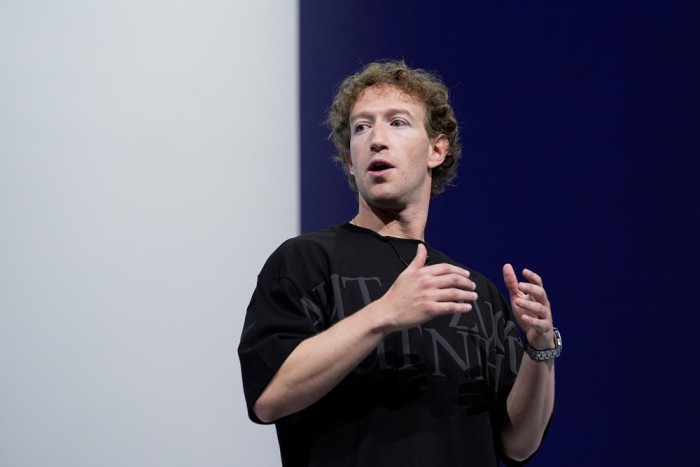 |
| Meta CEO Mark Zuckerberg speaks at the "Connect" developer conference in Menlo Park, California on September 25, 2024 (local time). / AP-Yonhap |
Meta unveiled a new open AI model for developers, "Muse Glimmer," on the 10th (local time), declaring its intent to expand the adoption of open-source AI. The company also plans to provide developers with access to "Muse Spark," a closed, paid AI model it launched last month.
According to the Washington Post, Meta CEO Mark Zuckerberg laid out a vision that day in an online essay titled "The Future Belongs to Everyone," describing a future in which every individual has their own all-knowing "AI agent."
He expressed hope that this AI would help improve every aspect of people's lives, and explained why he favors open-source AI technology that lets developers freely build on its core components.
Zuckerberg said Meta's goal is an era in which anyone can start a new business, receive PhD-level personal tutoring, and get personalized lifestyle advice.
He added that his 8-year-old daughter is already able to turn ideas into code and produce videos, and predicted that everyone will soon possess inventor-level capabilities.
Zuckerberg warned that concentrating control of advanced AI in the hands of a small number of companies, institutions, or governments could be dangerous, producing outcomes unfavorable to everyone else.
He stressed that the key is finding a balance in which advanced AI is broadly distributed, so it can empower billions of people equally.
Meta, which has long championed making AI models' source code available, has struggled to keep pace with the technical capabilities of closed-model rivals such as OpenAI, Anthropic, and Google.
In the essay, Zuckerberg wrote that most other labs are focused on developing AI for corporations, governments, or other institutions, so if those labs come to dominate, the balance of power will tilt toward institutions rather than individuals. He did not name specific companies, but the remark is widely seen as aimed at competitors.
He also said the U.S. and its allies need to accelerate energy production capacity and infrastructure buildout to stay ahead of competitors like China.
Zuckerberg called for authorities to reconsider their stance on "distillation" techniques within the AI industry — a method that trains a relatively lower-performing model using the outputs of another AI as training data.
The U.S. administration recently signaled it would crack down on Chinese AI companies using distillation techniques to extract technical features from leading American AI models.
Zuckerberg argued that while some want to frame distillation as harmful, he believes it's important to uphold the principle that anything can be learned through observation, adding that this is simply how the world works, and that if the U.S. restricts itself in this area, it won't be able to lead the world.
Kim Hyun-min
Most Read
-
1
Trump shares map on social media labeling Strait o..

-
2
Kia Sportage outperforms Mazda CX-5 in German auto..

-
3
Houthis launch successive attacks on Saudi airport..

-
4
U.S. deploys carrier, 10,000 more troops to Middle..

-
5
Trump rejects Iran's offer to open Strait of Hormu..

-
6
N. Korea conducts first swarm attack drill with dr..

-
7
U.S.-China summit falls short on substance as Trum..

PEOPLE






HEADLINE NEWS
- Seoul dismisses Ukraine's claim of 'S. Korean support for Russia' as "inaccurate and inappropriate"
- S. Korea, Japan race to develop nuclear-powered submarines
- Henri Kagan, Kenso Soai win Nobel Prize in Chemistry for uncovering how mol..
- Vance says Alaska LNG cooperation will move forward with Seoul's current or..

-
Address : In-Young Bldg., 34, Uisadang-daero 1-gil, Yeongdeungpo-gu, Seoul
Copyright by ASIATODAY CO., LTD. All rights resereved