



Katayama says, "No hesitation on further joint U.S.-Japan intervention"
Aug 04, 2026, 10:13 am


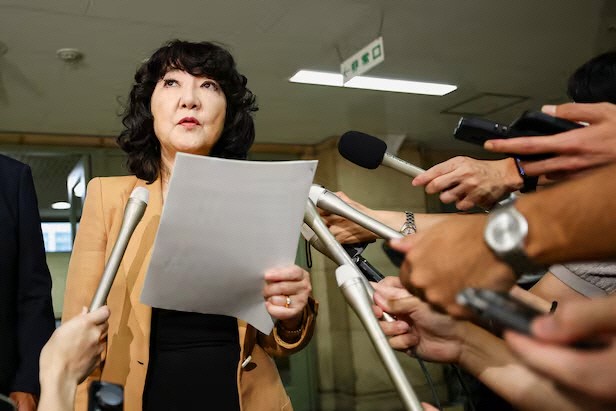 |
| Japanese Finance Minister Satsuki Katayama tells reporters at the Ministry of Finance on the morning of the 3rd, "Japan and the U.S. jointly intervened in the market to buy yen on the 31st of last month." / Reuters-Yonhap |
Japanese Finance Minister Satsuki Katayama said on the 3rd that if a sharp yen depreciation resumes, Japan could take additional joint currency intervention with the United States. She also raised, for the first time, the possibility of borrowing dollars from the U.S. Federal Reserve using Japan's holdings of U.S. Treasury bonds as collateral.
In a statement released that morning, Katayama officially confirmed that Japan had carried out joint intervention with the U.S. Treasury on the 31st of last month (U.S. Eastern Time), buying yen and selling dollars.
She said the move was based on the joint statement issued by the U.S. and Japanese finance ministers last September, explaining that it addressed recent excessive volatility and disorderly movements in the yen. She added that Japan is monitoring the situation while maintaining close communication with the U.S. Treasury, and stressed that Japan will not hesitate to conduct further joint intervention going forward.
Speaking to reporters at the Ministry of Finance after the statement, Katayama said Japanese and U.S. authorities will take resolute action against disorderly market moves and follow through on it. Atsushi Mimura, Japan's top currency policy official, called the joint intervention the completed form of what could be described as a U.S.-Japan currency alliance, saying Japan intends to continue sending a sustained warning to markets together with the U.S.
This marks the first joint U.S.-Japan intervention since 2011, when the yen spiked sharply after the Great East Japan Earthquake. At that time, Japan sold yen to curb its appreciation; this time, it bought yen to stem its depreciation. It is the first time in 28 years — since 1998, during the Asian financial crisis — that the U.S. has joined Japan in buying yen. For the U.S. to directly participate in defending Japan's currency outside a financial crisis or major disaster is highly unusual.
The Japanese government and the Bank of Japan carried out yen-buying, dollar-selling intervention for two consecutive days starting on the 30th of last month. U.S. monetary authorities conducted a "rate check" with financial institutions on the 30th, asking about current exchange rates, before actually joining the intervention on the 31st. Katayama also said Japan plans to make use of the Fed's Foreign and International Monetary Authorities (FIMA) repo facility to secure the capacity for longer-term intervention.
Known as the "FIMA repo," this facility allows foreign central banks or monetary authorities to borrow dollars for a set period by pledging U.S. Treasury bonds held at the Fed as collateral. This would let Japan secure the dollars needed for yen-buying intervention without having to sell its U.S. Treasury holdings on the open market.
If Japan were to sell a large volume of U.S. Treasuries, it could push down Treasury prices and push up yields. Japan's government has judged that using the FIMA repo facility would let it continue defending the yen without shocking U.S. financial markets.
The statement is seen as going beyond simply confirming last month's joint intervention — it appears intended to warn markets that the U.S. and Japan have already prepared further intervention and funding methods in advance. With the Korean won also weakening alongside the yen, attention is turning to how this standing U.S.-Japan currency coordination framework could affect how South Korean and U.S. financial authorities respond in the foreign exchange market going forward.
Choi Young-jae
Most Read
-
1
Celltrion’s Omlyclo gains ground in major European..

-
2
Trump demands rates fall below 1% as Fed hikes for..

-
3
Trump makes $1 trillion bet ahead of midterm elect..

-
4
Iran resumes ballistic missile production, assembl..

-
5
Samsung Electronics, Mistral AI to jointly develop..

-
6
Trump warns countries not helping U.S. must pay re..

-
7
Apple launches first foldable, 1 million won prici..

PEOPLE






HEADLINE NEWS
- Trump to roll out ‘unprecedented welcome’ for Xi with B-2 bombers, F-22 fighters
- S. Korea, U.S., and Japan form united front on Taiwan and economic coercion..
- Trump administration moves to impose sweeping sanctions on International Cr..
- Xi to make state visit to U.S. Sept. 23-25, dispelling rumors over his heal..

-
Address : In-Young Bldg., 34, Uisadang-daero 1-gil, Yeongdeungpo-gu, Seoul
Copyright by ASIATODAY CO., LTD. All rights resereved