



Trump to roll out ‘unprecedented welcome’ for Xi with B-2 bombers, F-22 fighters
Sep 22, 2026, 10:19 am


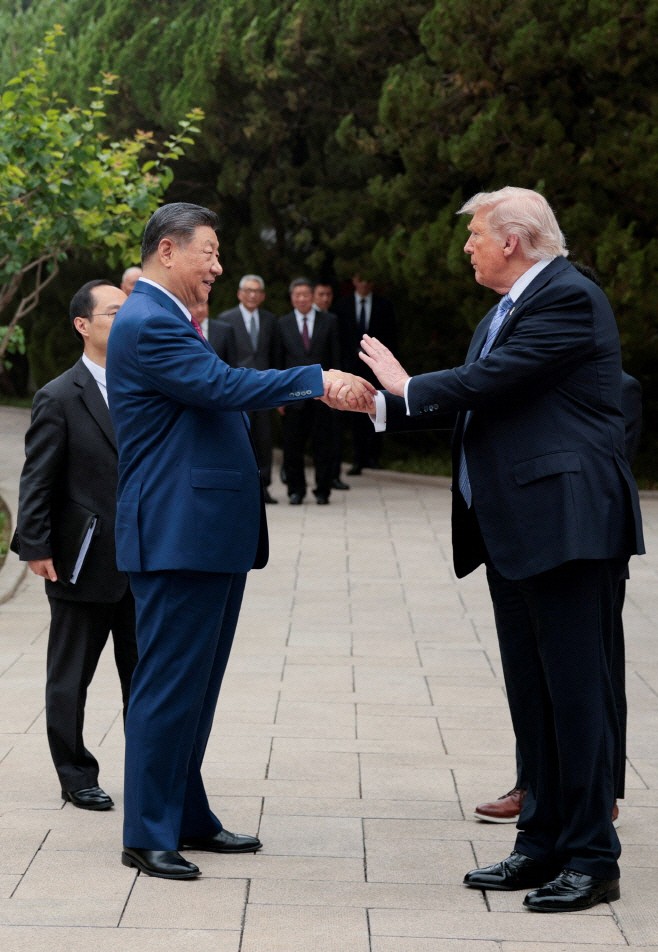 |
| U.S. President Donald Trump, right, shakes hands with Chinese President Xi Jinping as he departs after visiting the Zhongnanhai garden in Beijing on May 15. / Reuters-Yonhap |
Chinese President Xi Jinping will pay a state visit to the U.S. from the 23rd to the 25th (local time) at the invitation of U.S. President Donald Trump, the Chinese Foreign Ministry announced on the 21st.
President Trump will personally greet President Xi at Joint Base Andrews in Maryland on the 23rd and host a state arrival ceremony and summit at the White House on the 24th, where the two leaders will discuss extending the trade truce expiring on November 10, rare earths, artificial intelligence (AI), and issues surrounding Taiwan and Iran.
This visit marks a reciprocal exchange between the leaders just four months after President Trump visited Beijing in May. Chinese Foreign Ministry spokesperson Guo Jiakun called the reciprocal visits by both leaders within six months a "historic milestone," stating that both sides will expand dialogue and cooperation while managing differences.
Trump to personally greet Xi at Joint Base Andrews, flyover by one B-2 and four F-22s
On the 23rd, President Trump will personally receive President Xi and first lady Peng Liyuan at Joint Base Andrews near Washington, D.C. It is rare for a U.S. president to welcome a foreign head of state directly at the airfield. A state arrival ceremony featuring 479 service members representing all branches of the U.S. military will follow at the White House on the 24th. After an inspection of honor guards and military bands from the Army and Marine Corps, a B-2 Spirit strategic bomber and four F-22 Raptor fighters will conduct a celebratory flyover. The White House noted that this marks the first visit to the White House by President Xi and his wife in roughly a decade.
Following the arrival ceremony, the summit and programs for the presidential couples will proceed. First lady Melania Trump and Madam Peng will visit the Smithsonian's National Museum of Asian Art, and a state dinner will be held in the East Room of the White House that evening. Guests expected to attend include Amazon founder Jeff Bezos, Alphabet CEO Sundar Pichai, OpenAI CEO Sam Altman, Apple CEO Tim Cook, Tesla CEO Elon Musk, Nvidia CEO Jensen Huang, and Dell Technologies CEO Michael Dell, Reuters reported. On the 25th, the presidential couples will hold tea time in the Red Room of the White House before visiting the National Archives to view historical records on U.S.-China relations.
President Xi is also likely to be accompanied by business leaders. Executives from companies including BYD, Contemporary Amperex Technology (CATL), Xiaomi, Gotion High-tech, and Bank of China were considered candidates for the business delegation, though the final roster has not been finalized, Reuters reported on the 18th. They are expected to attend the White House state dinner, even as some of these firms face U.S. sanctions or regulatory measures.
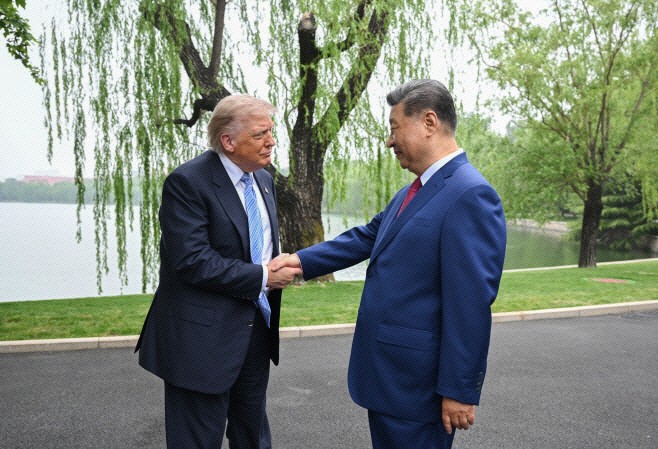 |
| Chinese President Xi Jinping, left, greets U.S. President Donald Trump at Zhongnanhai in Beijing, the capital of China, on the 15th. / Xinhua, Yonhap |
U.S. and China discuss extending Nov. 10 trade truce as China's rare earth dominance limits U.S. hardline pressure
Behind the glamorous protocol, the biggest economic issue of the summit is whether to extend the U.S.-China trade truce agreed upon at the Busan summit on October 30 last year. U.S. Treasury Secretary Scott Bessent and Chinese Vice Premier He Lifeng discussed this in New York on the 20th, but they did not disclose whether they agreed on an extension. Reuters reported that the White House is also lowering expectations for a major agreement at the summit, and the core lies in whether the two leaders will extend the truce ending on November 10.
The negotiation environment has changed from last year. China's global trade surplus is expected to exceed 1 trillion dollars (1,375.2 trillion won) for the second consecutive year. Out of about 6,500 items China exports to the U.S. this year, exports have increased from 2025 in more than half of them. Economists have begun calling China's export expansion 'China Shock 2.0,' Reuters reported.
Rare earths, in particular, are China's core leverage. According to consulting firm AlixPartners, China controls up to 70% of global rare earth mining, 85% of refining capacity, and about 90% of rare earth metal alloy and magnet production. Reuters analyzed that China's control over rare earths is constraining the Trump administration's threats of high tariffs and technology export bans, shifting the U.S. stance toward China ahead of this summit to be less aggressive than before.
Along with the trade truce, expanding investment between the two countries is also on the agenda. According to U.S. internet media outlet Axios, the two leaders established the U.S.-China Board of Investment in May to handle investment issues. However, the U.S. auto industry is protesting the possibility of Chinese automakers producing and investing in the U.S., and a White House official also stated that existing national security restrictions on Chinese investments will be maintained.
Officials from both countries are also detailing a separate framework for trade consultations. According to the AP, Secretary Bessent and Jamieson Greer, the U.S. Trade Representative (USTR), agreed during their meeting with Vice Premier He to actually launch the trade committee discussed by the two leaders last May. Representative Greer stated that non-sensitive items subject to tariff reductions could include consumer goods, agricultural products, energy products, and medical devices.
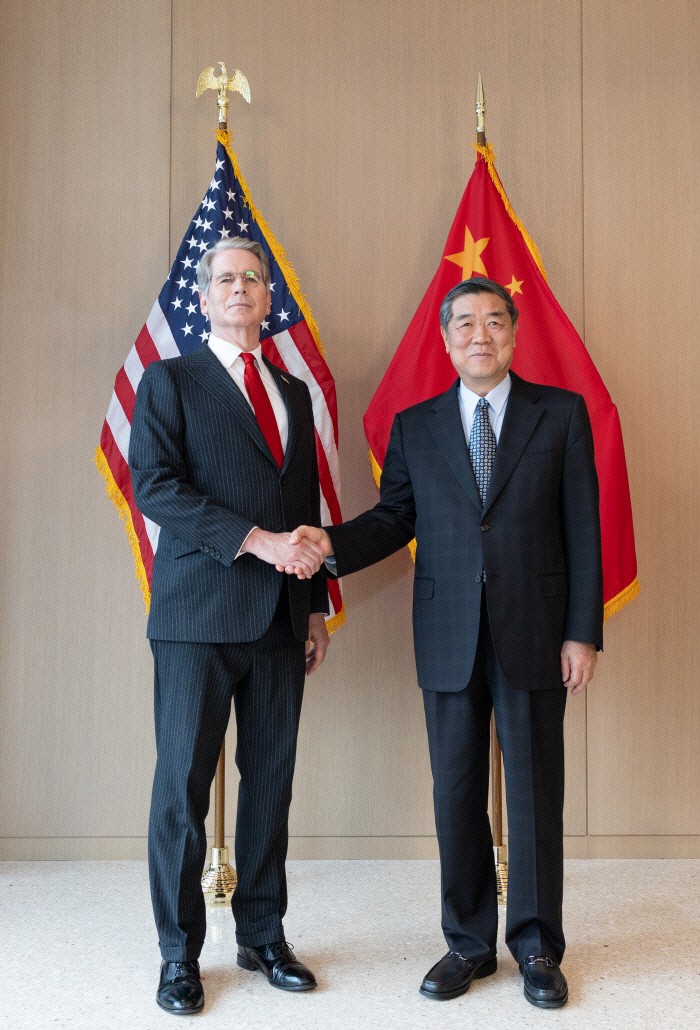 |
| Chinese Vice Premier He Lifeng, right, who is a member of the Political Bureau of the Communist Party of China Central Committee, shakes hands with U.S. Treasury Secretary Scott Bessent ahead of U.S.-China economic and trade talks in New York on the 20th local time. Delegations from the two countries began discussions on economic and trade issues that morning. / Xinhua, Yonhap |
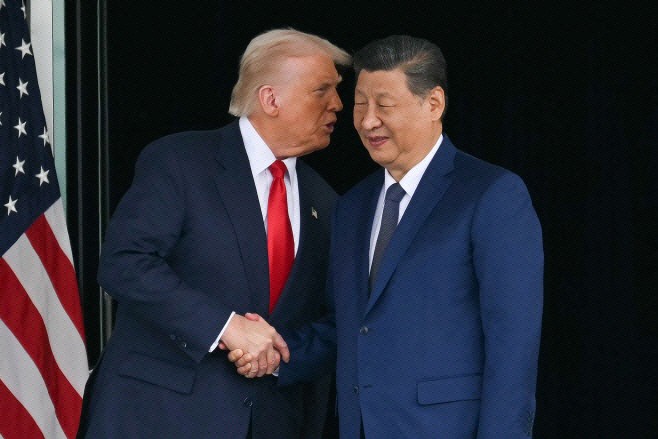 |
| U.S. President Donald Trump, left, and Chinese President Xi Jinping converse as they leave the venue after concluding their summit at Gimhae International Airport on October 30, 2025. / AFP, Yonhap |
Trump views 14 billion dollar Taiwan arms package as negotiating chip, Iran sanctions also a factor
As trade and technology negotiations proceed, the Taiwan issue remains the most sensitive security concern. President Trump stated that during their Beijing meeting in May, President Xi repeatedly asked about U.S. arms sales to Taiwan and Washington's commitment to defending Taiwan. President Trump described the 14 billion dollar (19.2528 trillion won) arms package for Taiwan as a "negotiating chip" with China. Following this, some officials in Taiwan and Japan are concerned that President Trump might link the Taiwan issue to economic concessions, such as purchases of Boeing aircraft and agricultural goods or cracking down on fentanyl precursors, Reuters reported.
On the Iran issue, China's posture appears mixed. Secretary Bessent stated that Chinese financial authorities are actively engaging on the enforcement of U.S. sanctions against Iran. He noted that he has been having constructive discussions with figures including Pan Gongsheng, governor of the People's Bank of China.
Secretary Bessent warned that starting on the 23rd, companies providing fuel, landing services, or ticket sales to Iranian airlines could be cut off from the dollar payment system. He noted that this would effectively halt international operations by Iranian carriers.
However, it is difficult to view China as fully cooperating with U.S. pressure on Iran. Reuters reported that Iran has procured billions of dollars worth of Chinese goods through sanctions evasion networks, and President Xi has shown no clear willingness to pressure Iran to end the war.
The Chinese Foreign Ministry maintains that it is unaware of such sanctions evasion networks. Axios also reported that while the U.S. has sanctioned Chinese firms and small refiners, it has so far refrained from taking the most aggressive measures against major Chinese banks.
Reuters cited experts noting that both leaders share an interest in stabilizing bilateral relations to focus on their respective, more pressing domestic and global issues.
Accordingly, rather than a comprehensive deal, the key focal points for the talks on the 24th are expected to be whether the two sides extend the trade truce, secure stability in rare earth supplies, and establish an AI crisis management framework.
Ha Man-ju
Most Read
-
1
Celltrion’s Omlyclo gains ground in major European..

-
2
Trump demands rates fall below 1% as Fed hikes for..

-
3
Trump makes $1 trillion bet ahead of midterm elect..

-
4
Iran resumes ballistic missile production, assembl..

-
5
Samsung Electronics, Mistral AI to jointly develop..

-
6
Trump warns countries not helping U.S. must pay re..

-
7
Apple launches first foldable, 1 million won prici..

PEOPLE






HEADLINE NEWS
- Trump to roll out ‘unprecedented welcome’ for Xi with B-2 bombers, F-22 fighters
- S. Korea, U.S., and Japan form united front on Taiwan and economic coercion..
- Trump administration moves to impose sweeping sanctions on International Cr..
- Xi to make state visit to U.S. Sept. 23-25, dispelling rumors over his heal..

-
Address : In-Young Bldg., 34, Uisadang-daero 1-gil, Yeongdeungpo-gu, Seoul
Copyright by ASIATODAY CO., LTD. All rights resereved