



S. Korea, U.S., and Japan form united front on Taiwan and economic coercion ahead of U.S.-China summit
Sep 22, 2026, 10:26 am


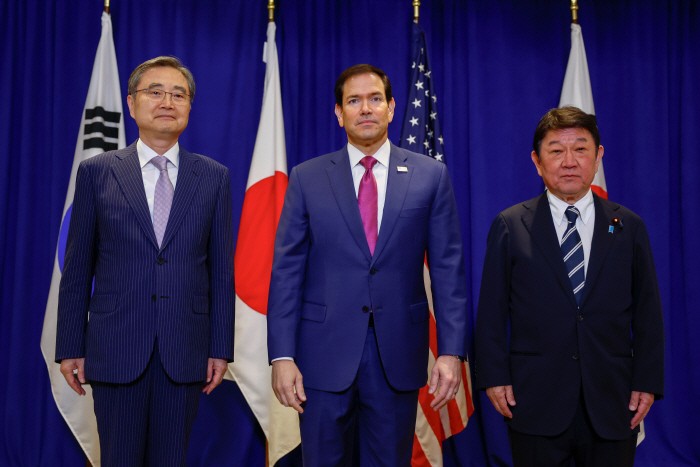 |
| South Korean Foreign Minister Cho Hyun, left, U.S. Secretary of State Marco Rubio, and Japanese Foreign Minister Toshimitsu Motegi pose for a commemorative photo ahead of a trilateral foreign ministers' meeting in New York on the 21st local time, as the high-level week of the 81st United Nations General Assembly gets underway. / AP, Yonhap |
The foreign ministers of South Korea, the U.S., and Japan met in New York on the 21st (local time) and reaffirmed the principle of the complete denuclearization of North Korea while urging Pyongyang to return to dialogue. The three countries also agreed to expand cooperation to maintaining peace and stability across the Taiwan Strait, responding to economic coercion, and ensuring supply chain and energy security.
Foreign ministers of South Korea, U.S., and Japan reaffirm North Korea denuclearization, pursue dialogue and sanctions monitoring in tandem
South Korean Foreign Minister Cho Hyun, U.S. Secretary of State Marco Rubio, and Japanese Foreign Minister Toshimitsu Motegi met on the sidelines of the high-level week of the 81st United Nations General Assembly. The three nations reaffirmed the complete denuclearization of North Korea in accordance with UN Security Council resolutions, as well as the ban on revenue generation that supports its nuclear and ballistic missile programs. Noting that "the path to dialogue remains open," they urged North Korea to return to negotiations and committed to continuing efforts for peace and stability on the Korean Peninsula.
Monitoring the implementation of sanctions against North Korea was presented alongside the emphasis on dialogue. The three nations welcomed the monitoring activities of the Multilateral Sanctions Monitoring Team (MSMT) concerning violations and evasions of UN Security Council resolutions by North Korea. They also welcomed progress made in advisories regarding North Korean information technology (IT) workers and countermeasures against cyber threats. In addition, the ministers reaffirmed their commitment to the immediate resolution of issues concerning abductees, detainees, unrepatriated prisoners of war, and separated families.
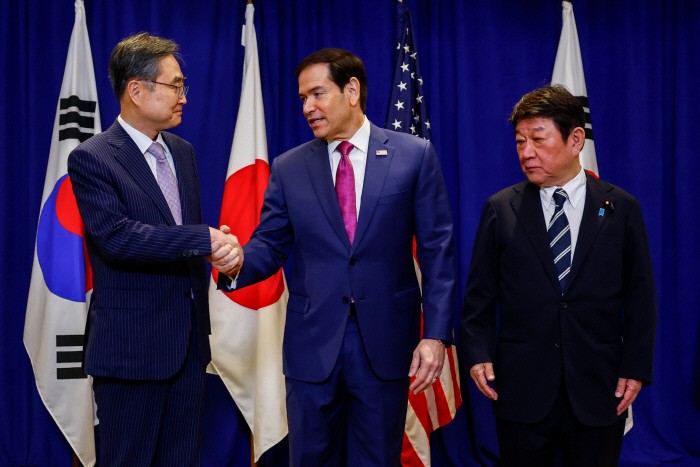 |
| South Korean Foreign Minister Cho Hyun, left, and U.S. Secretary of State Marco Rubio, center, shake hands ahead of a trilateral foreign ministers' meeting in New York on the 21st local time, as the high-level week of the 81st United Nations General Assembly gets underway. At right is Japanese Foreign Minister Toshimitsu Motegi. / AP, Yonhap |
Three countries to jointly counter economic coercion and export restrictions, expand SMR and semiconductor cooperation
Discussions continued into economic security. The three nations voiced opposition to economic coercion and non-market policies and practices that generate harmful overcapacity and market distortions. They also agreed to jointly respond to arbitrary export restrictions that disrupt supply chains, while strengthening the trilateral supply chain early warning system. In addition, they welcomed the launch of a new trilateral economic security consultative body.
In the energy sector, the three countries agreed to enhance regional supply resilience by expanding strategic petroleum reserves and bolstering cooperation between producing and consuming countries. To follow through on the memorandum of cooperation (MOC) signed on July 7, they decided to accelerate the deployment of small modular reactors (SMRs) in third countries. They also committed to jointly fostering and protecting artificial intelligence (AI), quantum technology, digital infrastructure, and biotechnology, while welcoming the expansion of cooperation in the semiconductor sector. Furthermore, they expressed interest in broadening collaboration among their respective national laboratories.
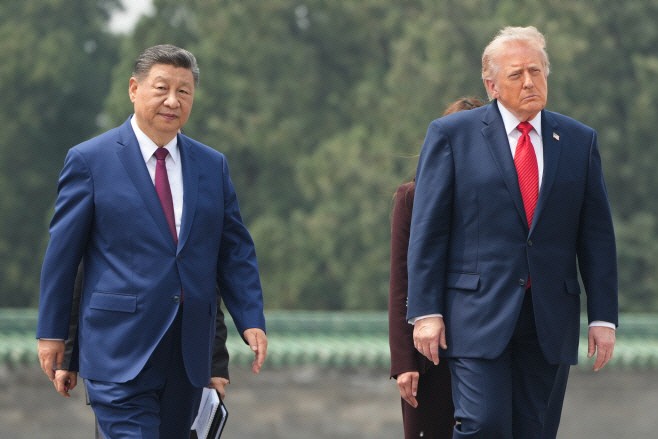 |
| U.S. President Donald Trump, left, and Chinese President Xi Jinping walk toward the Temple of Heaven after concluding an expanded bilateral summit at the Great Hall of the People in Beijing, China, on May 14. / AP, Yonhap |
U.S. reaffirms extended deterrence including nuclear capabilities, opposes changing status quo in Taiwan Strait
In the security realm, U.S. defense commitments were explicitly laid out. The U.S. reaffirmed its ironclad defense commitments to South Korea and Japan, backed by "overwhelming military capabilities, including nuclear capabilities." It also reiterated its extended deterrence commitments to both Seoul and Tokyo.
The three countries went on to emphasize the importance of maintaining peace and stability across the Taiwan Strait. They urged the peaceful resolution of cross-strait issues and opposed any unilateral attempts to alter the status quo. They also expressed support for Taiwan's meaningful participation in appropriate international organizations. Regarding maritime order, the three nations underscored the importance of freedom of navigation and overflight and unimpeded lawful commerce in the Indo-Pacific and across the globe in accordance with international law.
Furthermore, they reiterated their support for freedom of navigation and overflight and unimpeded lawful commerce in the Indo-Pacific and worldwide pursuant to international law.
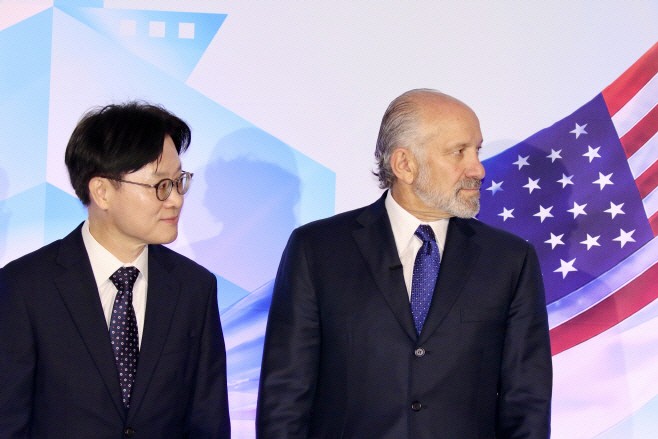 |
| South Korean Minister of Trade, Industry and Energy Kim Jung-kwan, left, and U.S. Secretary of Commerce Howard Lutnick look in the same direction on stage during the opening ceremony of the Korea-U.S. Shipbuilding and Offshore Plant Cooperation Center (KUSPC) at the Mayflower Hotel in Washington, D.C., on July 23 local time. / Washington Correspondent Ha Man-ju |
Reuters reports U.S. allies worry Trump may concede to China, South Korea's $350 billion U.S. investment also a factor
Foreign media drew connections between the meeting and the upcoming summit between U.S. President Donald Trump and Chinese President Xi Jinping, scheduled for the 24th at the White House in Washington, D.C.
According to Reuters, experts analyzed that U.S. allies are concerned President Trump might make concessions to China on Taiwan or trade issues to secure economic achievements. Reuters reported that experts expect allies to closely monitor how any trade agreement resulting from the U.S.-China summit could affect their competitiveness against China.
Reuters noted that Japanese Prime Minister Sanae Takaichi and South Korean President Lee Jae-myung are hoping to meet with President Trump on the sidelines of the UN General Assembly. Prime Minister Takaichi previously drew backlash from China last year by mentioning the possibility of Japanese involvement in a contingency involving Taiwan.
South Korea's investment negotiations with the U.S. are also intertwined. Seoul and Washington have been negotiating the specific terms of a $350 billion (approximately 481.32 trillion won) U.S. investment package included in last year's bilateral trade agreement. Reuters reported that Representative Kim Sung-won of the People Power Party pointed out that South Korea could shoulder excessive financial risks in energy project negotiations, stressing the need for formal parliamentary approval rather than a routine government report.
Reuters reported that the projects under discussion between the two countries include a gas power plant in Texas and the construction of up to eight nuclear reactors. However, South Korea's Ministry of Trade, Industry and Energy stated that the specific details have not yet been finalized.
Ha Man-ju
Most Read
-
1
Celltrion’s Omlyclo gains ground in major European..

-
2
Trump demands rates fall below 1% as Fed hikes for..

-
3
Trump makes $1 trillion bet ahead of midterm elect..

-
4
Iran resumes ballistic missile production, assembl..

-
5
Samsung Electronics, Mistral AI to jointly develop..

-
6
Trump warns countries not helping U.S. must pay re..

-
7
Apple launches first foldable, 1 million won prici..

PEOPLE





HEADLINE NEWS
- Trump to roll out ‘unprecedented welcome’ for Xi with B-2 bombers, F-22 fighters
- S. Korea, U.S., and Japan form united front on Taiwan and economic coercion..
- Trump administration moves to impose sweeping sanctions on International Cr..
- Xi to make state visit to U.S. Sept. 23-25, dispelling rumors over his heal..

-
Address : In-Young Bldg., 34, Uisadang-daero 1-gil, Yeongdeungpo-gu, Seoul
Copyright by ASIATODAY CO., LTD. All rights resereved