



Trump imposes new Iran blockade and 20% Hormuz toll
Jul 14, 2026, 09:03 am


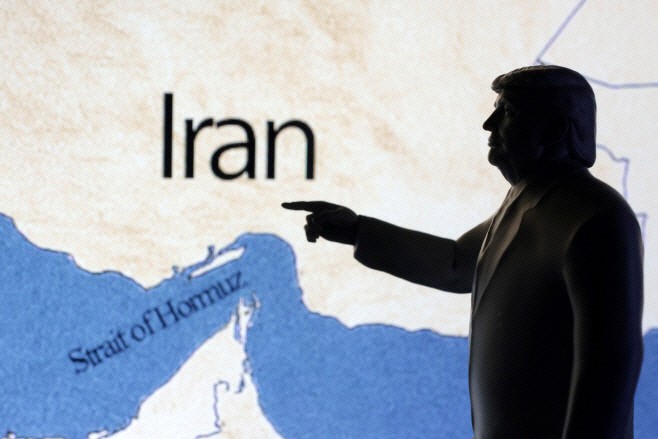 |
| A 3D-printed miniature of U.S. President Donald Trump stands in front of a map detailing the Strait of Hormuz and Iran, as captured on June 22 (local time). / Photo courtesy of Reuters via Yonhap News Agency |
U.S. President Donald Trump announced on July 13 (local time) that the United States will reinstate a naval blockade on Iranian ports and coastal waters, while levying a 20% "security fee" on cargo transiting the Strait of Hormuz.
Following the announcement, the U.S. Central Command (CENTCOM) declared that the blockade would take effect at 4:00 PM on July 14 (5:00 AM on July 15, Korean time), as U.S. forces launched a third consecutive day of airstrikes against Iranian targets.
Trump demands 20% toll on Hormuz transit, blockades ships to and from Iran
"The Strait of Hormuz is open, with or without Iran," Trump stated on his social media platform, Truth Social, as he announced the resumption of the maritime blockade against Iran.
Labeling the United States "THE GUARDIAN OF THE HORMUZ STRAIT," Trump declared that Washington would demand 20% of the value of shipped cargo as a security guarantee fee. However, he did not provide specific operational plans, such as the exact valuation criteria or collection procedures.
The U.S. Navy-led Joint Maritime Information Center (JMIC) issued a warning stating that vessels entering or leaving all Iranian ports, oil terminals, and coastal zones will be intercepted regardless of their registry. The agency added that non-compliant vessels could face seizure or the use of military force. Neutral vessels navigating the strait to or from non-Iranian destinations will still be permitted transit.
"We are going to hit Iran very hard tonight, and we are going to hit them hard tomorrow. There is nothing they can do," Trump said later in a radio interview.
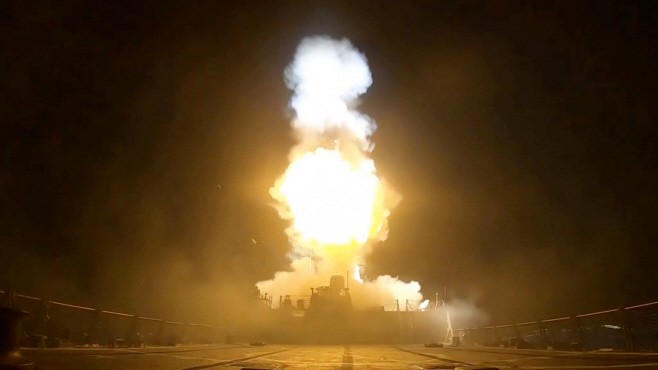 |
| A screen capture from a video released by the U.S. Central Command (CENTCOM) shows a projectile being launched toward Iran on July 11 (local time). / Photo courtesy of U.S. Central Command via Reuters/Yonhap News Agency |
US Central Command deploys three unmanned surface vessels for the first time, striking maintenance facilities at an Iranian naval base
U.S. Central Command (CENTCOM) announced via X (formerly Twitter) that it deployed three "Corsair" unmanned surface vessels (USVs) yesterday to strike submarine and vessel maintenance facilities at Iran’s Bandar Abbas naval base. This marks the first time the U.S. military has deployed maritime drones in combat operations.
The Corsair, manufactured by U.S. defense company Saronic, is an unmanned surface vessel measuring 24 feet (7.3 meters) in length, with a top speed of 35 knots, a range of over 1,150 miles (1,851 kilometers), and a payload capacity of 1,000 pounds (454 kilograms). Each unit is priced under 1 million dollars (approximately 1.4996 billion Korean won), the Wall Street Journal (WSJ) reported.
The Corsair had previously been deployed in a search and rescue operation to recover two U.S. Army Apache helicopter crew members who went down in the Gulf of Oman last month. CENTCOM evaluated that this latest strike successfully degraded Iran's capabilities to attack commercial vessels.
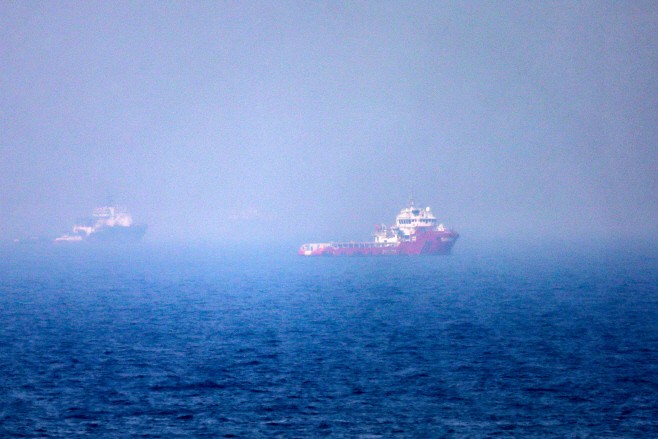 |
| Vessels navigate near the Strait of Hormuz off Khor Fakkan on the eastern coast of the United Arab Emirates (UAE) on July 13 (local time). / Photo courtesy of AFP via Yonhap News Agency |
Iran declares it will not relinquish control of the strait; Brent crude surges 9.6%; Trump schedules national address for July 16
A spokesperson for the IRGC's Imam Khomeini Central Command stated that Iran will resolutely refuse to permit any U.S. intervention in the management of the Strait of Hormuz.
"Iran has been the guardian of the strait and will remain its guardian forever," Iranian Foreign Minister Abbas Araghchi countered on X. "A 20% toll is naturally extortionate. We will ensure fairness."
Following the reinstatement of the Hormuz blockade, Brent crude oil prices skyrocketed by 9.6% from the previous trading session to settle at 83.30 dollars per barrel (approximately 124,917 Korean won). Concurrently, U.S. West Texas Intermediate (WTI) crude jumped 9.4% to close at 78.14 dollars per barrel (around 117,179 Korean won).
On the New York Stock Exchange, major indexes closed lower amidst the escalating tensions. The Dow Jones Industrial Average dropped 138.37 points (-0.26%) to finish at 52,498.64. The S&P 500 Index slid 60.05 points (-0.79%) to close at 7,515.34, while the tech-heavy Nasdaq Composite Index shed 408.43 points (-1.55%) to end the session at 25,873.18.
The lifting of the naval blockade—which had served as a cornerstone of last month's cessation of hostilities memorandum of understanding (MOU)—has now been rescinded, effectively nullifying the core terms of the peace agreement. President Trump has announced that he will deliver a live national address on July 16 at 9:00 PM (10:00 AM on July 17, Korean time).
U.S. media outlets, including the New York Times (NYT) and the Wall Street Journal (WSJ), pointed out that Trump's demand for a 20% fee directly contradicts the established stance of his own administration. On June 23, Secretary of State Marco Rubio stated during a visit to Abu Dhabi that international law strictly prohibits any nation from levying tolls or fees within international waterways.
Vice President J.D. Vance also publicly affirmed last month that international shipping lanes must remain free of tolls. Furthermore, a spokesperson for the United Nations International Maritime Organization (IMO) expressed firm opposition to the imposition of transit fees on straits utilized for international navigation.
"President Trump is attempting to counter Iran's provocations at their own game, at least rhetorically," noted Holly Dagres, a senior fellow at the Washington Institute for Near East Policy, in an interview reported by Bloomberg. She cautioned, however, that Iran is highly unlikely to relinquish its grip on the vital shipping lane without resistance.
Ha Man-joo
Most Read
-
1
Celltrion’s Omlyclo gains ground in major European..

-
2
Trump demands rates fall below 1% as Fed hikes for..

-
3
Trump makes $1 trillion bet ahead of midterm elect..

-
4
Iran resumes ballistic missile production, assembl..

-
5
Samsung Electronics, Mistral AI to jointly develop..

-
6
Trump warns countries not helping U.S. must pay re..

-
7
Apple launches first foldable, 1 million won prici..

PEOPLE






HEADLINE NEWS
- Trump to roll out ‘unprecedented welcome’ for Xi with B-2 bombers, F-22 fighters
- S. Korea, U.S., and Japan form united front on Taiwan and economic coercion..
- Trump administration moves to impose sweeping sanctions on International Cr..
- Xi to make state visit to U.S. Sept. 23-25, dispelling rumors over his heal..

-
Address : In-Young Bldg., 34, Uisadang-daero 1-gil, Yeongdeungpo-gu, Seoul
Copyright by ASIATODAY CO., LTD. All rights resereved