



[Exclusive] Justice Minister says ISDS must respect gov't regulatory rights in Coupang case
Jun 02, 2026, 09:41 am


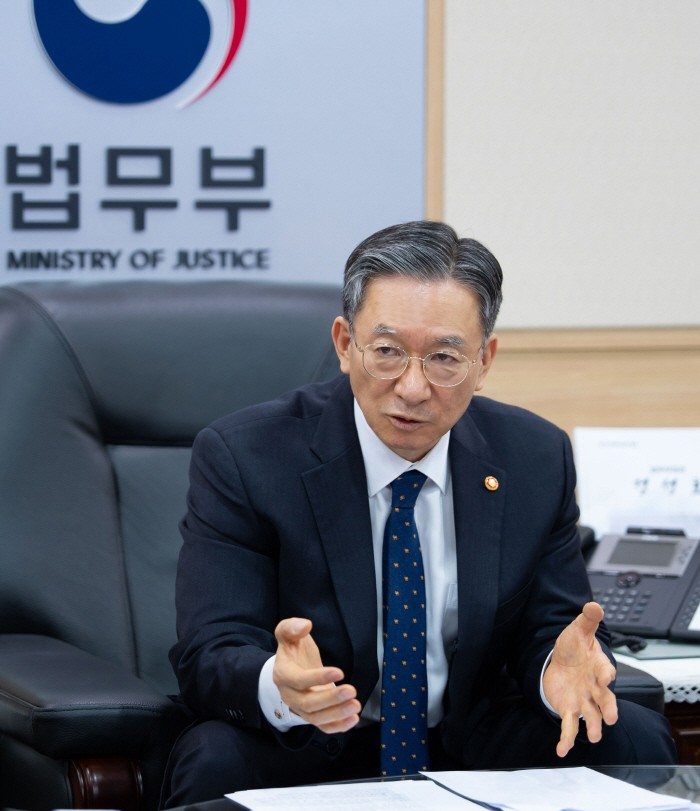 |
| Justice Minister Jung Sung-ho. / Photo via Ministry of Justice |
"The core of this incident lies in Coupang’s poor management and irresponsible attitude, which exposed the personal information of 33.7 million citizens."
On January 23 of this year, Justice Minister Jung Sung-ho strongly criticized Coupang’s response regarding the 'Coupang personal information leak incident' via social media (SNS). Minister Jung censured American investment firms holding stakes in Coupang for submitting a notice of intent for Investor-State Dispute Settlement (ISDS) arbitration against the South Korean government, stating, "They submitted a notice of intent for ISDS arbitration packed with groundless claims and requested the intervention of the U.S. government."
Now, approximately four months later, the Ministry of Justice (MOJ) is preparing for the ISDS arbitration battle by establishing a response framework alongside relevant government ministries and government-retained law firms. In tandem, Minister Jung is reviewing a punitive damages system as well as a class action litigation act. Asia Today sat down for an interview to hear about the response to the Coupang ISDS case and the MOJ’s vision for promoting bills related to public livelihood and safety. The MOJ stated that it is pursuing an independent confiscation system, refining the system for reverting pro-Japanese property to the state, and revising the Civil Act.
Q. The Coupang personal information leak incident has escalated to American investment firms submitting notices of intent for ISDS arbitration and U.S. political circles raising the issue. How do you view the current situation?
- The government is closely reviewing the claims of the claimants, who are American investment firms, including their notices of intent for ISDS arbitration. Fundamentally, our position is that 'the government's legitimate and lawful exercise of regulatory authority must be respected.' Under the framework of the 'International Investment Dispute Response Task Force' led by the MOJ, the government is responding to ISDS cases systematically and professionally by collaborating with relevant ministries and government-retained law firms.
In particular, as ISDS cases directly tied to national interests like this one grow in scale and complexity, the MOJ is working to establish a more systematic, sustainable, and stable ISDS response framework. The 'Bill on the Prevention of and Response to International Investment Disputes' recently proposed by Representative Park Geun-taek of the Democratic Party of Korea elevates the existing prevention and response framework under presidential directives to a statutory level. If passed, it is expected to strengthen the government's capabilities to prevent and respond to increasingly sophisticated ISDS cases.
Q. The need to enact a Class Action Litigation Act is being highlighted once again following a series of recent personal information leak incidents. Amid varying opinions, particularly regarding retroactive application, how do you believe the balance between victim relief and legal stability should be designed?
- Under current law, victims of small-claim, multi-party damages have no choice but to file lawsuits individually, which poses limits on compensating all victims. Therefore, I agree with the opinion that institutional improvements are necessary to ensure proper relief for victims.
Meanwhile, I am well aware that the business community has expressed concerns that allowing class actions for past incidents could impose a significant burden. To faithfully protect the rights of victims, the MOJ proposed a revision to the National Assembly that allows class actions for past incidents but limits the scope of past incidents subject to the Class Action Litigation Act to 'cases where three years have not passed since the date the damage occurred,' considering the stability of the legal order. Moving forward, we will actively support relevant discussions in the National Assembly to harmonize substantive damage recovery with the stability of the legal order.
Q. While the retroactive legislation of the Class Action Litigation Act is meaningful from the perspective of victim relief, some argue it could undermine corporate value by raising legal risks and uncertainties for companies. What is your position on opinions that this could threaten the principles of legal stability and protection of trust?
- The Class Action Litigation Act does not create new substantive rights; rather, it is a law that regulates procedures to efficiently realize the already existing rights of victims. Matters for which the statute of limitations has already expired do not newly become targets for rights relief even if the Class Action Litigation Act is introduced.
Furthermore, it is difficult to view the public interest sought through the Class Action Litigation Act—namely, the realization of victims' right to trial—as smaller than the procedural trust of corporations. If the introduction of the class action system drives companies to deter unlawful acts and preemptively block major risks, I believe it can contribute to enhancing corporate value.
Q. Some opine that the punitive damages system must be expanded and improved for the class action system to operate effectively. What is the MOJ's position on this?
- I agree with the opinion that some improvements are needed for the punitive damages system, given that it is scattered across various individual laws, leading to discrepancies in application requirements and limits depending on the law, and that individual laws are often revised only after an incident occurs. To deter illegal acts and strengthen victim protection, we will gather opinions from various sectors, including the business community and academia, to identify problems in the current punitive damages system and review potential improvements.
Q. Discussions are underway regarding the introduction of an independent confiscation system to reinforce the forfeiture of criminal proceeds from criminal organizations, including the recovery of slush funds from former Presidents Chun Doo-hwan and Roh Tae-woo. However, there are concerns that confiscating or collecting assets without a finalized guilty verdict from a court may violate the constitutional principle of presumption of innocence or the principle of protecting property rights. What is your view on this?
- An independent confiscation system is a mechanism designed to thoroughly recover criminal proceeds, strip criminals of the profits gained from crime, and fundamentally cut off the economic incentives for committing crimes, and it is implemented by several countries. The independent confiscation system bills currently discussed in the National Assembly require a prosecutor to request independent confiscation, after which the court reviews and decides whether to grant it, while also providing an appeals process against the court's decision. Therefore, it is difficult to see it as contradicting the constitutional principle of presumption of innocence or the principle of protecting property rights.
Q. The draft Special Act on the Reversion of Pro-Japanese Property to the State passed the National Assembly with bipartisan consensus. As the bill awaits promulgation, how would you evaluate it?
- I understand that the law was able to pass with bipartisan consensus because everyone agreed with its intent, as the law on the reversion of pro-Japanese property is an expression of national resolve to completely finish liquidating pro-Japanese remnants in accordance with the spirit of the March 1st Movement enshrined in our Constitution.
In addition to re-establishing the committee, this draft bill supplements the recovery system by clarifying the grounds for reclaiming the proceeds of disposal if pro-Japanese property has been sold, and by establishing new provisions for paying rewards to encourage reporting on pro-Japanese property.
I expect this law to contribute to securing financial resources for the stability of independent activists and their bereaved families, as well as for independence movement memorial projects, and that the task of establishing historical justice by recovering wealth unjustly accumulated by pro-Japanese, anti-national collaborators will accelerate once again.
Q. The revision of the Civil Act being pursued by the MOJ is evaluated as an effort to narrow the gap between reality and the law. What are the main revision details that citizens should pay attention to, and what content do you believe must pass the National Assembly without fail?
- The amendment to the Civil Act submitted to the National Assembly in December 2025 mainly includes the introduction of a floating legal interest rate system that adjusts legal interest rates according to economic conditions, and the recognition of canceling declarations of intent made under undue interference such as gaslighting. This content is absolutely essential to modernize contract law by reflecting changing realities. Furthermore, we are reviewing altering the legal status of animals through subsequent revisions to the Civil Act. To strictly respond to animal abuse and raise social awareness of animal rights, we will also pursue a Civil Act amendment regarding the 'non-objectification of animals' after reaching a public consensus.
Q. A special law is being pursued to exclude the statute of limitations and the extinctive prescription for state violence crimes. However, some point out that applying this to past incidents could clash with the principle of non-retroactivity of legislation. What is your position on this?
- I strongly agree with the legislative intent that anti-humanitarian state violence crimes committed by state organs must face no statute of limitations so that accountability can be pursued to the end. It is the stance of precedents and academia that even if a criminal act has concluded, the statute of limitations can be excluded to punish crimes for which the statute of limitations has not yet expired. The MOJ will actively support the legislative process in the National Assembly so that it can be finalized in balance with other similar systems.
Jung Min-hoon
Most Read
-
1
Celltrion’s Omlyclo gains ground in major European..

-
2
Trump demands rates fall below 1% as Fed hikes for..

-
3
Trump makes $1 trillion bet ahead of midterm elect..

-
4
Iran resumes ballistic missile production, assembl..

-
5
Samsung Electronics, Mistral AI to jointly develop..

-
6
Trump warns countries not helping U.S. must pay re..

-
7
Apple launches first foldable, 1 million won prici..

PEOPLE






HEADLINE NEWS
- Trump to roll out ‘unprecedented welcome’ for Xi with B-2 bombers, F-22 fighters
- S. Korea, U.S., and Japan form united front on Taiwan and economic coercion..
- Trump administration moves to impose sweeping sanctions on International Cr..
- Xi to make state visit to U.S. Sept. 23-25, dispelling rumors over his heal..

-
Address : In-Young Bldg., 34, Uisadang-daero 1-gil, Yeongdeungpo-gu, Seoul
Copyright by ASIATODAY CO., LTD. All rights resereved