



US, Japan launch "AI Manhattan Project" to check China
Jun 01, 2026, 10:44 am


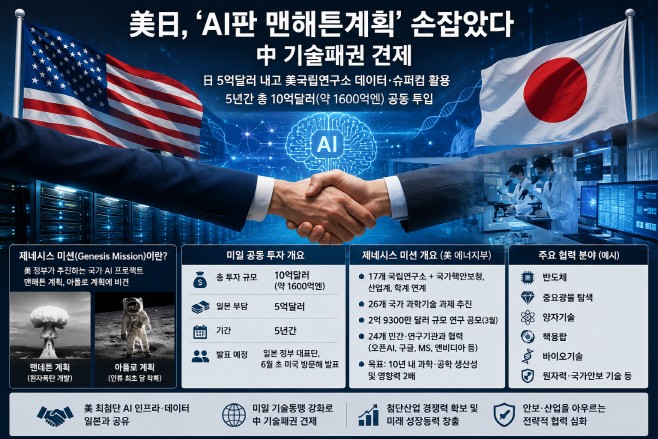 |
| Japan will participate as the first international partner in a massive, state-led artificial intelligence (AI) initiative spearheaded by the United States. The Yomiuri Shimbun reported on June 1 that the Japanese government has finalized its plans to join the "Genesis Mission," a U.S. national project aimed at accelerating scientific discoveries and technological innovations through the utilization of advanced AI. / Image via ChatGPT |
Japan is set to join a massive, state-led artificial intelligence (AI) initiative spearheaded by the United States as its inaugural international partner.
The Yomiuri Shimbun reported on June 1 that the Japanese government has finalized its strategy to participate in the "Genesis Mission," a U.S. national project aimed at accelerating scientific discoveries and technological innovations through the utilization of AI. Under this partnership, the U.S. and Japanese governments plan to invest a combined total of 1 billion dollars (approximately 160 billion yen) over the next five years into the joint development of AI and other critical fields. The initiative heavily functions as a joint U.S.-Japan countermeasure designed to secure a competitive edge in the ongoing technological hegemony race against China.
High-ranking officials from Japan's Ministry of Education, Culture, Sports, Science and Technology and the Ministry of Economy, Trade and Industry are scheduled to visit the United States in early June to announce specific cooperation plans alongside officials from the U.S. Department of Energy, which oversees the project. Japan will reportedly contribute 500 million dollars of the total funding, collaborating with the United States in cutting-edge sectors such as quantum technology, nuclear fusion, and biotechnology. For Japan, the primary advantage lies in gaining access to the massive repositories of scientific data, supercomputers, and foundational AI research infrastructure accumulated by U.S. national laboratories.
This initiative extends far beyond standard joint research and development in AI. The United States is positioning the Genesis Mission as a landmark national endeavor on par with the "Manhattan Project" that developed the atomic bomb, and the "Apollo Program" that led to mankind's first moon landing. While the Manhattan Project and the Apollo Program were total national mobilizations that fundamentally reshaped the landscapes of warfare and the space race, respectively, the Genesis Mission is positioned as the ultimate turning point in the geopolitical battle for scientific and technological supremacy, with AI serving as the vanguard.
Official briefings from the U.S. Department of Energy reinforce this framing. The Genesis Mission is designed to build an AI-driven scientific platform by interconnecting the capabilities of 17 U.S. national laboratories, the National Nuclear Security Administration, private industry, and academia. The core objective is to drastically compress the time required for traditional experiments and computations by integrating world-class supercomputers, experimental facilities, advanced AI systems, and proprietary scientific data. Through this project, the U.S. Department of Energy has set a target to double the productivity and global impact of American science and engineering within the next ten years.
Geopolitical tech race shifts to science and technology
The scope of the project spans a broad spectrum of disciplines. The U.S. Department of Energy has released an initial slate of 26 national science and technology challenges to be addressed through the Genesis Mission. This comprehensive list includes semiconductors, critical minerals, advanced manufacturing, biotechnology, nuclear energy, quantum information science, and technologies vital to national security. In pursuit of these goals, Washington announced a 293 million dollar funding opportunity announcement this past March to back related research. Ultimately, the United States views AI not merely as a supplementary research tool, but as a foundational national infrastructure capable of completely restructuring the entire landscape of global scientific and technological competition.
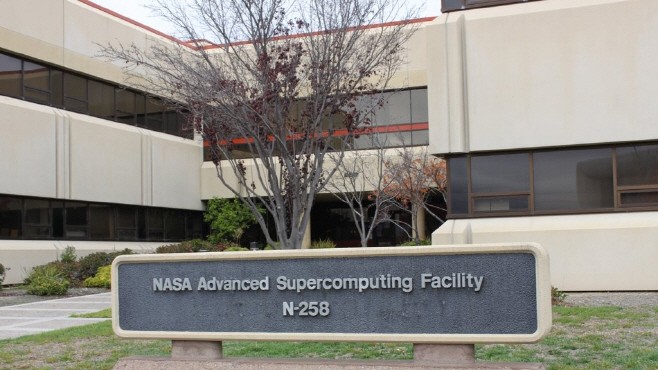 |
The "NASA Advanced Supercomputing facility" inside NASA's Ames Research Center. Currently, "D-Wave 2X"—the world's fastest quantum computer—is installed here at the Quantum Artificial Intelligence Laboratory (QuAIL). / Photo via Yonhap News
Major Big Tech corporations have also jumped on board in massive numbers. The U.S. Department of Energy previously announced cooperative agreements with 24 organizations to drive the Genesis Mission forward. The official partner roster includes premier AI, semiconductor, and cloud enterprises such as OpenAI, Google, Microsoft, Nvidia, IBM, AMD, Oracle, Palantir Technologies, Intel, and Micron Technology. The structural design integrates government research institutions, supercomputers, private-sector AI firms, and semiconductor chipmakers into a single, unified operational platform.
Washington's choice of Tokyo as its inaugural international partner carries immense symbolic weight. The AI race no longer stops at conversational chatbots or search engine optimizations. It has evolved into a foundational utility dictating comprehensive national competitiveness—spanning semiconductor architecture, advanced materials synthesis, nuclear fusion, biotechnology, novel drug discovery, critical mineral exploration, and military defense technologies. Faced with Beijing's rapid catching-up, the United States seeks to pool the financial capital, proprietary tech, and research personnel of its allies. For Japan, the calculus centers on anchoring itself within the highest tier of U.S.-led research infrastructure to avoid falling behind technologically and to secure a launchpad for a renaissance in its high-tech sectors.
Notably, Japan commands an established foundation in semiconductor materials, fabrication equipment, precision machinery, and quantum and nuclear fusion research. On the flip side, the United States possesses state-of-the-art AI models, cloud ecosystems, supercomputing clusters, and national laboratory repositories. Merging these reciprocal strengths amplifies the strategic effectiveness of the tech alliance geared toward containing China. Mirroring the recent expansion of joint missile development and defense cooperation between Washington and Tokyo, an alliance framework that binds national security and industrial strategy together is becoming unmistakably evident across the AI and scientific domains.
This deepening AI cooperation between the U.S. and Japan sends a delicate signal to South Korea. AI, semiconductors, quantum mechanics, biotechnology, nuclear fusion, and critical minerals are all directly intertwined with the future competitiveness of South Korean industries. The fact that the U.S. designated Japan as the first international partner for the Genesis Mission indicates that the distribution of roles within alliance networks could quickly solidify under the emerging high-tech global order.
Ultimately, this U.S.-Japan collaboration underscores that the global AI race has evolved past corporate-level technology developments into a total, nation-against-nation state warfare. As China's technological push intensifies, the realignment of alliances centered around AI is bound to accelerate even further. For South Korea, the window of time to chart its course is rapidly narrowing.
Choi Young-jae |
Most Read
-
1
U.S. Treasury Secretary Bessent publicly warns ove..

-
2
Celltrion’s Omlyclo gains ground in major European..

-
3
Hyundai Motor Group breaks ground on integrated st..

-
4
Russia faces warning signs over prolonged war econ..

-
5
U.S. strikes 3 Iranian oil tankers, Iran vows reta..

-
6
S. Korea seeks redemption from World Cup setback w..

-
7
Trump makes $1 trillion bet ahead of midterm elect..

PEOPLE







-
Address : In-Young Bldg., 34, Uisadang-daero 1-gil, Yeongdeungpo-gu, Seoul
Copyright by ASIATODAY CO., LTD. All rights resereved