



Samsung Electronics moves to ease bonus backlash with 5 trillion won plan
May 28, 2026, 08:15 am


 |
Samsung Electronics is seeking to contain growing controversy over its performance-based bonus system after its wage agreement proposal was approved despite deepening divisions between business units and mounting criticism from shareholders.
The company said Wednesday that its executives pledged to invest a total of 5 trillion won ($3.6 billion) over the next five years to support shared growth initiatives, industrial ecosystem development and future talent cultivation.
The announcement came after Samsung Electronics labor unions approved a tentative wage agreement that had triggered internal disputes between employees in the semiconductor-focused Device Solutions (DS) division and the Device eXperience (DX) division, which oversees mobile and consumer electronics businesses.
In a joint message, Samsung executives said the company would strengthen its social responsibility efforts so that “Samsung’s growth and achievements can create a virtuous cycle not only for employees but also for society as a whole.”
The company said the investment could include support for second- and third-tier suppliers, industrial accident relief funds, expanded inclusive financing programs for small business owners and vulnerable groups, industry-academia cooperation to foster AI talent and youth education programs. Specific plans will be finalized after discussions with the board of directors and the compliance monitoring committee.
The wage negotiations largely centered on how much bonus compensation should be allocated to semiconductor employees. The issue sparked broader debate in South Korea over whether the gains generated during the semiconductor boom should be concentrated among current employees.
Samsung’s latest proposal is seen as an attempt to ease criticism by broadening the beneficiaries of the company’s profits beyond its workforce.
However, tensions remain severe within the company.
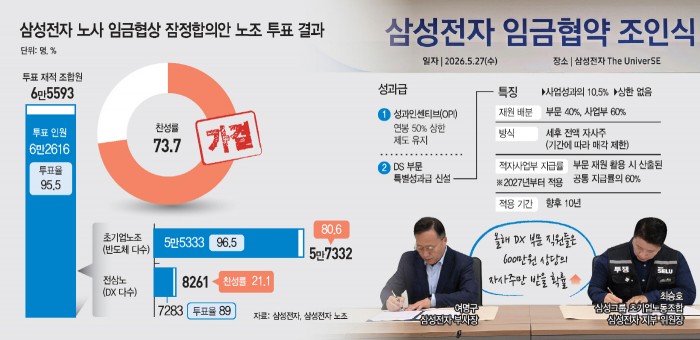
Voting results showed overwhelming opposition from non-semiconductor employees. Even within the Korean Metal Workers’ Union-affiliated Samsung Electronics labor union, which is dominated by DS employees, approval barely exceeded 80 percent. Support within the DX-focused National Samsung Electronics Union stood at only 21.1 percent, representing 16,474 workers.
Following the vote, TM Roh, Samsung Electronics Vice Chair and head of the DX division, issued a separate message to DX employees acknowledging frustration over the negotiation process and agreement terms.
“I feel regret and responsibility as division head over the reality that differences in business conditions and industry cycles are leading to different outcomes among divisions,” Roh said. He added that he would focus on restoring the DX division’s competitiveness and returning it to growth.
Under the agreement, employees in the DS division’s memory business are expected to receive performance bonuses worth around 600 million won before tax, while DX employees may receive only company stock valued at around 6 million won.
Discontent among DX employees intensified during negotiations, prompting the DX-centered Donghaeng Union to withdraw from the joint bargaining group. Some members also filed an injunction seeking to halt the negotiations. The union is now considering lawsuits challenging the validity of the vote.
Choi Seung-ho, head of the Samsung Electronics labor union, told members that the union would reorganize its DX division leadership and replace officials responsible for DX negotiations. He also announced plans for a confidence vote on the union leadership.
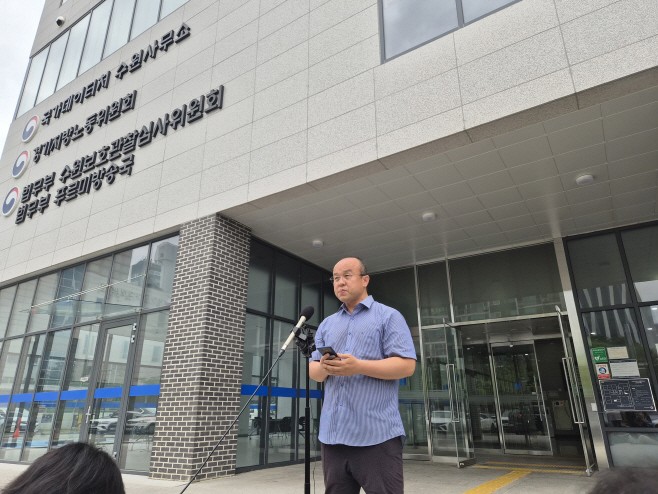 |
| Korea Shareholders Activism Headquarters representative Min Kyung-kwon announces plans to pursue legal action over Samsung Electronics’ operating profit-linked bonus scheme outside the Gyeonggi Regional Labor Relations Commission in Suwon on May 27. /Photo by Lee Ji-sun |
Shareholder groups have also raised objections.
Korea Shareholders Activism Headquarters claimed the operating profit-linked bonus scheme could violate commercial law and announced plans to pursue lawsuits, including a shareholder derivative suit.
The group argued that operating profit should only be distributed after corporate tax and dividend calculations and with shareholder approval at a general meeting. It also criticized the idea of determining “performance” through labor-management negotiations, warning that the scope could later expand to sales or other financial metrics.
Legal experts remain divided on whether linking bonuses to operating profit constitutes an unlawful profit distribution or a legitimate component of the company’s compensation system.
#Samsung Electronics #TM Roh #bonuses #wage agreement #labor union
Copyright by Asiatoday
Most Read
-
1
Kia Sportage outperforms Mazda CX-5 in German auto..

-
2
Houthis launch successive attacks on Saudi airport..

-
3
Saudi Arabia, Iran hold first diplomatic talks to..

-
4
U.S. deploys carrier, 10,000 more troops to Middle..

-
5
Saudi airport in Riyadh struck again, leaving at l..

-
6
Putin's ally visits China on the 8th ahead of APEC..

-
7
Chinese military support and training center opens..

PEOPLE






HEADLINE NEWS

-
Address : In-Young Bldg., 34, Uisadang-daero 1-gil, Yeongdeungpo-gu, Seoul
Copyright by ASIATODAY CO., LTD. All rights resereved