



The power grid dilemma: AI infrastructure hinges on overcoming community resistance
Jul 14, 2026, 09:49 am


 |
While the government has unveiled a blueprint to adopt artificial intelligence (AI) and semiconductors as national growth engines, the construction of the power grid required to support these industries remains gridlocked due to local resident opposition and delayed permits. Experts point out that without securing public consensus, these national mega-projects will face severe hurdles in proceeding as planned.
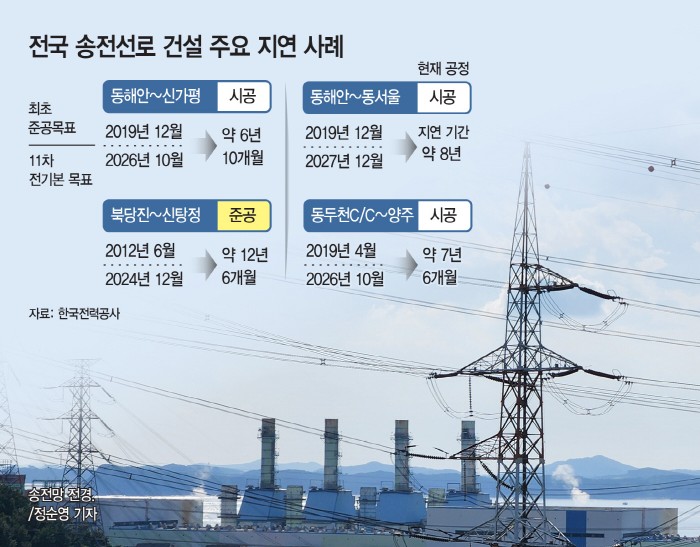
According to the energy industry on July 13, an analysis of major project implementations under the 11th Basic Plan for Electricity Supply and Demand revealed that out of 54 total projects—consisting of 29 transmission lines and 25 substations or converter stations—20 projects have seen delayed completions compared to their original schedules. Excluding the Bukdangjin–Sintangjeong transmission line and the Sincheongju substation, 18 of these projects remain delayed.
The primary drivers behind these delays are civil complaints and licensing friction. A prime example is the Bukdangjin–Sintangjeong transmission line. Hampered by resident petitions and local government zoning delays, the project missed its original 2012 completion target and was only completed last year, marking the longest delay in the history of domestic transmission network projects. Current initiatives face a similar fate. While construction is underway for the high-voltage direct current (HVDC) line designed to transmit power from the East Coast to the Seoul metropolitan area, expansion of the East Seoul converter station remains stalled amid local protests and regulatory bottlenecks.
Under the 11th Basic Plan for Electricity Supply and Demand, the target completion for the East Coast–Singapyeong line (Phase 1) was adjusted from December 2019 to October 2026, while the East Coast–East Seoul line (Phase 2) was pushed back to December 2027. Similarly, the Sinjangseong substation, a key component of the Sinhaenam–Sinjangseong grid, saw its timeline deferred from April 2021 to September 2027 due to community resistance. The Dongducheon C/C–Yangju transmission line has also been delayed for over seven years due to local opposition to transmission towers.
The underlying challenge is that these conflicts could intensify as the government pushes forward with its Honam semiconductor cluster and AI data center initiatives. Consequently, securing local acceptance has emerged as the most critical hurdle. Recognizing this, the government has begun steps to engage communities. The Ministry of Climate, Energy and Environment held two rounds of meetings this year with resident representatives opposing grid construction, discussing improvements to site selection committees, broader public opinion gathering, and enhanced compensation systems. Meanwhile, environmental organizations express concern that the government's AI mega-projects will only exacerbate community friction.
Against this backdrop, experts agree that power competitiveness in the AI era will ultimately be determined by social consensus rather than mere power generation capacity.
"The issues surrounding the transmission grid boil down to two core approaches," said Professor Park Jong-bae of Konkuk University. "Although it increases the financial burden on KEPCO, we must gradually expand underground cabling to structurally minimize conflict. Alternatively, we need to elevate the quality and scope of compensation for residents living near transmission lines through initiatives like grid or transmission pensions."
Professor Cho Hong-jong of Dankook University also emphasized the need for proactive engagement. "Instead of trying to patch up conflicts after a project has already been launched, we need a preemptive approach that involves robust communication and defined compensation structures right from the planning stage," Cho noted. He added, "Rather than pursuing power plants, transmission networks, industrial complexes, and battery energy storage systems as isolated projects, a pan-governmental integrated control tower must plan them in unison, with the government spearheading grid expansion through financial support and public-private cooperation frameworks."
Lee Se-mi
#AI infrastructure
Copyright by Asiatoday
Most Read
-
1
Kia Sportage outperforms Mazda CX-5 in German auto..

-
2
Houthis launch successive attacks on Saudi airport..

-
3
Saudi Arabia, Iran hold first diplomatic talks to..

-
4
U.S. deploys carrier, 10,000 more troops to Middle..

-
5
Saudi airport in Riyadh struck again, leaving at l..

-
6
Japan tracks Ukraine fiber-optic drones, bolsters..

-
7
Putin's ally visits China on the 8th ahead of APEC..

PEOPLE






HEADLINE NEWS

-
Address : In-Young Bldg., 34, Uisadang-daero 1-gil, Yeongdeungpo-gu, Seoul
Copyright by ASIATODAY CO., LTD. All rights resereved