



US depletes interceptor missiles defending Israel, fueling East Asia security anxiety
May 22, 2026, 02:19 pm


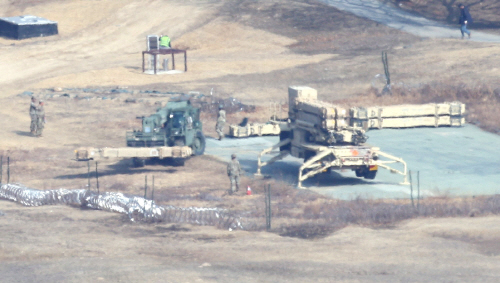 |
| As reports surfaced on March 10 that the United States Department of Defense was relocating portions of the Terminal High Altitude Area Defense (THAAD) system stationed in South Korea to the Middle East, operations to dismantle air defense missile launchers are underway at the US military THAAD base in Seongju County, Gyeongbuk Province, on March 5. /Yonhap News |
The United States has heavily depleted its stockpile of cutting-edge interceptor missiles while defending Israel in the conflict with Iran, triggering deep concerns over the cascading fallout on global security.
According to a recent Pentagon assessment reported by The Washington Post on May 21, the US military launched more than 200 Terminal High Altitude Area Defense (THAAD) interceptors to thwart Iranian ballistic missile strikes during Operation Epic Fury. This volume represents approximately half of the Department of Defense’s total operational inventory.
In addition to the land-based THAAD assets, US naval vessels deployed over 100 Standard Missile-3 (SM-3) and Standard Missile-6 (SM-6) interceptors during the operations.
Conversely, Israel preserved its own domestic arsenals by firing fewer than 100 of its proprietary Arrow and David’s Sling advanced defense systems. The Washington Post noted that this discrepancy has ignited intense scrutiny over an asymmetric expenditure of military resources.
Defense analysts attribute this imbalance to pre-arranged ballistic missile defense frameworks under which the US assumed primary responsibility for the highest-tier defensive missions.
Confronted with multi-front engagements spanning the Gaza Strip, Lebanon, and Yemen, the Israel Defense Forces (IDF) have seen their military capacities stretched to their logistical limits, prompting a heavy reliance on the US to neutralize strategic ballistic threats.
The Washington Post underscored that as the US consumption of interceptor missiles accelerates out of pace with domestic manufacturing lines, security anxieties are mounting across East Asia. Allies like South Korea and Japan rely heavily on American deterrence architectures to counter regional threats from North Korea and China.
"There is a palpable danger that the invoice for this theater will ultimately be delivered to a completely unrelated battlespace in East Asia," warned Kelly Grieco, a senior fellow at the Stimson Center, a Washington-based think tank.
These concerns over a defense vacuum in East Asia are compounded by recent Pentagon disclosures revealing that the US domestic inventory of Patriot air defense missiles has dropped to just 25%.
Against this backdrop, any resumption of hostilities with Iran is projected to exacerbate the vulnerabilities in the global security framework.
Lee Jeong-eun
Most Read
-
1
Celltrion’s Omlyclo gains ground in major European..

-
2
Trump demands rates fall below 1% as Fed hikes for..

-
3
Trump makes $1 trillion bet ahead of midterm elect..

-
4
Iran resumes ballistic missile production, assembl..

-
5
Samsung Electronics, Mistral AI to jointly develop..

-
6
Trump warns countries not helping U.S. must pay re..

-
7
Apple launches first foldable, 1 million won prici..

PEOPLE






HEADLINE NEWS
- Trump to roll out ‘unprecedented welcome’ for Xi with B-2 bombers, F-22 fighters
- S. Korea, U.S., and Japan form united front on Taiwan and economic coercion..
- Trump administration moves to impose sweeping sanctions on International Cr..
- Xi to make state visit to U.S. Sept. 23-25, dispelling rumors over his heal..

-
Address : In-Young Bldg., 34, Uisadang-daero 1-gil, Yeongdeungpo-gu, Seoul
Copyright by ASIATODAY CO., LTD. All rights resereved