



Hyundai premium push lifts global vehicle pricing
May 19, 2026, 10:22 am


 |
| /AI-generated image |
Hyundai Motor Company has surpassed 80 million won ($58,000) in overseas average selling prices for passenger vehicles for the first time, underscoring the success of its long-term premium vehicle strategy driven by strong sales of Genesis luxury models and high-margin hybrid vehicles.
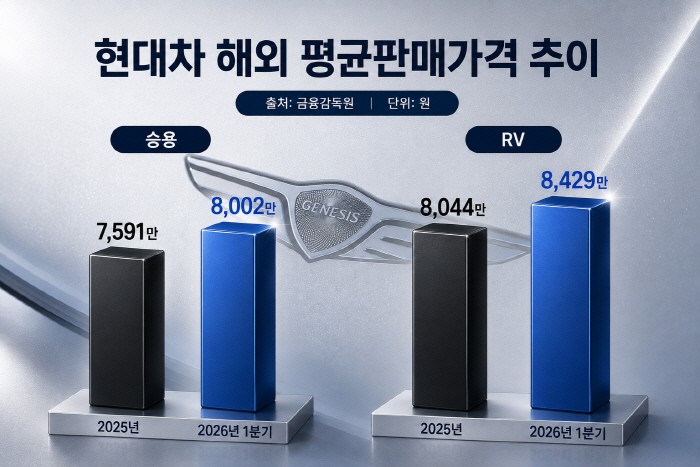
According to data from South Korea’s Financial Supervisory Service released Sunday, Hyundai’s overseas average selling price (ASP) for passenger cars reached 80.02 million won in the first quarter of 2026, up 5.4% from 75.91 million won a year earlier.
The company’s recreational vehicle (RV) ASP also climbed to 84.29 million won from 80.44 million won last year, extending gains after already crossing the 80 million won threshold in 2025.
Industry analysts attributed the increase to strong demand for premium SUVs, hybrid vehicles and luxury models under Hyundai’s Genesis marque, particularly in the United States.
In the U.S., the world’s largest automobile market, Genesis sales rose 4.6% on-year to 18,317 units in the first quarter. During the same period, Hyundai’s local hybrid vehicle sales surged 55% to 55,416 units.
Hybrid models typically sell for 2 million to 6 million won more than comparable internal combustion engine vehicles, helping boost profitability.
Hyundai’s hybrid-focused strategy also gained traction in Europe, where automakers have been grappling with slowing electric vehicle demand. The proportion of hybrid sales in Europe rose to 27% this year from 20.3% last year.
The company also improved its product mix by shifting consumers toward larger and higher-priced vehicles. Sales of the compact i10 model fell sharply from 38.8% of total sales last year to 20% in the first quarter, while the proportion of i20 hatchback sales increased from 41.5% to 59%.
Market observers said Hyundai’s pricing gains reflect more than temporary currency effects, calling them the result of years of brand repositioning aimed at improving pricing power globally.
“Breaking the 80 million won mark in both passenger vehicles and RVs demonstrates Hyundai’s qualitative growth in the global automotive market,” an industry official said. “Its strategy centered on high-spec SUVs and eco-friendly vehicles has proven effective.”
Meanwhile, affiliate Kia Corporation also posted higher overseas vehicle prices. Kia’s overseas passenger vehicle ASP rose 9.7% on-year to 45.17 million won in the first quarter, while RV ASP increased 3.1% to 71.21 million won, surpassing the 70 million won level for the first time.
#Hyundai Motor #Genesis #hybrid vehicles #average selling price #ASP
Copyright by Asiatoday
Most Read
-
1
Kia Sportage outperforms Mazda CX-5 in German auto..

-
2
Houthis launch successive attacks on Saudi airport..

-
3
Saudi Arabia, Iran hold first diplomatic talks to..

-
4
U.S. deploys carrier, 10,000 more troops to Middle..

-
5
Saudi airport in Riyadh struck again, leaving at l..

-
6
Putin's ally visits China on the 8th ahead of APEC..

-
7
Chinese military support and training center opens..

PEOPLE






HEADLINE NEWS

-
Address : In-Young Bldg., 34, Uisadang-daero 1-gil, Yeongdeungpo-gu, Seoul
Copyright by ASIATODAY CO., LTD. All rights resereved