



India encourages higher birth rates despite 1.4-billion population; offers 470,000 won for third child
May 19, 2026, 11:09 am


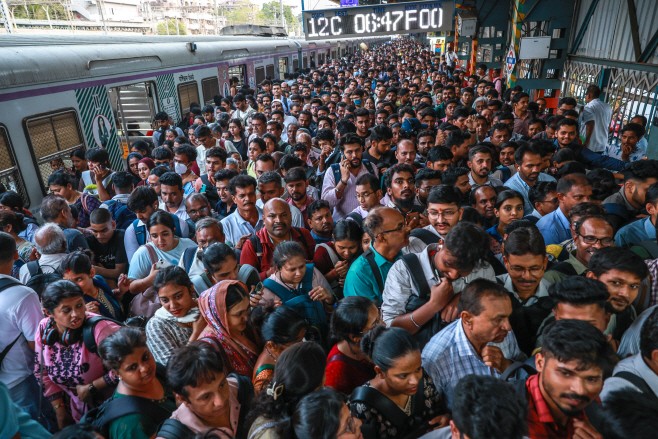 |
| Commuters disembark from a train and walk along a platform at a railway station in Mumbai, India, on May 12 (local time). India, the world's most populous nation with 1.42 billion people, has seen its total fertility rate drop to 2.0, falling below the population replacement level of 2.1; consequently, various regions across the country are launching initiatives to encourage larger families. / EPA·Yonhap News |
A campaign encouraging citizens to have more children is gaining full momentum in India, the world’s most populous nation. Despite its population reaching 1.42 billion, the total fertility rate has dropped below the population replacement level, prompting political allies of Prime Minister Narendra Modi to introduce a series of pro-natal policies.
According to Reuters on May 19 (local time), a government survey conducted between 2019 and 2021 showed India's total fertility rate (TFR—the average number of children a woman bears in her lifetime) standing at 2.0. This marks a sharp decline from the 3.4 recorded in 1992–1993. Reuters attributed the drop to increased use of contraceptives and rising education levels among women. The Indian government believes a fertility rate of 2.1 is necessary to maintain the population at its current level.
A prime example of this shift is the southern state of Andhra Pradesh. Governed by a coalition of a regional party and Prime Minister Narendra Modi’s Bharatiya Janata Party (BJP), the state government announced over the weekend that it will provide a lump-sum payment of 30,000 rupees (about 470,000 won) to families welcoming a third child, and 40,000 rupees (about 620,000 won) for a fourth. The policy shifts the focus to third and subsequent children, moving away from an initial plan that proposed 25,000 rupees (about 390,000 won) for a second child. The exact implementation date was not disclosed.
Chief Minister Chandrababu Naidu pointed out that falling birth rates lead to an aging society and economic contraction. "In the past, we focused heavily on family planning, but the situation has changed, and we must now view children as assets," he said.
Sikkim, a small state in the northeast, has also joined the push for larger families. The state government has introduced incentives including one year of maternity leave, one month of paternity leave, and financial support for IVF treatments.
Beyond the state level, the Rashtriya Swayamsevak Sangh (RSS)—a Hindu nationalist organization that serves as Modi’s political foundation—is also advocating for larger families. Given that the Modi-led BJP itself originated from the RSS, the group holds significant influence. RSS General Secretary Dattatreya Hosabale told reporters last week, "We have always said India is a nation of youths, but the total fertility rate is gradually declining." He added, "If the demographic balance is disrupted, it leads to conflicts."
India’s pro-natal shift mirrors the path previously taken by East Asian nations. According to the United Nations, in the mid-1980s, China, Japan, South Korea, Thailand, and Turkey all viewed their birth rates as too high and implemented population control policies. By 2015, however, they completely reversed course to promote childbearing. India is now following this pattern, where policy directions pivot once fertility rates fall below a critical threshold.
However, India's starting line differs from that of East Asia. The United Nations projects that India's population will continue to expand for about another 40 years, peaking at around 1.7 billion. Currently, the Indian labor market suffers from a shortage of jobs rather than a shortage of workers. According to government statistics, while the overall unemployment rate for those aged 15 and older was 3.1% last year, the youth unemployment rate for ages 15 to 29 stood at 9.9%, spiking to 13.6% in urban areas. This means the multi-child campaign is ramping up at a time when the population continues to grow and youth employment remains scarce.
Most Read
-
1
Celltrion nears additional contract with major U.S..

-
2
Putin proposes trilateral U.S.-China-Russia summit..

-
3
U.S. weighs dropping MOAB, world's most powerful n..

-
4
"Aren't those foreigners on welfare?": M..

-
5
Attention centers on APEC for possible Trump-Xi-Pu..

-
6
Saudi Arabia, Iran hold first diplomatic talks to..

-
7
U.S., Israel plan to resume strikes on Iran after..

PEOPLE







-
Address : In-Young Bldg., 34, Uisadang-daero 1-gil, Yeongdeungpo-gu, Seoul
Copyright by ASIATODAY CO., LTD. All rights resereved