



Trump says Iran deal ‘very likely’ as US, Iran finalize ceasefire MOU
May 07, 2026, 08:31 am


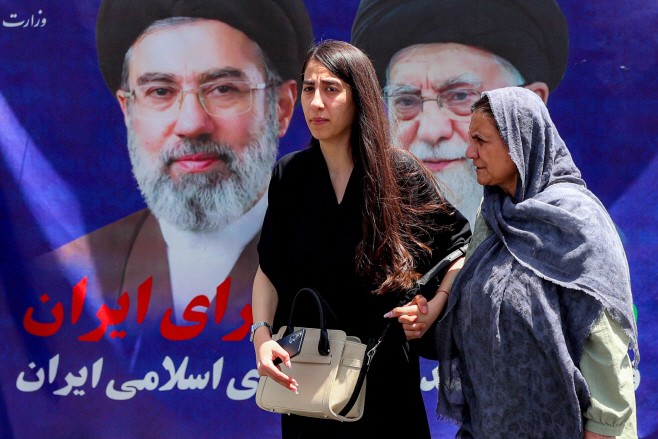 |
| Iranian women walk past a large banner depicting Iran’s current Supreme Leader Ayatollah Mojtaba Khamenei (left) and his predecessor and father, the late Ali Khamenei, on a street in Tehran on May 6. /AFP-Yonhap |
U.S. President Donald Trump said Tuesday that the possibility of reaching a ceasefire agreement with Iran was “very likely,” as Washington and Tehran reportedly entered final-stage negotiations over a 14-point memorandum of understanding aimed at ending the war.
Trump’s remarks came after Axios reported that the United States and Iran were coordinating a one-page MOU outlining a declaration to end hostilities and launch 30 days of detailed negotiations.
Iran confirmed it was reviewing the proposal, though resistance has emerged within the Iranian parliament, where some lawmakers dismissed the plan as “America’s wish list.”
According to U.S. media reports including The New York Times, Iran’s worsening economic pressure — particularly the near exhaustion of its oil storage capacity due to the U.S. maritime blockade — is increasing the likelihood that Tehran may accept the deal.
Global oil prices and stock markets reacted positively to hopes for a breakthrough, although Trump warned that failure to reach an agreement could lead to “far stronger bombing” than before.
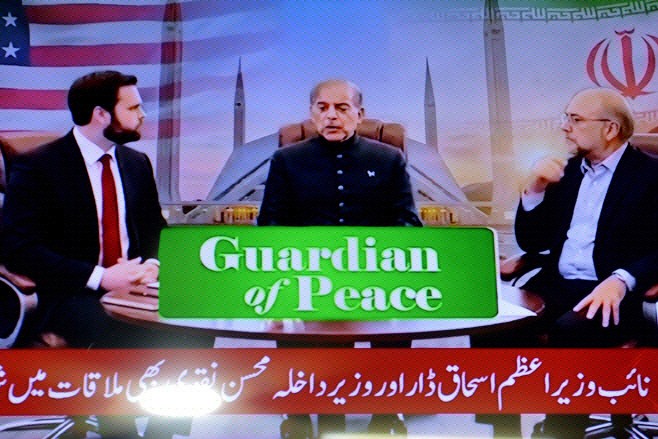 |
| U.S. Vice President J.D. Vance (left) and Iranian Parliament Speaker Mohammad Bagher Ghalibaf (right) hold ceasefire negotiations under the mediation of Pakistani Prime Minister Shehbaz Sharif at a hotel in Islamabad on April 11, in this image captured from a television broadcast. /EPA-Yonhap |
14-point framework links nuclear freeze and sanctions relief
According to Axios and CNN, the proposed MOU is not a final peace agreement but rather a framework for formally ending the conflict and beginning intensive follow-up negotiations over the next 30 days.
The draft reportedly includes a temporary suspension of Iran’s uranium enrichment program, phased lifting of U.S. sanctions and release of frozen Iranian assets worth billions of dollars, gradual reopening of the Strait of Hormuz, and phased easing of the U.S. naval blockade on Iran.
Axios reported that the uranium enrichment moratorium is expected to last at least 12 years, with 15 years emerging as the most likely compromise after Washington initially demanded 20 years and Tehran proposed five.
In an interview with PBS, Trump confirmed that the MOU includes provisions for transferring Iran’s highly enriched uranium abroad and shutting down underground nuclear facilities, saying the material would be “sent to the United States.”
However, Axios reported that shipment to the U.S. remains only one of several options under discussion, while The Wall Street Journal said Iran opposes transferring the uranium to America.
Trump also denied reports that Iran would be permitted to enrich uranium up to 3.67% after the moratorium period, though Axios said the issue remains under negotiation.
Reuters noted that previous rounds of talks also featured repeated U.S. optimism but failed to produce an agreement. The agency added that the current draft does not clearly include longstanding U.S. demands such as restrictions on Iran’s ballistic missile program, an end to support for proxy groups including Hezbollah and the Houthis, or concrete measures regarding Iran’s stockpile of more than 400 kilograms of highly enriched uranium.
Key issues including nuclear inspection mechanisms and conditions for extending the moratorium in case of violations also remain unresolved, Axios reported.
Negotiations are reportedly being led by Trump’s Middle East envoy Steve Witkoff and Trump’s son-in-law Jared Kushner through both direct and mediated channels. Islamabad and Geneva are being discussed as possible venues for the next round of talks.
U.S. officials told Axios that communication delays are slowing negotiations because Iran’s Supreme Leader Mojtaba Khamenei remains in a secure undisclosed location and all messages must physically reach him before responses are returned. American officials expect Tehran’s reply within 24 to 48 hours but stressed that “there is no deal yet.”
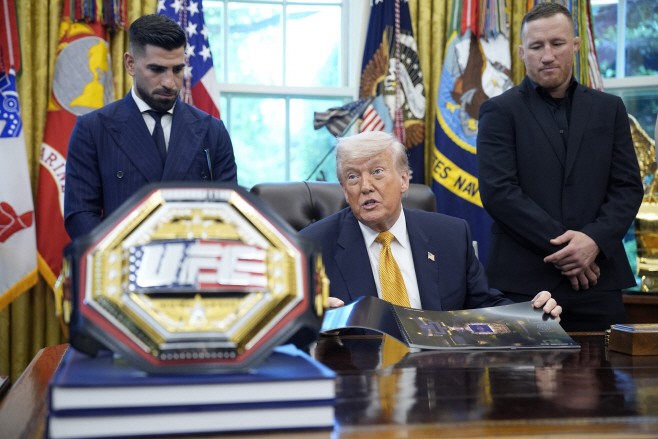 |
| Donald Trump speaks in the Oval Office at the White House in Washington, D.C. on May 6 as UFC fighters set to compete in the “Big Fight” event on the White House South Lawn on June 14 listen attentively. /UPI-Yonhap |
Trump keeps pressure on Tehran despite diplomacy
Trump told Fox News that a deal could come “within a week,” although he later told reporters at the White House that “there is no deadline.”
In his PBS interview, Trump suggested an agreement could be reached before his planned trip to China next week, but cautioned, “I’ve felt this way before, so we’ll see what happens.”
On Truth Social, Trump warned that if Iran rejects the proposal, bombing campaigns “far more intense than before” would resume.
Secretary of State Marco Rubio said there was no need to finalize a complete agreement “in one day,” but reportedly expressed skepticism about the talks, criticizing some Iranian leaders as “crazy,” according to Axios.
Although Trump suspended “Project Freedom” — a military initiative linked to the conflict — the U.S. maritime blockade on vessels entering Iranian ports remains fully in effect.
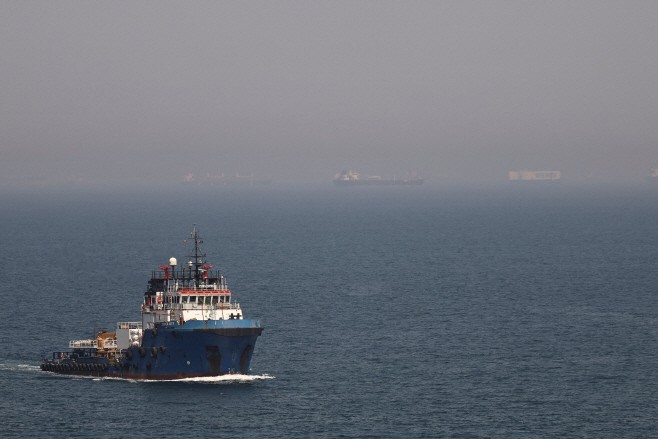 |
| The marine operations vessel Zakher Duty is anchored at Fujairah Port in the United Arab Emirates on May 6, as maritime traffic through the Strait of Hormuz remains restricted amid escalating tensions between the United States, Israel and Iran. /Reuters-Yonhap |
Iran seeks support from China and Russia amid domestic backlash
Iranian Foreign Ministry spokesperson Esmail Baghaei confirmed to ISNA that Tehran was reviewing the U.S. proposal and would convey its position to Pakistani mediators once finalized.
However, Iran’s Tasnim News Agency cited unnamed sources saying the proposal contains “unacceptable” provisions. Iranian parliamentary foreign affairs committee spokesman Ebrahim Rezaei dismissed the Axios report as unrealistic, saying the U.S. “cannot obtain through negotiations what it failed to achieve in war.”
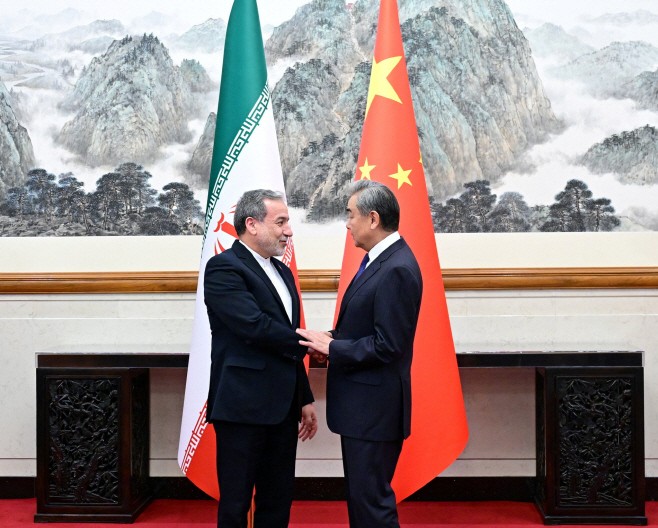 |
| Chinese Foreign Minister Wang Yi (right) shakes hands with Iranian Foreign Minister Abbas Araghchi in Beijing on May 6, in this photo released by China’s Foreign Ministry. /Reuters-Yonhap |
Iranian Foreign Minister Abbas Araghchi visited Beijing on Tuesday for talks with Chinese Foreign Minister Wang Yi, expressing appreciation for China’s four-point regional peace initiative and vowing to defend Iran’s “legitimate rights and interests,” according to IRNA.
Wang urged all parties to avoid renewed fighting and called for the rapid reopening of the Strait of Hormuz.
Bloomberg reported that Iran’s intensified diplomacy with China and Russia reflects Tehran’s strategy to strengthen ties with countries capable of softening U.S. pressure. Araghchi also met Russian President Vladimir Putin in St. Petersburg last month.
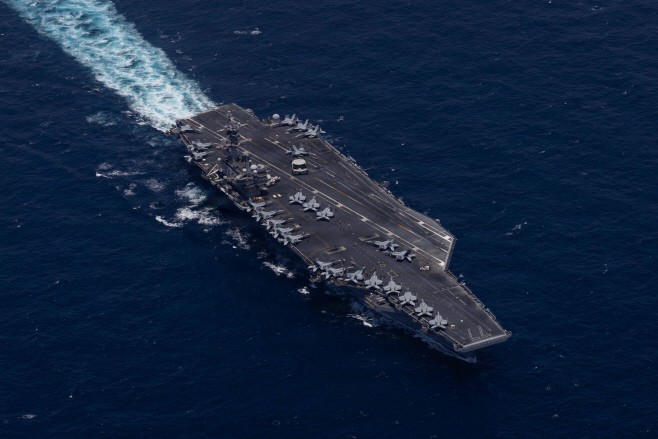 |
| The U.S. Navy Nimitz-class aircraft carrier USS George H.W. Bush (CVN-77) sails in the Arabian Sea on May 3, in a photo released by U.S. Central Command on May 5. /AFP-Yonhap |
Hormuz disruption and economic pain increase urgency
The New York Times reported that Iran’s deepening economic crisis has become a major driver pushing Tehran toward compromise.
Before the blockade, 98% of Iran’s oil exports passed through the Strait of Hormuz. Since the U.S. blockade began on April 13, not a single Iranian oil tanker has reportedly exited the waterway.
Maritime analytics firm Kpler estimates that if the blockade continues, Iran’s oil storage facilities could reach full capacity within 25 to 30 days.
Iranian oil officials warned that once storage is exhausted, some aging oil fields may need to shut down permanently due to difficulties restarting production.
The NYT also reported that Iran’s southern ports, which previously handled 70% of the country’s imports and exports, are facing severe disruptions. The Iranian rial has plunged in value, inflation has climbed to a record 60%, and at least one million jobs have reportedly been lost.
Kpler data showed commercial shipping traffic through the Strait of Hormuz remained virtually halted Tuesday, compared with an average of 120 vessels per day before the blockade.
U.S. Central Command said a U.S. Navy F/A-18E Super Hornet launched from the aircraft carrier USS Abraham Lincoln fired 20mm cannon rounds to disable the rudder of the Iranian tanker Hasna after it attempted to breach the blockade.
The International Maritime Organization said the container ship San Antonio, operated by French shipping giant CMA CGM, was attacked, injuring eight crew members. Since the conflict began, 32 ships have reportedly come under attack, killing 10 sailors.
German shipping company Hapag-Lloyd estimated that the Hormuz disruption is costing the industry about $60 million per week.
Meanwhile, Benjamin Netanyahu convened Israel’s security cabinet after reports of progress in U.S.-Iran negotiations. Israeli officials reportedly instructed security agencies to prepare for “all scenarios, including renewed combat.”
Netanyahu reiterated that any final agreement must include the complete removal of Iran’s enriched nuclear material and dismantlement of its enrichment capabilities.
Israeli media outlet Channel 12 reported that Washington informed Israel that Iran had shown “surprising openness” toward transferring highly enriched uranium to a third country, while Israeli officials continue monitoring whether ballistic missile restrictions and limitations on Iran-backed proxy groups are adequately addressed in the negotiations.
#Donald Trump #Iran #US-Iran talks #ceasefire MOU #nuclear enrichment moratorium
Copyright by Asiatoday
Most Read
-
1
Trump shares map on social media labeling Strait o..

-
2
Kia Sportage outperforms Mazda CX-5 in German auto..

-
3
Houthis launch successive attacks on Saudi airport..

-
4
U.S. deploys carrier, 10,000 more troops to Middle..

-
5
Trump rejects Iran's offer to open Strait of Hormu..

-
6
N. Korea conducts first swarm attack drill with dr..

-
7
U.S.-China summit falls short on substance as Trum..

PEOPLE






HEADLINE NEWS
- Seoul dismisses Ukraine's claim of 'S. Korean support for Russia' as "inaccurate and inappropriate"
- S. Korea, Japan race to develop nuclear-powered submarines
- Henri Kagan, Kenso Soai win Nobel Prize in Chemistry for uncovering how mol..
- Vance says Alaska LNG cooperation will move forward with Seoul's current or..

-
Address : In-Young Bldg., 34, Uisadang-daero 1-gil, Yeongdeungpo-gu, Seoul
Copyright by ASIATODAY CO., LTD. All rights resereved