



Trump urges Iran to call as Hormuz crisis deepens
Apr 27, 2026, 08:51 am


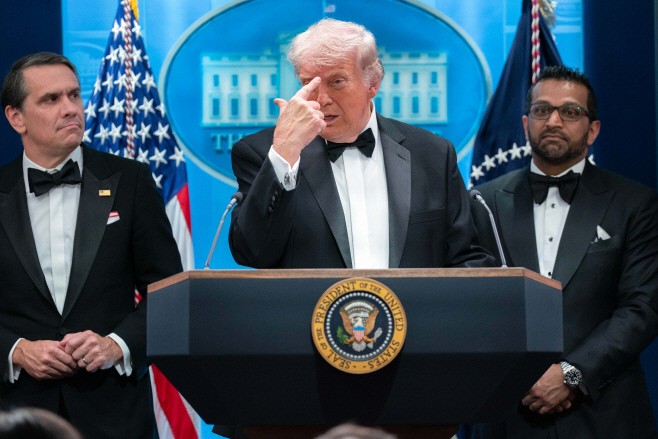 |
| Donald Trump (center) speaks at a press conference at the White House in Washington, D.C., on April 25 regarding the gunfire incident that led to the cancellation of the White House Correspondents’ Association (WHCA) dinner, as acting Attorney General Todd Blanche (left) and FBI Director Kash Patel look on. /AP-Yonhap |
US President Donald Trump on April 26 proposed phone-based negotiations with Iran, signaling a shift away from direct diplomatic engagement as tensions escalate amid the ongoing Strait of Hormuz blockade.
Iranian Foreign Minister Abbas Araghchi, after shuttle diplomacy through Pakistan and Oman, departed for Russia, underscoring the lack of a breakthrough in ceasefire talks. The The New York Times described the situation as entering a “No War, No Peace” stalemate.
Trump Cancels Envoys, Pushes ‘Call Me’ Diplomacy
In a phone interview with Fox News, Trump said, “We hold all the cards,” adding, “They can call us anytime they want. We have secure lines.”
He also claimed Iran’s oil infrastructure is under severe pressure, warning that storage constraints could trigger explosions within days, further increasing urgency on Tehran.
Earlier, Trump wrote on his social platform Truth Social that Iran had made multiple proposals but “not enough,” and canceled planned visits by Middle East envoy Steve Witkoff and Jared Kushner to Pakistan.
Following the decision, two U.S. Air Force C-17 transport aircraft withdrew personnel security equipment and vehicles from Pakistan, according to Reuters.
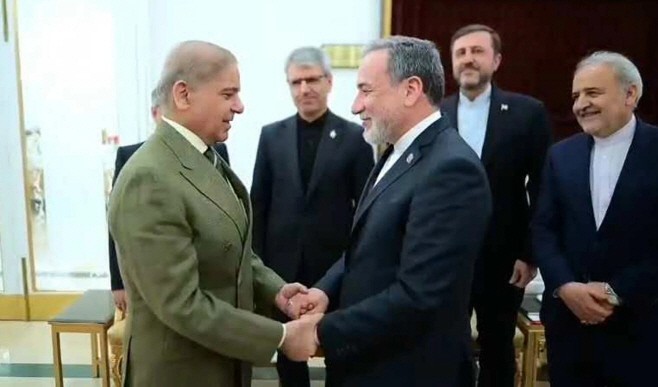 |
| Shehbaz Sharif (left) shakes hands with Abbas Araghchi in Islamabad on April 25. /Courtesy of the Prime Minister’s Office of Pakistan, Xinhua-Yonhap |
Iran Presents Four Conditions via Regional Diplomacy
Araghchi visited Islamabad on April 24 and again briefly on April 26 after stopping in Oman, where he met Sultan Haitham bin Tariq to discuss regional security and the Strait of Hormuz.
Iran’s semi-official Tasnim News Agency reported that the purpose of the visit was to clearly convey four conditions for ending the conflict to mediating countries: the implementation of a new legal framework for the Strait of Hormuz, compensation for war damages, guarantees against renewed aggression by the parties involved, and the lifting of the maritime blockade. The report added that these discussions are being conducted separately from the nuclear issue.
Iranian President Masoud Pezeshkian reiterated that negotiations cannot proceed under threats or blockade, insisting the U.S. must first lift restrictions.
After his regional tour, Araghchi traveled to Moscow, where he is expected to meet Vladimir Putin on April 27 to discuss ceasefire prospects.
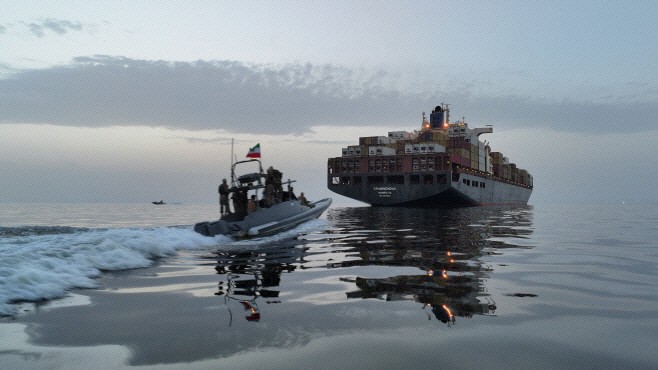 |
| An Islamic Revolutionary Guard Corps (IRGC) patrol boat seizes the Liberia-flagged vessel Epaminondas in the Strait of Hormuz on April 22. /Reuters-Yonhap |
‘No War, No Peace’ Deadlock Intensifies
The U.S. and Iran remain locked in a strategic standoff, each waiting for the other to concede. The New York Times noted that while both sides seek to avoid full-scale war, neither is willing to abandon pressure tactics.
Iran’s leadership appears inclined to maintain the status quo, viewing it as the safest political option. Meanwhile, Trump faces domestic pressure to end the conflict amid declining approval ratings.
Former U.S. envoy Robert Malley described the dynamic as a clash of strategies: “Trump wants immediate results, while Iran is prepared for a long game and willing to endure significant hardship rather than concede core interests.”
Negotiations are further complicated by unresolved nuclear concerns. Iran is estimated to possess about 11 tons of uranium at various enrichment levels, including roughly 440 kg near weapons-grade.
While Trump has downplayed the remaining material as “nuclear dust,” experts cited by The New York Times warn it remains highly dangerous.
Beyond nuclear issues, Reuters reported that the U.S. is demanding limits on Iran’s support for proxy groups such as Hezbollah and Hamas, as well as restrictions on ballistic missile capabilities. Iran, in turn, is seeking sanctions relief and a halt to Israeli attacks on its allies.
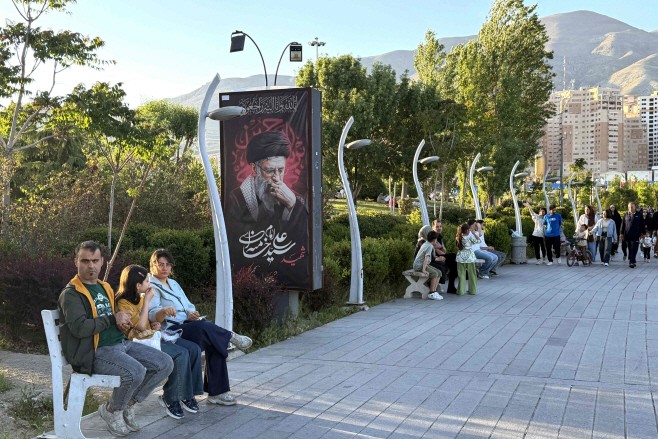 |
| A sign reading “Martyr Ayatollah Ali Khamenei” is installed along a walkway at Chitgar Lake park in Tehran on April 26. /AFP-Yonhap |
Oil Shock as Hormuz Traffic Collapses
The economic impact is rapidly escalating. Bloomberg data shows commercial vessel traffic through the Strait of Hormuz has plunged from an average of 135 ships per day to near-zero levels.
The U.S. Navy has intercepted or turned back 37 vessels since the blockade began, while Iran’s Islamic Revolutionary Guard Corps has deployed fast boats to enforce restrictions.
Goldman Sachs analysts estimate oil production from Persian Gulf countries has dropped 57% compared to pre-conflict levels, with recovery expected to take months even after reopening.
Energy prices have surged sharply. Brent crude rose to $105.33 per barrel, up more than 45% from pre-war levels, while U.S. gasoline prices climbed to $4 per gallon, a 33% increase since late February. European LNG benchmark prices have also risen by about one-third.
Russell Hardy, CEO of Vitol, warned that total supply losses could reach at least 1 billion barrels, with prolonged disruption expected even after the strait reopens.
As diplomatic channels stall and economic pressures mount, the U.S.-Iran confrontation is entering a prolonged and uncertain phase with global repercussions.
#Donald Trump #Iran #Strait of Hormuz #Abbas Araghchi #US-Iran tensions
Copyright by Asiatoday
Most Read
-
1
Trump shares map on social media labeling Strait o..

-
2
Kia Sportage outperforms Mazda CX-5 in German auto..

-
3
Houthis launch successive attacks on Saudi airport..

-
4
U.S. deploys carrier, 10,000 more troops to Middle..

-
5
Trump rejects Iran's offer to open Strait of Hormu..

-
6
N. Korea conducts first swarm attack drill with dr..

-
7
U.S.-China summit falls short on substance as Trum..

PEOPLE






HEADLINE NEWS
- Seoul dismisses Ukraine's claim of 'S. Korean support for Russia' as "inaccurate and inappropriate"
- S. Korea, Japan race to develop nuclear-powered submarines
- Henri Kagan, Kenso Soai win Nobel Prize in Chemistry for uncovering how mol..
- Vance says Alaska LNG cooperation will move forward with Seoul's current or..

-
Address : In-Young Bldg., 34, Uisadang-daero 1-gil, Yeongdeungpo-gu, Seoul
Copyright by ASIATODAY CO., LTD. All rights resereved