



Trump claims Iran ship seizure amid rising tensions
Apr 20, 2026, 08:36 am


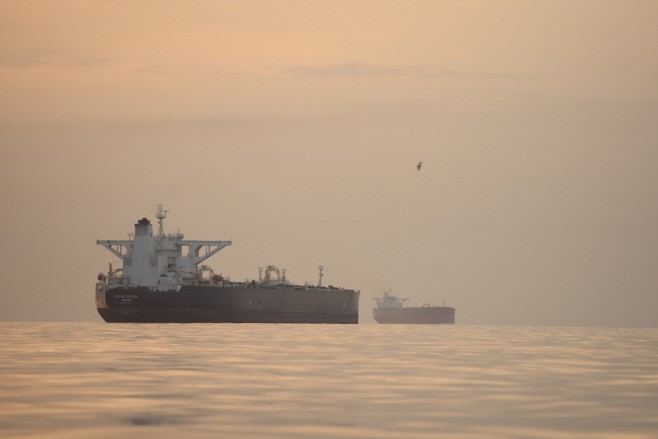 |
| Oil tankers anchor in the Strait of Hormuz near Iran’s Qeshm Island amid escalating tensions. |
US President Donald Trump said on April 19 that the U.S. Navy’s guided-missile destroyer USS Spruance struck the engine room of the Iranian-flagged cargo vessel TOUSKA and seized it in the Gulf of Oman.
Following Iranian Foreign Minister Abbas Araghchi’s declaration on April 17 that the Strait of Hormuz was “open,” attempts by vessels to pass through resumed but were halted within 24 hours amid gunfire and forced turnarounds. As a result, at least 135 million barrels of crude oil and refined products remain stranded aboard ships in the Persian Gulf, raising concerns over a deepening global energy crisis.
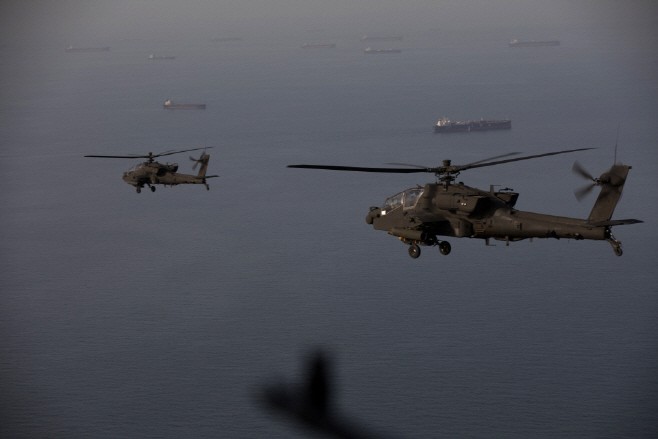 |
| U.S. AH-64 Apache helicopters conduct reconnaissance operations over the Strait of Hormuz, in a photo released by United States Central Command on X on April 18. /AFP-Yonhap |
Trump claims strike on Iranian vessel, first interdiction since blockade
Posting on his social media platform Truth Social, Trump said the Iranian vessel TOUSKA — about 900 feet (275 meters) long and “nearly the size of an aircraft carrier” — attempted to breach the blockade but “did not end well.” He added that the guided-missile destroyer USS Spruance responded after the crew ignored orders to stop, stating, “We put a hole in the engine room to stop the ship, and U.S. Marines are now onboard securing and searching it.”
The incident marks the first use of force since United States Central Command declared a blockade on vessels traveling to and from Iranian ports on April 13.
Trump also said the TOUSKA had been listed under U.S. Treasury sanctions due to a history of illicit activities.
According to a report by The Wall Street Journal, the U.S. military is preparing to expand operations within days to seize Iranian-linked tankers and commercial ships across international waters beyond the Strait of Hormuz.
In a related development, Mike Waltz told ABC News that inspections of Iranian vessels could extend as far as the Pacific, signaling a possible expansion of the blockade.
Earlier, Dan Caine said during a Pentagon briefing on April 16 that the U.S. would actively track Iranian-flagged ships or any vessels providing material support to Iran across other operational theaters, including the Indo-Pacific. He added that targets include so-called “dark fleet” or “shadow fleet” vessels used to transport oil illicitly in violation of sanctions.
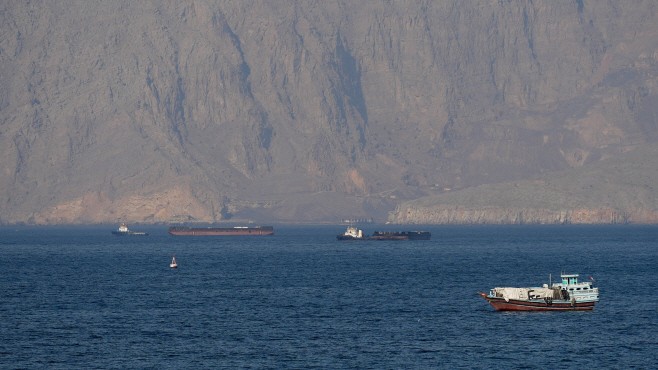 |
| Ships and oil tankers navigate the Strait of Hormuz off the coast of Musandam, Oman, on April 18. /Reuters-Yonhap |
Chaos in Hormuz as Iran reimposes blockade
Shortly after Iranian Foreign Minister Abbas Araghchi posted on X on April 17 that the strait was “completely open,” ships stranded in the Persian Gulf began attempting to pass through. However, Iran’s military reinstated a transit ban the following day, plunging the region into confusion.
According to Bloomberg, an Indian oil tanker attempting passage was forced to turn back after coming within about 4 miles (6.4 km) of the Iranian coast, where it faced gunfire and threats from armed personnel in small boats using rocket-propelled grenades. Associated Press also reported that two Indian merchant vessels were fired upon and forced to retreat.
The UK Maritime Trade Operations (UKMTO) said vessels linked to Islamic Revolutionary Guard Corps fired at a tanker near Oman, while a separate container ship was struck by an unidentified projectile.
Bloomberg data showed that 18 vessels successfully transited the area the previous day and 10 entered the region. However, after Iran’s renewed closure, more than 13 tankers turned back, and no ships were observed transiting the strait that day.
135 million barrels stranded, energy risks rise
Shipping disruptions have left at least 135 million barrels of crude oil and refined products stranded aboard tankers in the Persian Gulf, according to vessel tracking data from Bloomberg.
Brent crude had dropped about 9% to around $90 per barrel on hopes of de-escalation, but rebounded as tensions resurfaced following reports of the TOUSKA seizure and renewed closure of the strait. The U.S. dollar also strengthened amid increased demand for safe-haven assets.
The UAE’s largest energy firm, Abu Dhabi National Oil Company, reportedly redirected two LNG tankers toward the Strait of Hormuz after Iran’s reopening announcement, but later turned them back near Khor Fakkan port due to safety concerns and the risk of vessels becoming stranded.
Meanwhile, Iran’s parliament is pushing legislation to tighten control over the strait, including banning vessels linked to Israel and requiring ships from “hostile states” to obtain approval from the Supreme National Security Council before passage.
#Donald Trump #Iran #Strait of Hormuz #US Navy #oil tankers
Copyright by Asiatoday
Most Read
-
1
Trump shares map on social media labeling Strait o..

-
2
Kia Sportage outperforms Mazda CX-5 in German auto..

-
3
Houthis launch successive attacks on Saudi airport..

-
4
U.S. deploys carrier, 10,000 more troops to Middle..

-
5
Trump rejects Iran's offer to open Strait of Hormu..

-
6
N. Korea conducts first swarm attack drill with dr..

-
7
U.S.-China summit falls short on substance as Trum..

PEOPLE






HEADLINE NEWS
- Seoul dismisses Ukraine's claim of 'S. Korean support for Russia' as "inaccurate and inappropriate"
- S. Korea, Japan race to develop nuclear-powered submarines
- Henri Kagan, Kenso Soai win Nobel Prize in Chemistry for uncovering how mol..
- Vance says Alaska LNG cooperation will move forward with Seoul's current or..

-
Address : In-Young Bldg., 34, Uisadang-daero 1-gil, Yeongdeungpo-gu, Seoul
Copyright by ASIATODAY CO., LTD. All rights resereved