



Samsung labor seeks 40 trillion won bonus, pressure builds
Apr 13, 2026, 08:02 am


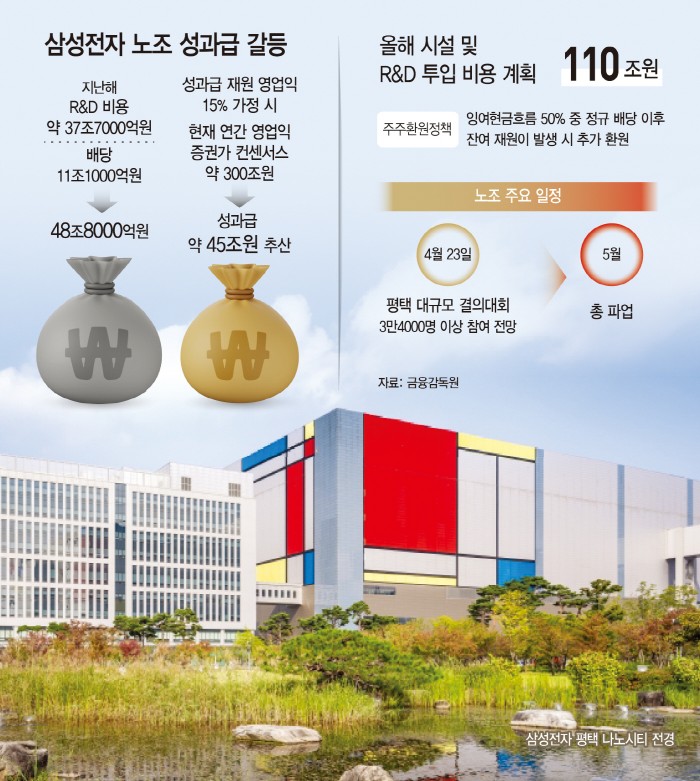 |
The labor union of Samsung Electronics has demanded performance bonuses equivalent to about 15% of operating profit, intensifying tensions ahead of a planned large-scale rally and possible strike.
According to industry sources on April 12, the union recently proposed setting the bonus pool at 40.5 trillion won, assuming annual operating profit of 270 trillion won. This corresponds to roughly 15% of operating earnings.
Market consensus estimates Samsung Electronics’ operating profit this year at around 297.5 trillion won, with some brokerages projecting figures exceeding 300 trillion won. If operating profit reaches 300 trillion won, the union’s demand would translate into a bonus pool of about 45 trillion won.
This figure is comparable to the company’s combined spending on research and development (R&D) and dividends last year. In 2025, Samsung Electronics spent approximately 37.7 trillion won on R&D and about 11.1 trillion won on dividends.
The company has already outlined plans to invest more than 110 trillion won this year in facilities and R&D, while also pursuing acquisitions in future growth sectors such as advanced robotics, med-tech, and automotive electronics. This highlights growing pressure to balance investment, shareholder returns, and employee compensation.
Samsung Electronics has also pledged to return 50% of its free cash flow to shareholders over three years, with additional returns if surplus funds remain after regular dividends. As a result, the union’s bonus demand may conflict with shareholder return policies.
As of the end of last year, Samsung Electronics had approximately 4.19 million retail shareholders, accounting for about 8% of South Korea’s population. These investors hold roughly 66% of the company’s total shares.
External risks further complicate the situation. While the global semiconductor industry is expected to grow through 2030, driven by the expansion of artificial intelligence, uncertainties remain. The ongoing Middle East conflict is increasing logistics costs, while supply disruptions of rare gases such as helium could raise production costs. Attacks on data centers in the region have also raised concerns about delays in global data center construction.
Despite these risks, industry observers emphasize that the semiconductor sector ultimately depends on technology and talent, underscoring the need for competitive compensation to retain skilled workers.
The union is also calling for the removal of bonus caps. A large-scale rally is scheduled for April 23 in Pyeongtaek, with more than 34,000 participants expected. The biggest concern is a potential general strike planned for May. If no agreement is reached by the end of April, disruptions to semiconductor production and damage to the company’s global credibility are anticipated.
#Samsung Electronics #labor union #bonus demand #operating profit #shareholders
Copyright by Asiatoday
Most Read
-
1
Kia Sportage outperforms Mazda CX-5 in German auto..

-
2
Houthis launch successive attacks on Saudi airport..

-
3
Saudi Arabia, Iran hold first diplomatic talks to..

-
4
U.S. deploys carrier, 10,000 more troops to Middle..

-
5
Saudi airport in Riyadh struck again, leaving at l..

-
6
Putin's ally visits China on the 8th ahead of APEC..

-
7
Chinese military support and training center opens..

PEOPLE






HEADLINE NEWS

-
Address : In-Young Bldg., 34, Uisadang-daero 1-gil, Yeongdeungpo-gu, Seoul
Copyright by ASIATODAY CO., LTD. All rights resereved