



China's Defense Ministry blasts Washington over latest arms deal with Taiwan
May 19, 2026, 09:44 am


The Defense Ministry of China has sharply criticized Taiwan’s arms procurement amid rising anxiety on the island over remarks by U.S. President Donald Trump suggesting that arms sales to Taiwan could be used as a bargaining chip. The statement can also be interpreted as a direct condemnation of the United States for selling weapons to Taiwan.
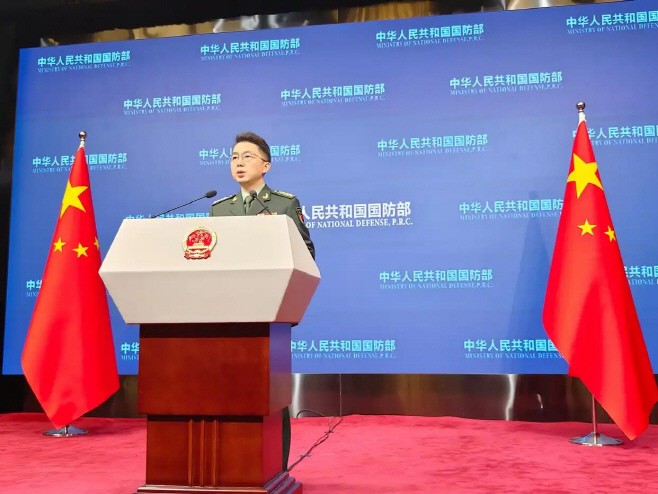 |
| China's Defense Ministry spokesperson Zhang Bin delivers a scathing rebuke aimed at both the United States and Taiwan over Washington's moves to sell weapons to Taipei. He went so far as to launch a fierce rhetorical attack, blasting the defense special budget of Taiwan’s ruling Democratic Progressive Party administration as a "vampire bill." / China's Ministry of National Defense |
During a regular press briefing on May 18, China's Defense Ministry spokesperson Zhang Bin expressed Beijing's stance on the defense special budget of Taiwan’s ruling Democratic Progressive Party (DPP) administration, stating, "This massive procurement of military supplies is nothing short of a 'vampire bill' through which the DPP authorities exploit the public and devastate people's livelihoods."
He further pointed out, "The DPP authorities are turning a blind eye to the hardships of the people and ignoring the reality that the island's youth do not wish to go to the battlefield for 'Taiwan independence.' Instead, they stubbornly use the public's blood, sweat, and tears to appease foreign forces, reducing themselves to an ATM for foreign arms dealers." He added, "Moreover, they advertise that 'the more money they spend, the safer they will be,' but their regression has failed to win the hearts of the people."
He also asserted, "Purchasing military hardware cannot buy safety. If you willingly become a pawn, you will ultimately find yourself hollowed out by exploitation," adding, "The reunification of the motherland and the great rejuvenation of the Chinese nation are the most solid guarantees for Taiwan."
Spokesperson Zhang then warned, "The more the DPP authorities seek independence through military force and rely on foreign powers for independence, the faster the demise of Taiwan independence will be accelerated."
Prior to this, President Trump remarked after the U.S.-China summit that arms sales to Taiwan serve as a "good bargaining chip" and revealed that he had discussed the issue of selling weapons to Taiwan with Chinese General Secretary and State President Xi Jinping. This naturally triggered a heightened sense of crisis in Taiwan.
In fact, Taiwanese President Lai Ching-te emphasized via social media on May 17, "With China refusing to renounce the annexation of Taiwan by force and continuously expanding its military power to alter the cross-strait status quo, it is necessary for the United States to continue selling weapons to Taiwan and deepening security cooperation. Furthermore, this is a core element in maintaining regional peace and stability."
Regarding President Xi's mention during the summit that the militaries of both nations should make better use of communication channels, Spokesperson Zhang expressed a relatively positive stance, noting, "The stable development of relations between the Chinese and U.S. militaries aligns with the shared interests of both sides. This is a universal expectation of the international community."
He also added, "We hope to push bilateral military relations to move forward steadily and far along a stable and positive trajectory, playing an active role for a bright future in bilateral relations as well as global peace and stability."
Most Read
-
1
Celltrion’s Omlyclo gains ground in major European..

-
2
Trump demands rates fall below 1% as Fed hikes for..

-
3
Trump makes $1 trillion bet ahead of midterm elect..

-
4
Iran resumes ballistic missile production, assembl..

-
5
Samsung Electronics, Mistral AI to jointly develop..

-
6
Trump warns countries not helping U.S. must pay re..

-
7
Apple launches first foldable, 1 million won prici..

PEOPLE






HEADLINE NEWS
- Trump to roll out ‘unprecedented welcome’ for Xi with B-2 bombers, F-22 fighters
- S. Korea, U.S., and Japan form united front on Taiwan and economic coercion..
- Trump administration moves to impose sweeping sanctions on International Cr..
- Xi to make state visit to U.S. Sept. 23-25, dispelling rumors over his heal..

-
Address : In-Young Bldg., 34, Uisadang-daero 1-gil, Yeongdeungpo-gu, Seoul
Copyright by ASIATODAY CO., LTD. All rights resereved