



Samsung rides chip super cycle, eyes global No.1 position
Apr 08, 2026, 08:27 am


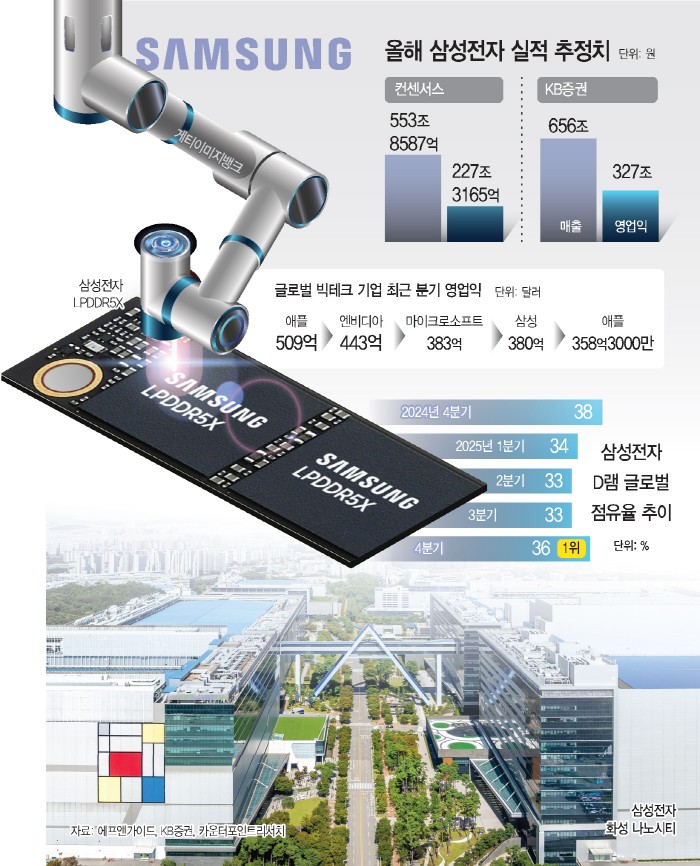 |
Samsung Electronics has posted a record-breaking first-quarter operating profit exceeding 50 trillion won, but analysts say this may only mark the beginning of a stronger earnings cycle.
With the semiconductor super cycle still not at its peak, expectations are rising that the company could continue breaking records throughout the year and potentially become the world’s top company by operating profit as early as 2027.
The expansion of AI data centers is expected to sustain strong demand for memory semiconductors, with supply struggling to keep pace. Samsung has further strengthened its momentum by expanding production and shipments of high-bandwidth memory (HBM).
According to market tracker FnGuide, Samsung’s operating profit is projected to remain above 50 trillion won in the second quarter and reach the 60 trillion won range in the third quarter. Given that first-quarter earnings exceeded forecasts by more than 40%, upward revisions to these estimates remain likely.
Some analysts suggest Samsung could become the world’s top company by operating profit next year. A report from KB Securities estimates Samsung’s operating profit at 488 trillion won, narrowing the gap with NVIDIA.
Despite this, Samsung’s market capitalization remains significantly lower—about 19% of Nvidia’s and 57% of TSMC—highlighting potential room for revaluation.
In the latest quarterly comparison among global tech giants, Samsung ranked among the top five, alongside companies such as Apple, Microsoft, and Alphabet.
Samsung continues to strengthen collaboration with global tech firms. Last month, it agreed to work with AMD on next-generation AI memory solutions and was selected as a primary supplier of HBM4 for AMD’s AI accelerators.
Discussions on foundry cooperation also signal potential improvement in its contract chip manufacturing business.
However, challenges remain. Labor disputes pose a near-term risk, with the company’s union planning a large-scale rally and potential general strike next month over disagreements on performance-based pay.
If realized, such actions could disrupt semiconductor production and affect external credibility.
Performance across business divisions also remains uneven. While the semiconductor division is estimated to have generated over 50 trillion won in operating profit, the mobile experience (MX) and network divisions are expected to post around 2 trillion won—roughly half of last year’s level.
Other segments, including TV and home appliances, are projected to see minimal profits or slight losses, while Harman and Samsung Display are expected to deliver modest gains.
As rising memory prices increase costs for other divisions, Samsung faces the challenge of narrowing the profitability gap across its businesses.
The company is set to release detailed divisional earnings on April 30.
#Samsung Electronics #semiconductor cycle #AI memory #HBM #Nvidia
Copyright by Asiatoday
Most Read
-
1
Kia Sportage outperforms Mazda CX-5 in German auto..

-
2
Houthis launch successive attacks on Saudi airport..

-
3
Saudi Arabia, Iran hold first diplomatic talks to..

-
4
U.S. deploys carrier, 10,000 more troops to Middle..

-
5
Saudi airport in Riyadh struck again, leaving at l..

-
6
Putin's ally visits China on the 8th ahead of APEC..

-
7
Chinese military support and training center opens..

PEOPLE






HEADLINE NEWS

-
Address : In-Young Bldg., 34, Uisadang-daero 1-gil, Yeongdeungpo-gu, Seoul
Copyright by ASIATODAY CO., LTD. All rights resereved