



Samsung Electronics strike deal eases crisis but exposes limits of labor mediation
May 22, 2026, 08:06 am


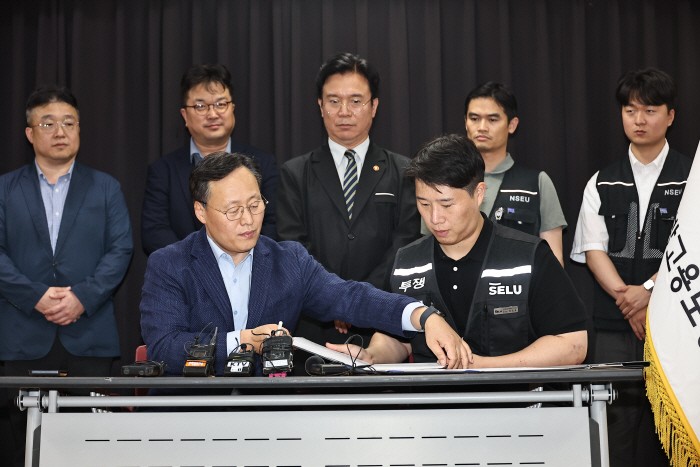 |
| Yeo Myung-gu, head of the People Team at Samsung Electronics’ Device Solutions division (right), and Choi Seung-ho, chief of the Samsung Electronics branch of the Samsung Group labor union, sign a tentative wage agreement during negotiations at the Gyeonggi Regional Employment and Labor Office in Suwon on May 20. /Pool photo |
A tentative agreement between management and labor at Samsung Electronics has temporarily defused the threat of a general strike, but the dispute has also exposed growing challenges for South Korea’s existing labor mediation framework in handling conflicts at major corporations.
As compensation structures, including bonus formulas and distribution standards, become central bargaining issues, labor authorities are finding it increasingly difficult to resolve disputes through traditional wage increase-focused negotiations alone.
Samsung Electronics management and labor signed a tentative agreement for 2026 wage negotiations on May 20 at the Gyeonggi Regional Employment and Labor Office in Suwon. The union suspended its planned general strike scheduled for May 21 and announced a membership vote on the agreement from May 22 to 27.
If approved, the agreement will end a labor dispute that has lasted more than five months since December last year.
However, the negotiation process proved highly difficult. Even after mediation by the National Labor Relations Commission was suspended, the two sides failed to narrow differences. Two rounds of follow-up mediation also ended without results.
A breakthrough only came after Kim Young-hoon personally stepped in to mediate during last-minute negotiations held just before the planned strike.
While the government succeeded in preventing a large-scale walkout, the case also revealed the limitations of the current formal mediation system in resolving labor disputes at large conglomerates.
Observers say the conflict demonstrated how labor negotiations at major companies are evolving beyond simple wage increase discussions into broader disputes over compensation structures.
The key issues in the Samsung Electronics talks included semiconductor division bonus pools, distribution methods among business units, penalties for underperforming divisions, and stock compensation plans.
Analysts warn that if demands tied to operating profit or business division performance become more common, wage negotiations could expand into debates over corporate investment resources, shareholder returns, and fairness between divisions.
Such changes would require labor mediators to handle far more complex conflicts than traditional wage-gap adjustments.
Park Ji-soon, a professor at Korea University School of Law, described the Samsung dispute as a “preview” of future labor-management conflicts.
“If traditional wage negotiations focused on salary increase rates, demands for a fixed percentage of operating profit represent an entirely different level of issue,” Park said.
He added that if performance-based compensation demands become institutionalized rather than one-time requests, they could significantly affect labor negotiations at other major corporations.
Experts say the broader question now is how far disputes over compensation systems should be recognized as legitimate subjects for collective bargaining and mediation by labor authorities.
Kim Deok-ho, a professor at Sungkyunkwan University, said questions remain over whether special management performance bonuses should formally qualify as bargaining subjects.
“This time, labor and management reached a voluntary agreement,” Kim said. “But if unions at other companies launch strikes over similar demands, disputes could arise over whether such issues qualify as legitimate bargaining topics or justified grounds for industrial action.”
Kim added that South Korea ultimately needs long-term discussions on a bargaining framework that reflects the realities of modern industrial ecosystems.
“Unless structural problems are properly addressed, negotiations will continue to end as temporary patchwork solutions,” he said.
#Samsung Electronics #labor union #strike #wage negotiations #compensation system
Copyright by Asiatoday
Most Read
-
1
Celltrion’s Omlyclo gains ground in major European..

-
2
Trump demands rates fall below 1% as Fed hikes for..

-
3
Hyundai Motor Group breaks ground on integrated st..

-
4
U.S. strikes 3 Iranian oil tankers, Iran vows reta..

-
5
Trump makes $1 trillion bet ahead of midterm elect..

-
6
Iran resumes ballistic missile production, assembl..

-
7
Samsung Electronics, Mistral AI to jointly develop..

PEOPLE







-
Address : In-Young Bldg., 34, Uisadang-daero 1-gil, Yeongdeungpo-gu, Seoul
Copyright by ASIATODAY CO., LTD. All rights resereved