



Gov't cracks down on housing fee fraud with permanent bans
May 21, 2026, 11:31 am


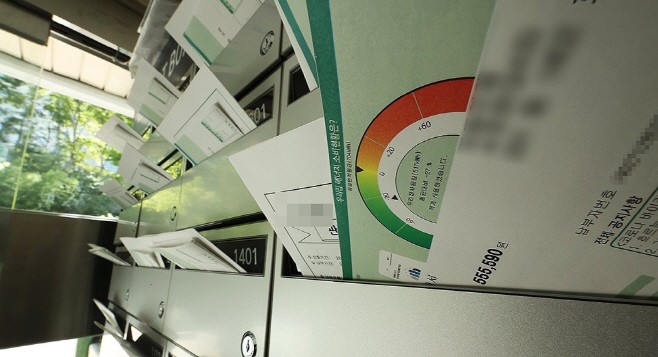 |
| An apartment management fee statement sits in a mailbox at a residential complex. / Photo courtesy of Yonhap News Agency |
The South Korean government will strengthen mandatory external financial audits and sharply increase criminal penalties to eradicate corruption linked to apartment maintenance fees. The move represents a comprehensive overhaul of the current oversight framework, specifically targeting non-transparent budget execution and the widespread abuse of non-competitive private contracts.
The Ministry of Land, Infrastructure and Transport (MOLIT) announced the measures on May 21 during a task force session focused on stabilizing consumer prices. The new regulatory guidelines will apply nationwide across all multi-family residential complexes, including high-rise apartments, townhouses, and multi-unit villas.
Under the new plan, the government will abolish an existing loophole that exempted residential complexes from mandatory external audits if a majority of residents agreed to waive the requirement. The policy reversal is intended to enhance financial transparency among property management firms and bolster routine oversight regarding how fees are utilized.
Administrative discipline for licensed property managers will also be severely tightened. Property managers who cause financial losses to residents or extract illicit profits through mismanagement will face the maximum administrative sanction—the immediate revocation of their professional licenses—effectively barring them permanently from the industry.
Furthermore, the government will raise the threshold for criminal penalties regarding maintenance fee violations. Property management personnel who fail to maintain financial ledgers or falsify account entries will face up to two years in prison or a maximum fine of 20 million won. Those who deny residents' requests to inspect or obtain copies of financial records will face up to one year in prison or a fine of up to 10 million won, while management entities that fail to disclose mandatory spending details will face administrative fines of up to 10 million won.
The bidding process for construction and service contracts within residential complexes will face stricter regulations as well. The government will restrict the scope of allowable non-competitive private contracts exclusively to emergency situations—such as natural disasters or critical safety hazards—and specialized projects requiring proprietary technology. Common service categories, including insurance procurement and mass-market consumer goods, will be barred from private contracting. Ongoing cleaning and security service agreements will only be eligible for private contract renewals under limited conditions that prioritize verified performance records.
Additionally, for restricted competitive bidding based on technical capabilities, management entities will be required to obtain prior consent from residents before applying patents or new proprietary technologies to a project.
This regulatory overhaul follows a joint investigation conducted by MOLIT and local municipal governments. Between March 25 and April 9, authorities executed on-site inspections across 19 residential complexes in 16 provinces and cities, evaluating compliance regarding fee disclosures, financial audits, and contractor selection processes.
The probe uncovered 57 violations, resulting in 38 cases of administrative guidance and correction orders, alongside 19 preliminary notifications for administrative fines. Notable infractions included prolonged delays or omissions in disclosing maintenance fee breakdown reports, external audit results, and service contracts. Investigators also documented instances where management offices failed to preserve financial ledgers, misappropriated maintenance funds for unauthorized purposes, or arbitrarily signed private agreements with firms that failed to meet the necessary legal criteria.
Most Read
-
1
Celltrion’s Omlyclo gains ground in major European..

-
2
Trump demands rates fall below 1% as Fed hikes for..

-
3
Hyundai Motor Group breaks ground on integrated st..

-
4
U.S. strikes 3 Iranian oil tankers, Iran vows reta..

-
5
Trump makes $1 trillion bet ahead of midterm elect..

-
6
Iran resumes ballistic missile production, assembl..

-
7
Samsung Electronics, Mistral AI to jointly develop..

PEOPLE







-
Address : In-Young Bldg., 34, Uisadang-daero 1-gil, Yeongdeungpo-gu, Seoul
Copyright by ASIATODAY CO., LTD. All rights resereved