



Blue House hopes rumored Xi visit will promote peninsula peace
May 21, 2026, 09:45 am


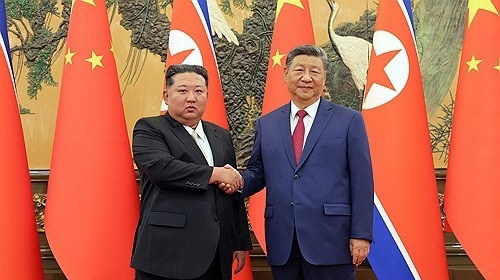 |
| North Korean Leader Kim Jong-un, who visited China to attend the military parade marking the 80th anniversary of Victory Day, held a bilateral summit with Chinese President Xi Jinping on the afternoon of September 4 last year, the Korean Central News Agency reported on September 5. / Yonhap News Agency |
The Blue House stated on May 21 that it is closely monitoring developments regarding Chinese President Xi Jinping’s potential visit to North Korea. As rumors of President Xi’s visit surface immediately following a US-China summit where North Korean nuclear issues were discussed, the Blue House appears to be carefully assessing the potential impact on the geopolitical landscape of the Korean Peninsula.
In a press notice released today, the Blue House conveyed this stance, saying, "The government hopes that exchanges between North Korea and China will develop in a direction that contributes to peace and stability on the Korean Peninsula. We expect China to continue playing a constructive role in resolving peninsular issues."
Diplomatic circles have speculated that President Xi could visit North Korea as early as next week. However, no official announcement regarding the visit has been made so far.
President Xi recently discussed North Korean nuclear issue during a summit with US President Donald Trump. The White House released a fact sheet on May 17 following the US-China summit, confirming that the two leaders reaffirmed their shared commitment to the denuclearization of North Korea.
Against this backdrop, diplomatic observers suggest that if President Xi’s visit materializes, China could position itself as a mediator, coinciding with a momentum to revive US-North Korea dialogue.
Conversely, some analysts caution that closer ties between Pyongyang and Beijing could introduce a new variable into denuclearization talks and the existing pressure campaign against North Korea. This implies that President Xi’s visit could transcend a simple bilateral exchange and significantly reshape both US-China relations and the broader dynamics of the Korean Peninsula.
Most Read
-
1
Trump demands rates fall below 1% as Fed hikes for..

-
2
Celltrion seeks rheumatoid arthritis indication ex..

-
3
Chinese e-commerce giants AliExpress, Temu and She..

-
4
Trump warns countries not helping U.S. must pay re..

-
5
Turkish Airlines named main club partner of Liverp..

-
6
China expels No. 2 military official Zhang Youxia..

-
7
Houthi rebels release video claiming downing of Sa..

PEOPLE







-
Address : In-Young Bldg., 34, Uisadang-daero 1-gil, Yeongdeungpo-gu, Seoul
Copyright by ASIATODAY CO., LTD. All rights resereved