



US envoy nominee Steel vows to boost alliance, urges equal treatment for US firms
May 21, 2026, 11:45 am


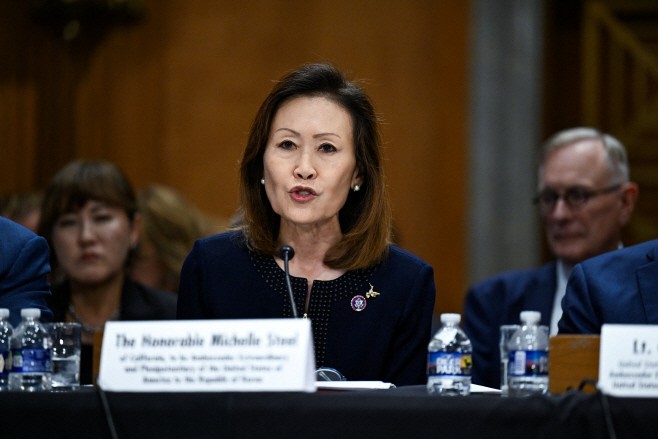 |
| Michelle Steel, the nominee for U.S. Ambassador to South Korea, testifies during her confirmation hearing before the Senate Foreign Relations Committee on Capitol Hill in Washington, D.C., on May 20 (local time). / Reuters-Yonhap News Agency |
Michelle Steel, the nominee for U.S. Ambassador to South Korea, testified during her confirmation hearing before the Senate Foreign Relations Committee on May 20 (local time) that American companies operating in South Korea must receive equal market access to their domestic competitors, vowing to address discrimination concerns faced by U.S. technology firms such as Coupang.
Steel expressed intentions to thoroughly review the funding mechanisms and implementation strategies of South Korea's planned 350 billion dollar investment in the United States. She also emphasized the critical necessity of reinforcing the Washington-Seoul alliance and trilateral cooperation among the U.S., South Korea, and Japan to counter North Korea's illicit weapons programs, expanding cybercrimes, and deepening military alignment with Russia.
Nominated by U.S. President Donald Trump on April 13, Steel requires formal confirmation from both the Senate Foreign Relations Committee and the full Senate chamber before assuming her post. The position of U.S. Ambassador to South Korea has remained vacant for over a year following the departure of former Ambassador Philip Goldberg in January last year.
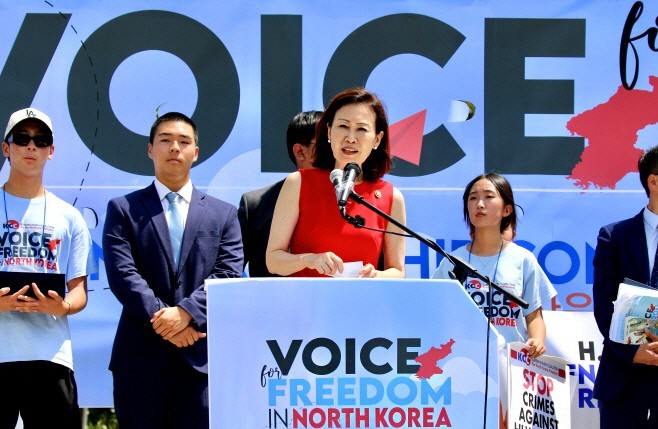 |
| Then-U.S. Representative Michelle Steel, a Republican who was later nominated as U.S. Ambassador to South Korea on April 13, delivers a speech during a "North Korea Freedom Week" event in front of the U.S. Capitol building in Washington, D.C., on July 10, 2024. / Photo by Washington Correspondent Ha Man-joo |
Steel cites summit pact to push for lifting barriers on US firms in Korea
During the confirmation hearing on Capitol Hill, U.S. Senator Bill Hagerty (R-TN) raised concerns regarding the potential discrimination faced by American technology firms, such as Coupang, in South Korea. In response, Ambassador nominee Michelle Steel referenced the joint fact sheet agreed upon by South Korean President Lee Jae-myung and U.S. President Donald Trump in late October last year.
"The joint fact sheet explicitly states that American companies must not face discrimination and will not encounter unnecessary regulatory barriers," Steel testified. "If confirmed, I will ensure that this commitment is strictly upheld."
Steel emphasized the principle of reciprocity in bilateral commerce. "Just as all South Korean corporations operating in the United States receive equal treatment, American enterprises in South Korea must be granted the same level of treatment as their domestic counterparts," she noted. In her opening remarks, she similarly pointed out that American firms doing business in South Korea deserve identical market access to what South Korean companies enjoy in the United States.
Senator Hagerty expressed deep concern over the operational environment for U.S. firms, urging Steel to remain vigilant so that American companies do not face discriminatory disadvantages compared to either domestic South Korean corporations or Chinese competitors.
Additionally, Senator Hagerty highlighted a multi-billion-dollar critical minerals investment project being pursued in his home state of Tennessee by the South Korean non-ferrous metal smelting company Korea Zinc. He requested that Steel treat the initiative as a top priority and provide the necessary diplomatic support. Steel responded that she would fully support the project upon her formal confirmation.
Hagerty warns of tech bias, urges support for Korea Zinc's investment
Senator Hagerty expressed deep concern over the operational environment for U.S. firms, urging Steel to remain vigilant so that American companies do not face discriminatory disadvantages compared to either domestic South Korean corporations or Chinese competitors.
Additionally, Senator Hagerty highlighted a multi-billion-dollar critical minerals investment project being pursued in his home state of Tennessee by the South Korean non-ferrous metal smelting company Korea Zinc. He requested that Steel treat the initiative as a top priority and provide the necessary diplomatic support. Steel responded that she would fully support the project upon her formal confirmation.
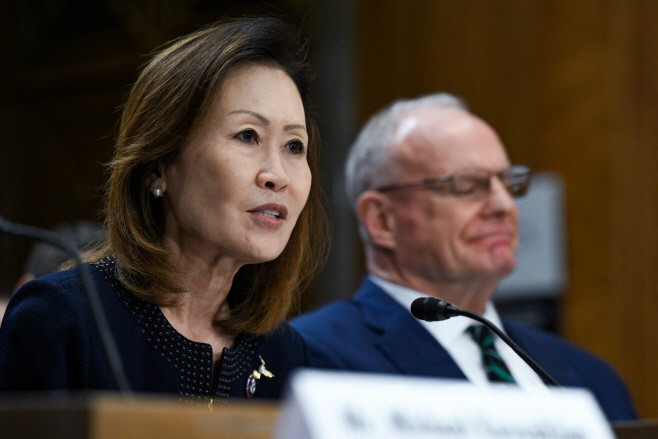 |
| Michelle Steel, the nominee for U.S. Ambassador to South Korea, testifies during her confirmation hearing before the Senate Foreign Relations Committee on Capitol Hill in Washington, D.C., on May 20 (local time). / Reuters-Yonhap News Agency |
Steel to scrutinize Korea's $350B investment plan, seek boost in US exports to slash trade deficit
Ambassador nominee Michelle Steel indicated a need to thoroughly review South Korea's planned 350 billion dollar investment in the United States, stating, "I want to see exactly where that is coming from," to examine the funding sources and specific implementation strategies.
Senator Jeanne Shaheen (D-NH) also pointed out that the precise allocation of the investment remains unclear and requested that the details be transparently shared with the Senate Foreign Relations Committee, to which Steel agreed.
Noting that South Korea's trade surplus with the United States has surpassed 50 billion dollars, Steel pledged to explore avenues to increase American exports to South Korea if confirmed.
Senator Pete Ricketts (R-NE) raised concerns regarding South Korea's non-tariff barriers on American agricultural products and the reduction of tariff-rate quota (TRQ) volumes for U.S. soybeans, demanding that Seoul honor its commitments to ease these barriers. Steel responded, "If confirmed, I will discuss this directly with the South Korean government and relevant trade officials."
Citing parents' escape from North Korea, Steel stresses US-South Korea-Japan alignment to defend Indo-Pacific
When asked by the committee's ranking Republican, Senator James Risch (R-ID), about the stark contrast between the two Koreas and Pyongyang's pressure on Seoul, Steel shared her personal background. "Both of my parents fled communism in North Korea and lost everything there," Steel said, adding, "We all know how much people suffer in North Korea." In her opening statement, she emphasized that her parents were able to rebuild their lives in war-torn South Korea because more than 36,000 American service members sacrificed their lives to defend freedom.
Steel evaluated President Trump's state visit to Gyeongju in 2025 as opening a "historic new chapter" for the Washington-Seoul alliance, noting that the 2025 US-ROK joint fact sheet represents a "once-in-a-generation upgrade" in security cooperation. She explained that under this framework, South Korea agreed to expand its defense spending and reinforce joint deterrence capabilities.
Highlighting that the United States and South Korea are closely coordinating responses to North Korea's illicit weapons programs, expanding cybercrimes, and deepening military alignment with Russia, Steel emphasized that trilateral cooperation with Japan remains essential to maintaining a free and open Indo-Pacific. "This is not just about protecting South Korea; it is about protecting the entire Indo-Pacific region," she added.
Born in Seoul in 1955 and immigrating to the United States in 1975, Steel served on the California State Board of Equalization and as an Orange County Supervisor before serving four years as a Republican member of the U.S. House of Representatives starting in 2021.
In her opening remarks, Steel quoted the Korean proverb, "Go-saeng kkeut-e nag-i onda" (No pain, no gain), noting that for someone whose third language is English—after Korean and Japanese—to represent a congressional district in the Capitol is something "only possible in a country like America."
Most Read
-
1
Celltrion’s Omlyclo gains ground in major European..

-
2
Trump demands rates fall below 1% as Fed hikes for..

-
3
Trump makes $1 trillion bet ahead of midterm elect..

-
4
Iran resumes ballistic missile production, assembl..

-
5
Samsung Electronics, Mistral AI to jointly develop..

-
6
Trump warns countries not helping U.S. must pay re..

-
7
Apple launches first foldable, 1 million won prici..

PEOPLE





HEADLINE NEWS
- Trump to roll out ‘unprecedented welcome’ for Xi with B-2 bombers, F-22 fighters
- S. Korea, U.S., and Japan form united front on Taiwan and economic coercion..
- Trump administration moves to impose sweeping sanctions on International Cr..
- Xi to make state visit to U.S. Sept. 23-25, dispelling rumors over his heal..

-
Address : In-Young Bldg., 34, Uisadang-daero 1-gil, Yeongdeungpo-gu, Seoul
Copyright by ASIATODAY CO., LTD. All rights resereved