



US-Iran tensions escalate as Trump orders naval blockade
Apr 13, 2026, 08:54 am


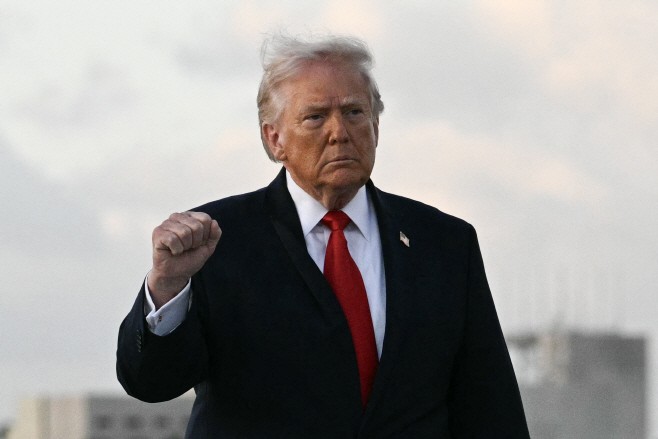 |
| U.S. President Donald Trump arrives at Miami International Airport in Florida on April 11. / AFP-Yonhap News |
Donald Trump warned that he had instructed the U.S. Navy to immediately begin procedures for a blockade of the Strait of Hormuz, placing a fragile two-week ceasefire between the United States and Iran at risk just five days after it was agreed.
Trump’s directive represents a “reverse thinking” strategy—turning Iran’s longstanding threat to block the strait into a tool against Tehran—aimed at forcing Iran to comply with U.S. demands.
The Islamic Revolutionary Guard Corps (IRGC) quickly warned of military retaliation, while Iran’s chief negotiator and parliamentary speaker Mohammad Bagher Ghalibaf declared, “If they start a fight, we will fight,” signaling a hardline stance.
‘Reverse blockade’ declared on Truth Social
Trump announced the move via his social media platform Truth Social, stating that “the world’s most powerful U.S. Navy will immediately begin blockade procedures for all vessels entering or leaving the Strait of Hormuz.”
The measure effectively mirrors Iran’s own strategy since the outbreak of the conflict, but in reverse—using U.S. naval power to simultaneously cut off Iran’s oil exports and restrict the inflow of external supplies needed for its war effort.
Hours before the announcement, Trump had already hinted at the possibility by sharing an article suggesting that a naval blockade could be used if Iran refused to yield.
The move is widely interpreted as part of a “maximum pressure” negotiation strategy targeting Iran, particularly as Tehran has not fully reopened the strait despite the ceasefire agreement.
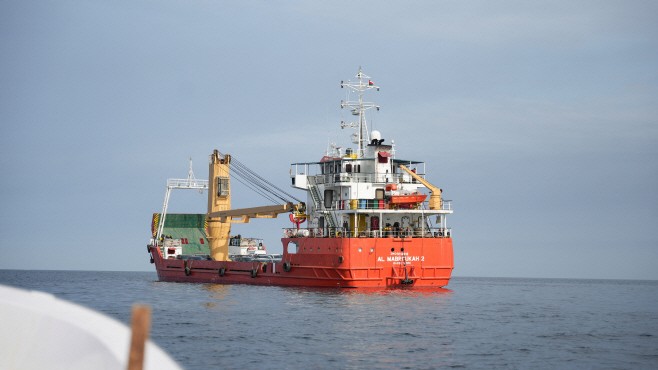 |
| A vessel sails through the Strait of Hormuz off the coast of Musandam, Oman, on April 12. / Reuters-Yonhap News |
Trump says Iran will concede, criticizes allies and warns China
Donald Trump said the planned blockade of the Strait of Hormuz would be implemented soon, despite requiring some time to carry out.
In a phone interview with Fox News, Trump stated, “It will take a little while, but it will happen soon,” adding, “It won’t take long to clean up the strait.”
He expressed confidence that Iran would ultimately comply, saying, “Iran has not left the negotiating table and will come back and give us everything we want. They have no cards.”
Trump also explained the breakdown of ceasefire negotiations held over 21 hours in Islamabad, Pakistan, saying that while talks had been “very friendly” toward the end and most U.S. demands were met, Iran’s refusal to abandon its nuclear ambitions remained the key obstacle.
He added that the U.S. had deployed mine-clearing vessels and that the United Kingdom and other allies were sending additional support.
At the same time, Trump criticized allies including Japan and South Korea, noting their heavy reliance on oil transported through the Strait of Hormuz—93% for Japan and 45% for South Korea—while claiming they had not provided sufficient assistance when requested.
When asked whether a proposed 50% tariff on countries supplying weapons to Iran was aimed at China, Trump replied, “Yes. It includes other countries, but if China is identified, then yes.”
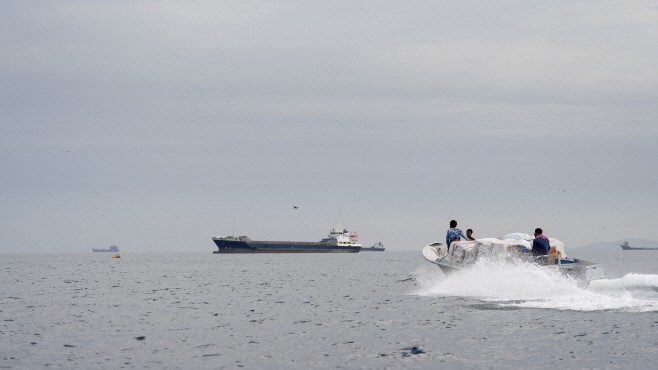 |
| Ships and boats sail through the Strait of Hormuz off the coast of Musandam, Oman, on April 12. / Reuters-Yonhap News |
Iran warns of retaliation as tensions escalate over Hormuz
Mohammad Bagher Ghalibaf said distrust toward the United States has built up over decades, blaming Washington for the collapse of ceasefire negotiations and warning of firm retaliation.
After returning from talks, Ghalibaf told reporters that Iran had never trusted the United States, adding that “our distrust has been built over 77 years.” He accused Washington of attacking Iran twice during less than a year of negotiations and said, “It is not Iran but the United States that must restore trust.”
He argued that Iran had presented constructive proposals but that a lack of sincerity from the U.S. side prevented progress. Responding to threats from Donald Trump, Ghalibaf said, “Such threats will have no impact on the Iranian people,” emphasizing that Iran has endured full-scale military threats, economic sanctions, and political pressure without yielding.
“If the United States starts a fight, we will fight. If it comes with logic, we will respond with logic,” he added.
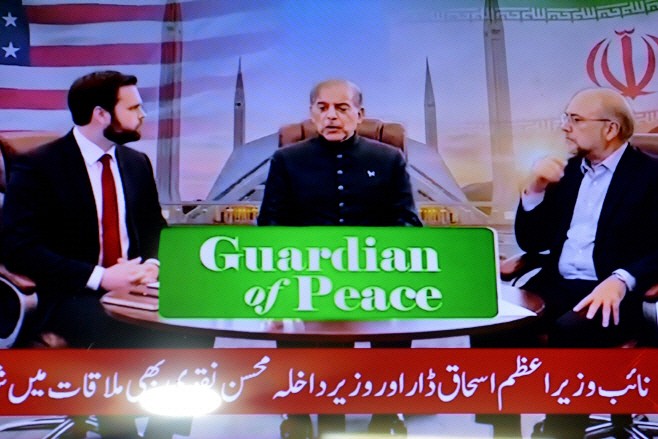 |
| U.S. Vice President J.D. Vance (left) and Iranian parliament speaker Mohammad Bagher Ghalibaf (right) hold ceasefire talks mediated by Pakistani Prime Minister Shehbaz Sharif at a hotel in Islamabad on April 11. / EPA-Yonhap News |
IRGC warns of ‘vortex of death’
The Islamic Revolutionary Guard Corps (IRGC) issued a stark warning, stating that all maritime traffic in the Strait of Hormuz is under full Iranian control.
According to IRGC-affiliated media, the navy command warned that “if enemies make even a single miscalculation, the strait will become a ‘vortex of death’ that swallows them.”
The IRGC released footage showing vessels targeted through crosshairs and declared that any approach by foreign warships would be treated as a violation of the ceasefire.
A naval blockade, typically used in wartime to cut off supply routes, raises the risk of direct confrontation between U.S. and Iranian forces. At the same time, it could drive global oil prices higher by restricting Iran’s exports.
With oil prices already having surged more than 60% since the conflict began in March, analysts warn the move could also impose economic costs on the United States.
Ghalibaf concluded that if Washington seeks an exit, “the only path is to gain the trust of the Iranian people,” adding that the U.S. now faces the burden of correcting past mistakes.
#Donald Trump #Strait of Hormuz #Iran #US Navy #oil prices
Copyright by Asiatoday
Most Read
-
1
Celltrion’s Omlyclo gains ground in major European..

-
2
Trump demands rates fall below 1% as Fed hikes for..

-
3
Trump makes $1 trillion bet ahead of midterm elect..

-
4
Iran resumes ballistic missile production, assembl..

-
5
Samsung Electronics, Mistral AI to jointly develop..

-
6
Trump warns countries not helping U.S. must pay re..

-
7
Apple launches first foldable, 1 million won prici..

PEOPLE






HEADLINE NEWS
- Trump to roll out ‘unprecedented welcome’ for Xi with B-2 bombers, F-22 fighters
- S. Korea, U.S., and Japan form united front on Taiwan and economic coercion..
- Trump administration moves to impose sweeping sanctions on International Cr..
- Xi to make state visit to U.S. Sept. 23-25, dispelling rumors over his heal..

-
Address : In-Young Bldg., 34, Uisadang-daero 1-gil, Yeongdeungpo-gu, Seoul
Copyright by ASIATODAY CO., LTD. All rights resereved