



Trump rejects Iran deal, insists on nuclear precondition
Apr 29, 2026, 09:21 am


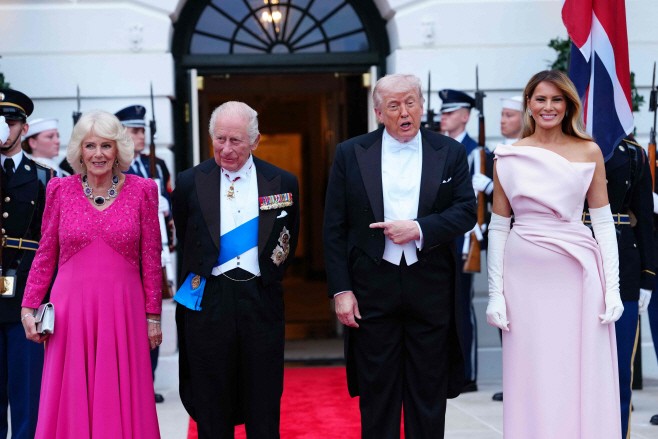 |
| Donald Trump (second from right) and First Lady Melania Trump (right) speak with Charles III (second from left) and Queen Camilla ahead of a state dinner in the East Room of the White House in Washington, D.C., on April 28. / AFP-Yonhap |
U.S. President Donald Trump said on April 28 that Iran had informed Washington it was in a “state of collapse,” as his administration maintained its demand that nuclear issues be resolved before any broader agreement—rejecting Tehran’s proposal for a phased deal.
The U.S. Treasury Department simultaneously escalated pressure by sanctioning 35 entities and individuals linked to Iran’s shadow financial network and warning against payments related to transit through the Strait of Hormuz.
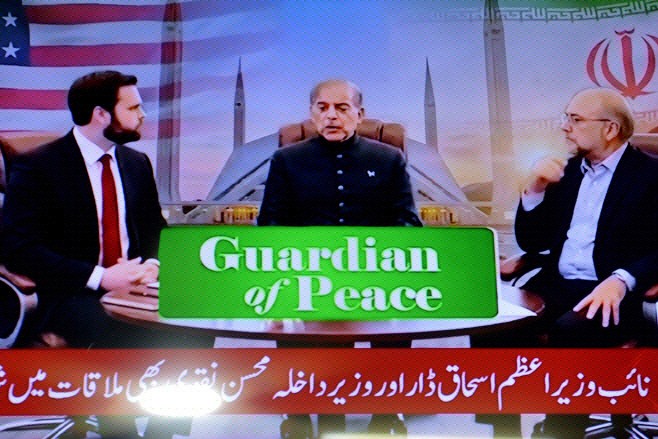 |
| U.S. Vice President J.D. Vance (left) and Iranian Parliament Speaker Mohammad Bagher Ghalibaf (right) hold ceasefire talks mediated by Pakistani Prime Minister Shehbaz Sharif at a hotel in Islamabad, Pakistan, on April 11, as captured from a TV screen. / EPA-Yonhap |
According to Reuters, Iran submitted a three-stage proposal via Pakistan that includes ending the war, lifting the U.S. maritime blockade, and then negotiating its nuclear program—mirroring the structure of the 2015 JCPOA.
However, the Trump administration views the nuclear issue as a core precondition for any agreement. Trump reportedly expressed dissatisfaction with Iran’s proposal during a national security meeting, according to The New York Times.
U.S. Secretary of State Marco Rubio said the proposal was “better than expected,” but questioned whether the Iranian representatives had the authority to negotiate, highlighting U.S. skepticism over internal divisions in Tehran.
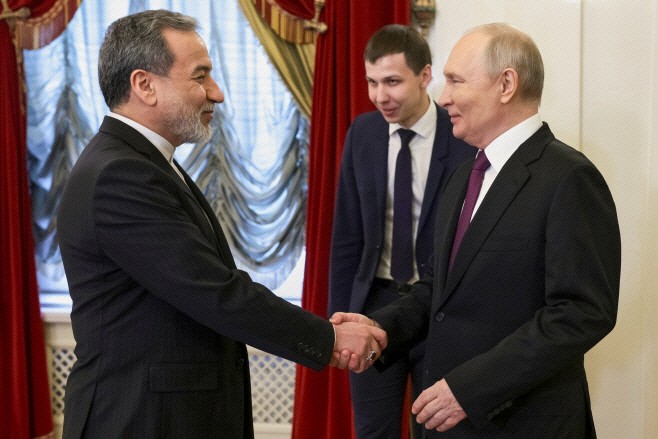 |
| Vladimir Putin (right) shakes hands with Iranian Foreign Minister Abbas Araghchi during a meeting at the Boris Yeltsin Presidential Library in St. Petersburg, Russia, on April 27. / AP-Yonhap |
The U.S. Treasury’s Office of Foreign Assets Control (OFAC) targeted a network accused of moving tens of billions of dollars to evade sanctions and support terrorism.
Treasury Secretary Scott Bessent warned that illicit funds flowing through this network pose a direct threat to U.S. interests and global stability.
OFAC also cautioned that financial institutions dealing with Chinese “teapot” refineries—major buyers of Iranian oil—could face significant sanctions risks. Payments to Iran or its military entities for safe passage through the Strait of Hormuz were also explicitly prohibited.
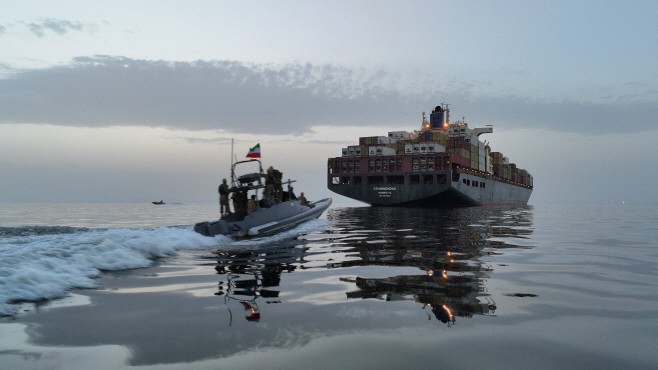 |
| An Iranian Revolutionary Guard Corps (IRGC) patrol boat seizes the Liberia-flagged vessel Epaminondas in the Strait of Hormuz on April 22. / Reuters-Yonhap |
Iran’s oil exports have sharply declined following a U.S.-led maritime blockade. Shipments fell to about 567,000 barrels per day between April 14 and 23, down 72% from February levels of 2 million barrels, according to The Wall Street Journal.
With limited storage capacity, Iran has resorted to reactivating outdated tanks and exploring rail exports to China.
Shipping traffic through the Strait of Hormuz has also plummeted, with only seven vessels passing in a recent 24-hour period—none carrying oil to international markets.
Analysts note an asymmetric balance of leverage in the conflict: Iran’s blockade of the Strait of Hormuz versus U.S. airstrikes.
Financial Times reported that Iran’s control over the strait provides stronger negotiating leverage, particularly as Trump has identified reopening the waterway as a key war objective.
At the same time, Iran may sustain a prolonged conflict by relying on oil revenues from China, supported by overland trade routes through Pakistan.
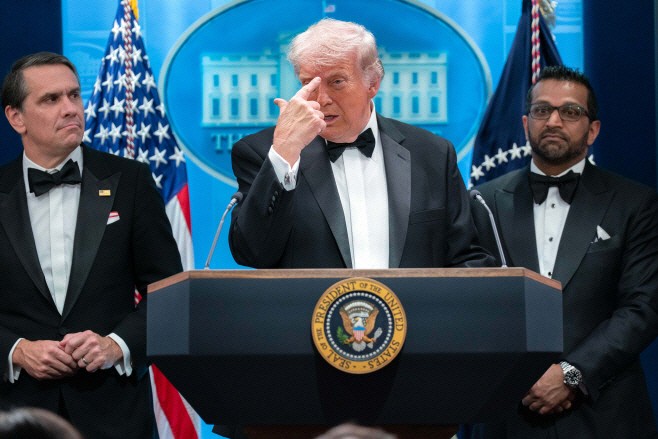 |
| Donald Trump (center) holds a press conference at the White House in Washington, D.C., on the evening of April 25 regarding a shooting incident that disrupted the White House Correspondents’ Association dinner, as Acting Attorney General Todd Blanche (left) and FBI Director Kash Patel look on. / AP-Yonhap |
U.S. intelligence agencies are now assessing how Iran might respond if Trump unilaterally declares victory, Reuters reported.
Early assessments suggest Iran could interpret a U.S. troop withdrawal as a victory for Tehran, while maintaining a U.S. presence would likely be seen as a negotiating tactic.
Trump’s domestic standing has weakened, with his approval rating falling to 34% in a Reuters/Ipsos poll. Only 26% of respondents said the military operation was worth its cost, and 25% believed it made the U.S. safer.
An aide cited by Axios described the current stalemate as “the worst possible scenario politically and economically” for Trump.
The conflict has entered a prolonged stalemate, described by The New York Times as a “No War, No Peace” situation, where neither side is willing to concede but both are avoiding full-scale escalation.
Amid this uncertainty, global energy markets remain volatile. The UAE has announced its withdrawal from OPEC, while Brent crude has risen for seven consecutive sessions, surpassing $111 per barrel.
#Trump #Iran #nuclear deal #sanctions #Hormuz Strait
Copyright by Asiatoday
Most Read
-
1
Trump shares map on social media labeling Strait o..

-
2
Kia Sportage outperforms Mazda CX-5 in German auto..

-
3
Houthis launch successive attacks on Saudi airport..

-
4
U.S. deploys carrier, 10,000 more troops to Middle..

-
5
Trump rejects Iran's offer to open Strait of Hormu..

-
6
N. Korea conducts first swarm attack drill with dr..

-
7
U.S.-China summit falls short on substance as Trum..

PEOPLE






HEADLINE NEWS
- Seoul dismisses Ukraine's claim of 'S. Korean support for Russia' as "inaccurate and inappropriate"
- S. Korea, Japan race to develop nuclear-powered submarines
- Henri Kagan, Kenso Soai win Nobel Prize in Chemistry for uncovering how mol..
- Vance says Alaska LNG cooperation will move forward with Seoul's current or..

-
Address : In-Young Bldg., 34, Uisadang-daero 1-gil, Yeongdeungpo-gu, Seoul
Copyright by ASIATODAY CO., LTD. All rights resereved