



Hyundai Motor Group posts record sales but split earnings
Apr 27, 2026, 08:08 am


 |
| /This image was generated using AI. |
Hyundai Motor Group reported record quarterly sales exceeding 102 trillion won, but its affiliates delivered sharply contrasting profit results, highlighting the growing importance of its “non-captive” strategy.
According to the Financial Supervisory Service on April 26, the group’s flagship automakers—Hyundai Motor Company and Kia Corporation—posted higher revenue but weaker profitability, while parts and logistics affiliates recorded both revenue and profit growth.
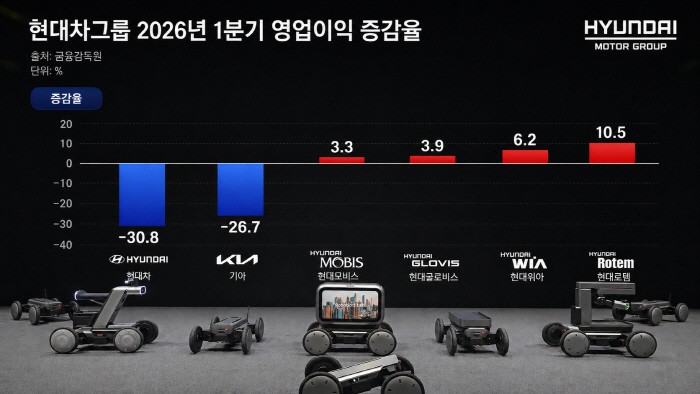
Hyundai Motor’s first-quarter revenue rose 3.4% year-on-year to 45.94 trillion won, but operating profit fell 30.8% to 2.51 trillion won. Kia reported a 5.3% increase in revenue to 29.50 trillion won, while its operating profit dropped 26.7% to 2.21 trillion won.
The decline in profitability was largely driven by higher cost of sales and tariff burdens. The group said additional costs from U.S. tariffs reached 860 billion won for Hyundai Motor and 755 billion won for Kia. Kia’s selling and administrative expense ratio also rose to 12.2%, up 1.2 percentage points from a year earlier, due to intensified competition in North America and Europe.
In contrast, Hyundai Motor Group’s affiliates—such as Hyundai Mobis, Hyundai Glovis, Hyundai Rotem, and Hyundai Wia—showed solid performance, supported by increased non-affiliate (non-captive) business.
Hyundai Mobis posted revenue of 15.56 trillion won and operating profit of 802.6 billion won, up 5.5% and 3.3% respectively. Growth was driven by expanded sales to global automakers and increased supply of high-value-added components.
Hyundai Glovis reported revenue of 7.81 trillion won, up 8.2%, and operating profit of 521.5 billion won, up 3.9%. Its shipping division stood out, with operating profit surging 40.5% thanks to increased high-margin non-affiliate cargo from Chinese automakers and improved fleet efficiency.
Hyundai Wia also improved its performance, with revenue rising 5.7% to 2.18 trillion won and operating profit increasing 6.2% to 51.6 billion won. While auto parts profit declined 9.7%, its defense and mobility solutions businesses saw a sharp 47.8% increase.
Hyundai Rotem managed to offset weakness in its railway and plant divisions with strong defense business growth. Revenue climbed 23.9% to 1.46 trillion won, and operating profit rose 10.5% to 224.2 billion won. Its defense segment alone recorded operating profit of 218.8 billion won, up 22.2% year-on-year.
An industry official said the group’s parts and logistics affiliates are moving away from reliance on internal demand and expanding third-party orders globally.
“As cost pressures and tariff burdens increase volatility in automakers’ earnings, diversifying external customers through a non-captive strategy will play a key role in stabilizing profitability,” the official said.
#Hyundai Motor Group #Hyundai Motor #Kia #Hyundai Mobis #Hyundai Glovis
Copyright by Asiatoday
Most Read
-
1
Kia Sportage outperforms Mazda CX-5 in German auto..

-
2
Houthis launch successive attacks on Saudi airport..

-
3
Saudi Arabia, Iran hold first diplomatic talks to..

-
4
U.S. deploys carrier, 10,000 more troops to Middle..

-
5
Saudi airport in Riyadh struck again, leaving at l..

-
6
Putin's ally visits China on the 8th ahead of APEC..

-
7
Chinese military support and training center opens..

PEOPLE






HEADLINE NEWS

-
Address : In-Young Bldg., 34, Uisadang-daero 1-gil, Yeongdeungpo-gu, Seoul
Copyright by ASIATODAY CO., LTD. All rights resereved