



"AI factory transition isn't just for conglomerates"—POSCO to make bold move to expand DX for SMEs
May 19, 2026, 11:22 am


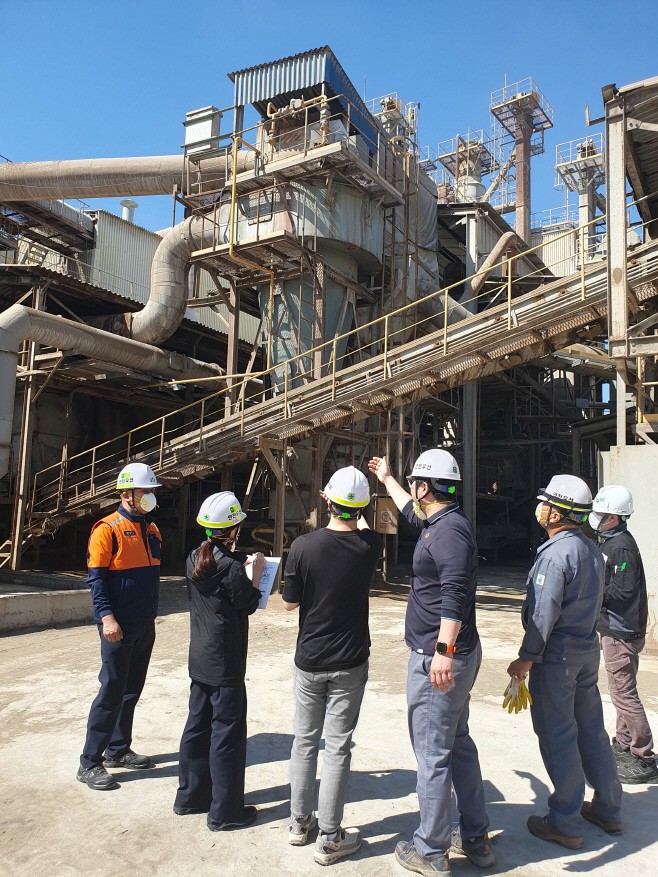 |
| Members of the POSCO Corporate Social Responsibility Joint Growth Task Force conduct an on-site consultation at a factory operated by Hankook Hyubwha, a participant in the smart factory construction support project designed for mutually beneficial cooperation between conglomerates and SMEs. / Courtesy of POSCO |
POSCO is accelerating its support for the artificial intelligence (AI)-driven production transition of small and medium-sized manufacturing enterprises. Moving beyond merely establishing smart factories, the steelmaker is advancing its support to integrate AI technologies directly into manufacturing sites. This strategy aims to expand the wave of manufacturing AI transformation, which has been largely centered around major conglomerates, to the SME sector.
POSCO announced on May 19 that it will open applications for the "Smart Factory Construction Support Project for Mutually Beneficial Cooperation between Large Enterprises and SMEs" on May 20, in partnership with the Ministry of SMEs and Startups. Since 2019, POSCO has contributed a cumulative 12 billion won to its mutual cooperation fund, supporting a total of 632 smart factory projects to date.
The distinguishing feature of this initiative is that it goes beyond simple equipment provision to actively drive digital transformation (DX) across the entire manufacturing field. POSCO’s dedicated internal task force, the Corporate Social Responsibility Joint Growth Task Force, provides close, hands-on assistance throughout the entire process, from planning the smart factory infrastructure to stabilizing the systems. This task force consists of experts possessing an average of over 25 years of on-site experience.
In line with the current manufacturing AI transformation (AX) trend, POSCO has newly introduced an "AI Track" starting this year. This expands the scope of support past conventional automation and digitalization, enabling the application of AI technologies to production, quality control, and logistics management.
Industry analysts note that as competition in manufacturing AI intensifies, the pace of digital transformation among SMEs could determine broader industrial competitiveness. While large corporations possess the internal capital to invest, small and medium manufacturers inevitably face a slower transition to AI due to financial and staffing constraints.
In practice, participating companies are already seeing tangible productivity improvements. Seil Jungki, a non-ferrous metal equipment manufacturer, upgraded its Enterprise Resource Planning (ERP) and Manufacturing Execution System (MES) networks, reducing manufacturing lead time by five days and lowering its finished product defect rate by 0.69 percentage points.
Daechun, a marine vessel parts manufacturer, introduced an ICT-based automated warehouse management system, cutting product shipment times by 23%. The company explained that this simultaneously reduced logistics costs and improved production efficiency.
POSCO is also expanding its financial support mechanisms. In addition to its existing low-interest loan fund and Steel ESG Joint Growth Fund, the company has been co-operating a 4000 billion won "Steel Supply Chain Stabilization Fund" with the Korea Trade Insurance Corporation and IBK Industrial Bank of Korea since January this year. As a result, POSCO's total financial support for small, medium, and mid-market steel trading partners has expanded to approximately 1 trillion won.
Industry observers evaluate that POSCO is moving beyond its traditional role as a steel producer to strengthen the competitiveness of its entire supply chain. A steel industry official commented, "While previous smart factory initiatives focused primarily on automation, the focus has now shifted to optimizing production through AI." He added, "The speed at which small and medium partners adopt manufacturing AI is highly likely to dictate the competitiveness of the entire industrial ecosystem."
A POSCO official stated, "We are facilitating the substantial growth of domestic small and medium enterprises through various joint growth initiatives, including supporting the construction of smart factories and providing financial assistance to steel trading partners." The official added, "We will continue to strengthen mutually beneficial cooperation between large enterprises and SMEs to help elevate the overall competitiveness of domestic industry."
Most Read
-
1
Kia Sportage outperforms Mazda CX-5 in German auto..

-
2
Houthis launch successive attacks on Saudi airport..

-
3
Saudi Arabia, Iran hold first diplomatic talks to..

-
4
U.S. deploys carrier, 10,000 more troops to Middle..

-
5
Saudi airport in Riyadh struck again, leaving at l..

-
6
Putin's ally visits China on the 8th ahead of APEC..

-
7
Chinese military support and training center opens..

PEOPLE






HEADLINE NEWS

-
Address : In-Young Bldg., 34, Uisadang-daero 1-gil, Yeongdeungpo-gu, Seoul
Copyright by ASIATODAY CO., LTD. All rights resereved