



Trump says Israel-Hezbollah halted fire, defusing Iran talk crisis
Jun 02, 2026, 09:26 am


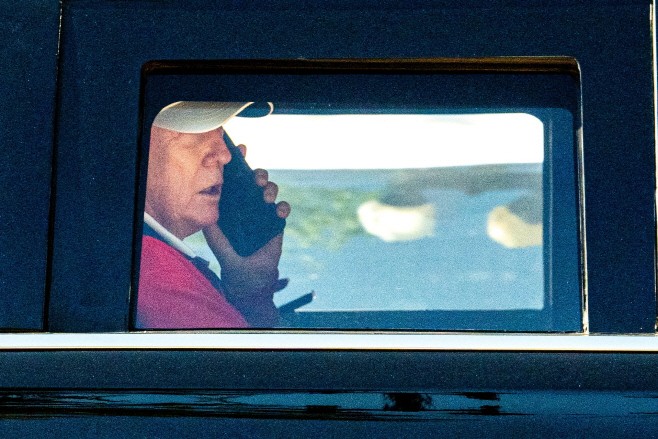 |
| U.S. President Donald Trump speaks on the phone as he departs the White House for Trump National Golf Club in Sterling, Virginia on May 31 (local time). / Photo via Reuters, Yonhap News |
U.S. President Donald Trump announced on June 1 (local time) that Israel and the pro-Iranian Lebanese militant group Hezbollah have agreed to a mutual cessation of hostilities.
The announcement came immediately after Iranian media reported that Tehran had decided to halt its exchange of peace negotiation messages with the U.S., citing Israel's air strikes on Lebanon.
President Trump also noted that talks with Iran are "moving forward at a very fast pace." While the Lebanese front has emerged as a new variable in the negotiations for a U.S.-Iran peace memorandum of understanding (MOU), oil prices pared gains after surging intra-day, and Wall Street hit record highs driven by gains in tech stocks.
Trump: "No Israeli troops entering Beirut, Hezbollah agrees to cease fire"; Lebanon confirms acceptance of U.S. proposal
"Just had a very productive call with Prime Minister Benjamin Netanyahu of Israel," President Trump stated on his social media platform Truth Social on the day. "There will be no troops heading toward Beirut. Any troops currently on the move have already been turned back."
President Trump further shared, "We also had a very good call with Hezbollah through top representatives. They have agreed to stop all firing. Israel will not attack them, and they will not attack Israel."
Reuters reported that there is no precedent for a U.S. president speaking directly with Hezbollah, an organization designated as a terrorist group by the United States.
The Lebanese Embassy in the U.S. stated that President Trump informed Lebanese Ambassador to the U.S. Nada Hamadeh that Prime Minister Netanyahu had accepted a new ceasefire framework, which Ambassador Hamadeh subsequently conveyed to Lebanese President Joseph Aoun, according to the AP. The embassy explained that the framework involves trading a halt to Hezbollah's attacks on Israel for a cessation of Israeli air strikes on Beirut's southern suburbs, with plans to later expand the truce nationwide across Lebanon.
However, the Times of Israel (TOI) analyzed that the Lebanese statement specifically limited Israel's cessation of air strikes to Beirut's southern suburbs while noting a countrywide ceasefire was merely "scheduled for expansion," thereby leaving room for the Israeli military to potentially continue operations in southern Lebanon.
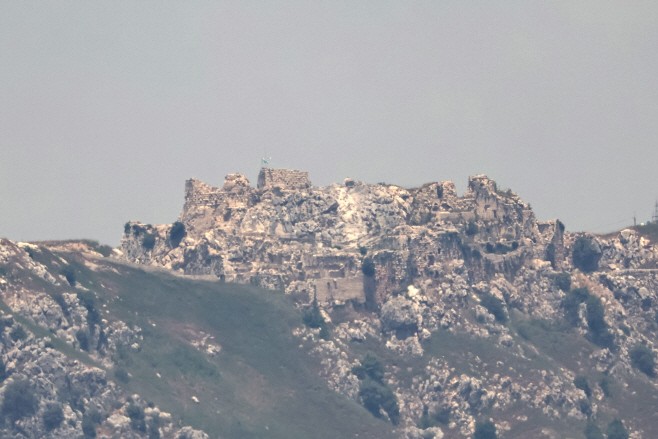 |
| The Crusader-era Beaufort Castle, controlled by the Israeli military, is seen from the Israeli side of the Upper Galilee border in northern Israel on June 1 (local time). / Photo via EPA, Yonhap News |
Netanyahu: "If attacks don't stop, we will strike Beirut"; Reuters reports hostilities continued after announcement
Following his call with President Trump, Prime Minister Netanyahu stated via a prime minister's office statement, "I told President Trump that if Hezbollah does not stop attacking our cities and citizens, Israel will strike terrorist targets in Beirut. Our position on this matter remains unchanged." He further emphasized, "The Israeli military will continue its operations in southern Lebanon as planned."
In regard to this, the AP noted that Prime Minister Netanyahu framed the statement as a warning rather than an expression of restraint, while TOI analyzed that the statement, coming roughly two hours after President Trump's ceasefire announcement, supports claims that the agreement was forced upon the Israeli government by the U.S. administration. Reuters reported that Israeli air strikes in southern Lebanon and Hezbollah attacks on Israeli forces continued even after President Trump's announcement.
The AP reported that Israel and Lebanon are scheduled to hold a fifth round of supplementary negotiations in Washington, D.C., from June 2 to 3 to discuss expanding the non-attack zones. The conflict has left 3,433 people dead and displaced over 1 million in Lebanon, the AP added.
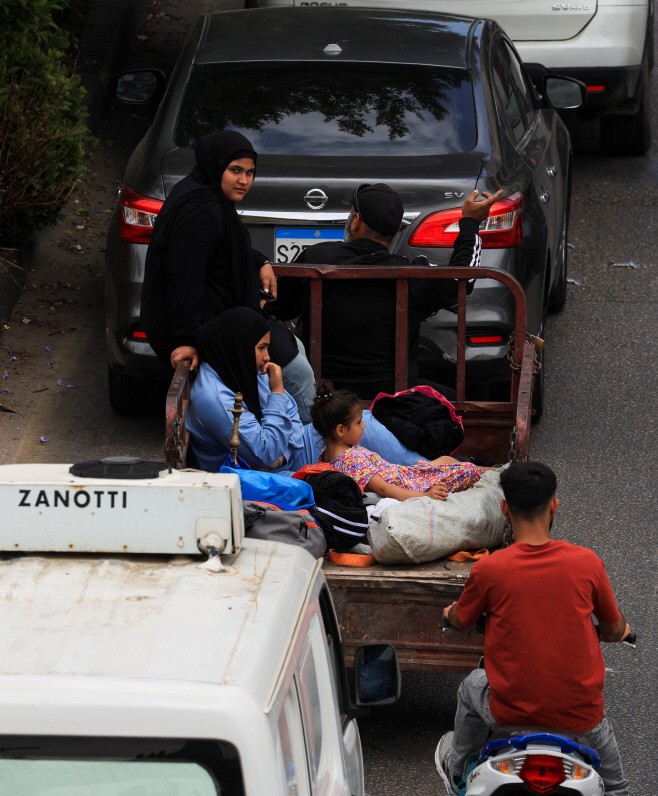 |
| Lebanese civilians flee the southern suburbs of Beirut on June 1 (local time). / Photo via Reuters, Yonhap News |
Tasnim News Agency: "Iran negotiators halt message exchange with U.S. over Lebanon air strikes... warn of Hormuz and Bab el-Mandeb blockade"
Earlier in the day, the semi-official Tasnim News Agency, which is affiliated with Iran's Islamic Revolutionary Guard Corps (IRGC), reported, "Considering that Israel's crimes in Lebanon continue and that Lebanon was one of the prerequisites for the April 8 ceasefire, the Iranian negotiating team has decided to stop dialogues and the exchange of documents conducted through mediators." Tasnim added that Iran and the 'Axis of Resistance' have placed on their agenda options to completely blockade the Strait of Hormuz and to activate new fronts, including the Bab el-Mandeb Strait at the entrance of the Red Sea.
Iranian Foreign Minister Abbas Araghchi stated on X, "The ceasefire between Iran and the U.S. is a ceasefire on all fronts, including Lebanon. A violation on any single front constitutes a violation on all fronts." Iranian Foreign Ministry spokesperson Baghaei stated during a regular briefing, "We began negotiations with the U.S. amid profound distrust and doubt," claiming that the U.S. frequently shifts its stance or introduces fresh, contradictory demands, thereby dragging out the negotiations.
The Washington Post (WP) cited an Iranian official reporting that U.S. negotiators amended the terms of the MOU over the weekend without notifying the Iranian side. President Trump stated in a phone interview with NBC News that he "has not been notified yet" regarding Iran's decision to halt negotiations, and remarked in an interview with CNBC, "Frankly, I don't care if the negotiations end or not. I don't care at all."
 |
| Nvidia CEO Jensen Huang introduces the RTX Spark GPU during a keynote speech at a side event of the annual Computex exhibition in Taipei, Taiwan, on June 1. / Photo via Reuters, Yonhap News |
Brent crude tops $97 before closing at $94.98; Wall Street hits record highs on Nvidia AI chip unveil
The draft MOU currently under discussion included reopening the Strait of Hormuz, extending the 60-day ceasefire between the U.S. and Iran, and initiating negotiations on Iran's nuclear program. However, President Trump did not approve it and instead sent back an amended version to Iran that tightened conditions on highly enriched uranium processing and control of the strait, the Wall Street Journal (WSJ) reported.
Vessels transiting the Strait of Hormuz plummeted from a pre-war average of over 130 per day to a total of just 36 over the last seven days. The AP reported that since the Gulf region accounts for 30 percent of the global fertilizer trade, concerns over food shortages are intensifying.
Brent crude futures surpassed $97 per barrel intra-day before paring gains following President Trump's comments on continuing negotiations, settling 4.2 percent higher from the previous session at $94.98 per barrel. WTI futures finished at $92.16, up 5.5 percent. The national average gas price reached $4.32 per gallon, marking a 45 percent surge since the outbreak of the war, according to the NYT.
On Wall Street, major indexes closed at fresh record highs as Nvidia surged 6.26 percent after unveiling the 'N1 X', its first AI PC chip developed through a three-year collaboration with Microsoft (MS). Driven by this momentum, the Dow Jones Industrial Average added 0.09 percent, the S&P 500 Index gained 0.26 percent, and the Nasdaq Composite rose 0.42 percent.
Dell Technologies and HP, which announced the adoption of the new Nvidia chips, skyrocketed 10.70 percent and 9.20 percent, respectively. Micron advanced 6.6 percent, closing above $1,000 per share for the first time in history. Conversely, traditional PC CPU powerhouses Intel and Qualcomm shed 4.67 percent and 8.78 percent, respectively.
The NYT reported that while European markets slid and Asian shares finished mixed, the 10-year U.S. Treasury yield settled at 4.46 percent after spiking earlier in the session.
"We don't really know what's going on," Thomas Martin, senior portfolio manager at GLOBALT, told Reuters. "The market seems to believe that something will be reached at some point, but we don't have enough information about what Iran actually wants or where President Trump is willing to compromise."
Ha Man-joo
Most Read
-
1
Celltrion’s Omlyclo gains ground in major European..

-
2
Trump demands rates fall below 1% as Fed hikes for..

-
3
Trump makes $1 trillion bet ahead of midterm elect..

-
4
Iran resumes ballistic missile production, assembl..

-
5
Samsung Electronics, Mistral AI to jointly develop..

-
6
Trump warns countries not helping U.S. must pay re..

-
7
Apple launches first foldable, 1 million won prici..

PEOPLE






HEADLINE NEWS
- Trump to roll out ‘unprecedented welcome’ for Xi with B-2 bombers, F-22 fighters
- S. Korea, U.S., and Japan form united front on Taiwan and economic coercion..
- Trump administration moves to impose sweeping sanctions on International Cr..
- Xi to make state visit to U.S. Sept. 23-25, dispelling rumors over his heal..

-
Address : In-Young Bldg., 34, Uisadang-daero 1-gil, Yeongdeungpo-gu, Seoul
Copyright by ASIATODAY CO., LTD. All rights resereved