



Nongshim spreads spicy K-food in Japan
Apr 20, 2026, 01:42 pm


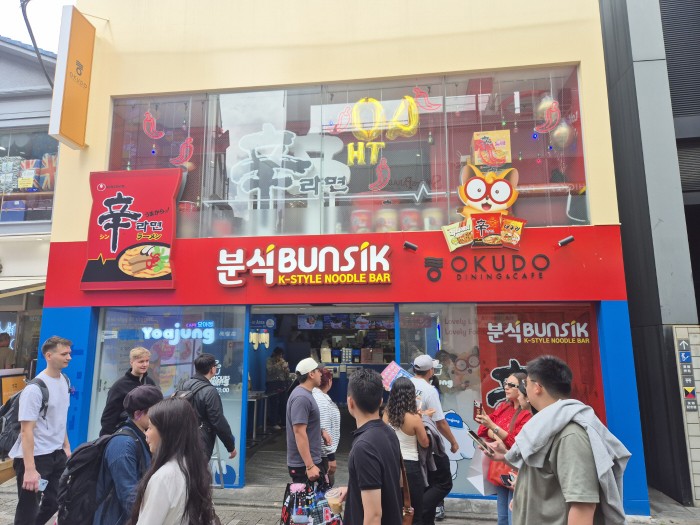 |
| Exterior view of the “Shin Ramyun Bunsik” pop-up store on Takeshita Street in Harajuku, Tokyo, one of the city’s busiest districts, as young Japanese customers enter the venue. |
Nongshim is driving the spread of K-food in Japan by staying true to its signature spicy flavor, reshaping a market once considered resistant to heat.
“Even if some consumers cannot handle the spice, we believed Shin Ramyun should maintain its original taste,” the company said, reflecting the philosophy of late founder Shin Chun-ho.
Creating a new market for spicy ramen
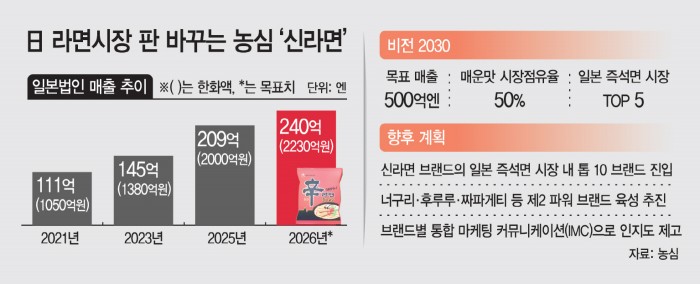
According to Nongshim, its Japanese subsidiary’s sales nearly doubled from 11.1 billion yen in 2021 to 20.9 billion yen last year. Of this, Shin Ramyun alone accounted for 16.5 billion yen.
Although spicy ramen represents only about 6% of Japan’s total instant noodle market, Shin Ramyun holds roughly 40% of that segment, driving overall category growth. The rapid expansion has prompted local giants such as Nissin Foods and Toyo Suisan to launch competing spicy products.
Nongshim’s success is particularly notable given that spicy ramen had long been considered a niche segment in Japan. The market has traditionally been dominated by sweeter and saltier broth styles such as miso, soy sauce, salt, and tonkotsu. Estimated at around 7 trillion won, the market is highly competitive, with more than 1,000 new products launched each year, many of which quickly disappear.
Kim Dae-ha, head of Nongshim’s Japan subsidiary, said, “When we established the local entity in 2002, there was no spicy category in Japan, but we refused to compromise with milder flavors. By firmly establishing our brand and differentiating our taste, we were able to create an entirely new market.”
He added that Nongshim also became the first overseas instant noodle maker to obtain Japan Agricultural Standards (JAS) certification, helping to build trust among Japanese consumers.
 |
Shin Ramyun Toomba drives growth in Japan
The key growth engine for Nongshim’s Japan business this year is “Shin Ramyun Toomba.”
The product has recently secured full-scale listings across all stores of Japan’s top three convenience chains — 7-Eleven Japan, FamilyMart, and Lawson — covering more than 53,000 locations nationwide. This is considered a rare achievement given the highly competitive nature of Japan’s retail distribution system.
Convenience stores in Japan function not only as retail outlets but also as key social infrastructure — supporting aging populations and even serving as disaster-response hubs — with food accounting for about 64% of sales. Products are typically removed after short trial periods of around one month, but Toomba has broken that norm by securing a permanent, year-round spot on shelves.
Shin Ramyun first entered Japan’s convenience store market through 7-Eleven in 1997 and only achieved full distribution across all major chains in 2015 — the first Korean ramen brand to do so. In contrast, Shin Ramyun Toomba accomplished the same feat within just one year of launch.
The company attributes this success to localization strategies, including a redesigned water-fill system and the adoption of microwave cooking — a relatively uncommon feature in Japan’s cup noodle segment. The product has surpassed 10 million units in cumulative sales and ranked 18th among Japan’s top hit products last year.
Vision 2030: building a second power brand
Nongshim Japan is accelerating its “Vision 2030,” aiming to surpass 50 billion yen in sales and capture 50% of the spicy ramen segment, ultimately breaking into the top five instant noodle companies in Japan.
To achieve this, the company is strengthening localized marketing efforts, including operating the “Shin Ramyun Bunsik” pop-up store in Harajuku, launching “Shin Ramyun Park” in collaboration with Fuji-Q Highland, and hosting tasting events tied to regional festivals such as the Sapporo Snow Festival. Discussions are also underway for a pop-up with Hankyu Department Store next year.
At the same time, Nongshim is positioning Neoguri as its second power brand. With its udon-like concept and thick noodles, Neoguri is gaining attention from Japanese consumers.
The company is focusing on strengthening its dual-brand strategy with Shin Ramyun and Neoguri, while taking a more gradual approach with Jjapaghetti, whose “black food” characteristics may be more polarizing.
Kim Dae-ha, head of Nongshim Japan, said, “It’s time to build a second major brand. Japanese consumers are particularly interested in the thick noodles of Neoguri, and we plan to develop it into a power brand comparable to Shin Ramyun through focused investment.”
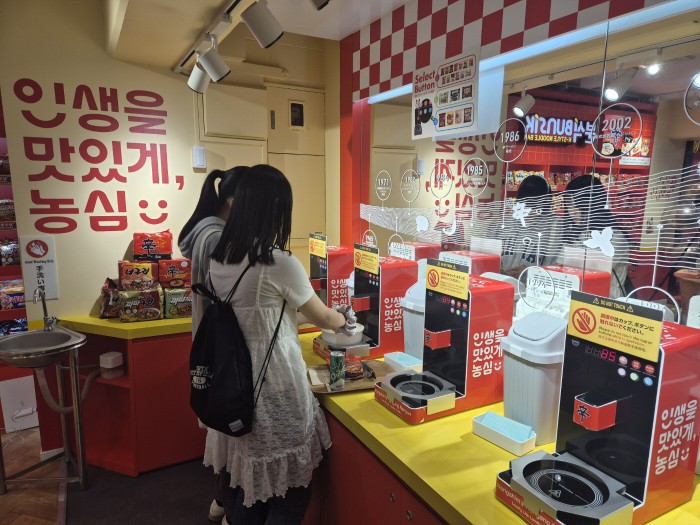 |
| Local customers in Japan cook Shin Ramyun using an automated noodle machine at the “Shin Ramyun Bunsik” pop-up store in Tokyo on April 15. |
#Nongshim #Shin Ramyun #Japan market #K-food #spicy ramen
Copyright by Asiatoday
Most Read
-
1
Celltrion’s Omlyclo gains ground in major European..

-
2
Trump demands rates fall below 1% as Fed hikes for..

-
3
Hyundai Motor Group breaks ground on integrated st..

-
4
U.S. strikes 3 Iranian oil tankers, Iran vows reta..

-
5
Trump makes $1 trillion bet ahead of midterm elect..

-
6
Iran resumes ballistic missile production, assembl..

-
7
Samsung Electronics, Mistral AI to jointly develop..

PEOPLE







-
Address : In-Young Bldg., 34, Uisadang-daero 1-gil, Yeongdeungpo-gu, Seoul
Copyright by ASIATODAY CO., LTD. All rights resereved