



Korea launches emergency economic response over Middle East crisis
Mar 25, 2026, 10:12 am


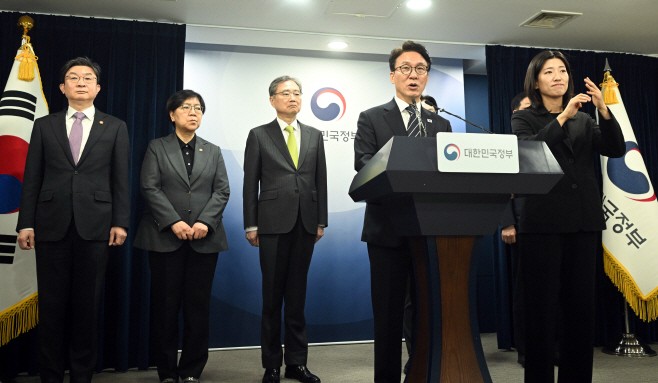 |
| Prime Minister Kim Min-seok speaks during a government briefing on the launch of an emergency economic response system at the Government Complex Seoul on March 25. / Asia Today reporter Park Sung-il |
The South Korean government has entered an emergency economic response mode and launched a new task force to counter growing risks from the prolonged Middle East conflict.
Prime Minister Kim Min-seok announced on March 25 the establishment of an “Emergency Economic Headquarters” to manage the impact of energy and raw material shortages caused by the ongoing crisis.
“The government needs to strengthen a whole-of-government response system, including preparation for worst-case scenarios, as the Middle East conflict drags on,” Kim said during a briefing at the Government Complex Seoul.
The new headquarters will operate as an inter-ministerial “one-team” system, executing policies outlined by the presidential Emergency Economic Review Meeting, which will serve as the control tower. In addition, the presidential office plans to run a separate emergency economic situation room.
The headquarters is an expanded and upgraded version of the previous emergency economic ministers’ meeting, now elevated to be chaired by the prime minister. Deputy Prime Minister and Finance Minister Koo Yun-cheol will serve as deputy head, overseeing working-level task forces.
Five response teams will be established under the headquarters:
- Macroeconomy and inflation response
- Energy supply management
- Financial stability
- Public welfare support
- Overseas situation monitoring
Each team will be led by the respective minister, with overall coordination handled by the deputy prime minister.
The headquarters will begin full-scale operations next week following a presidential meeting and will convene twice a week, with flexibility depending on developments in the Middle East.
Kim also urged the National Assembly to swiftly approve a supplementary budget to address the crisis, saying, “Timing is everything in crisis response. A supplementary budget to protect livelihoods and stabilize the economy is not optional but essential.”
He added that the government will use the crisis as an opportunity to strengthen supply chain resilience, reform capital markets, and accelerate the transition to a new energy structure.
Kim also called on citizens to participate in energy-saving efforts, including using public transportation and reducing electricity consumption.
#emergency economic response #Middle East crisis #South Korea government #Kim Min-seok #energy supply
Copyright by Asiatoday
Most Read
-
1
Trump shares map on social media labeling Strait o..

-
2
Kia Sportage outperforms Mazda CX-5 in German auto..

-
3
Houthis launch successive attacks on Saudi airport..

-
4
U.S. deploys carrier, 10,000 more troops to Middle..

-
5
Trump rejects Iran's offer to open Strait of Hormu..

-
6
N. Korea conducts first swarm attack drill with dr..

-
7
U.S.-China summit falls short on substance as Trum..

PEOPLE






HEADLINE NEWS
- Seoul dismisses Ukraine's claim of 'S. Korean support for Russia' as "inaccurate and inappropriate"
- S. Korea, Japan race to develop nuclear-powered submarines
- Henri Kagan, Kenso Soai win Nobel Prize in Chemistry for uncovering how mol..
- Vance says Alaska LNG cooperation will move forward with Seoul's current or..

-
Address : In-Young Bldg., 34, Uisadang-daero 1-gil, Yeongdeungpo-gu, Seoul
Copyright by ASIATODAY CO., LTD. All rights resereved