



Trump calls Iran proposal ‘garbage,’ warns ceasefire fragile
May 12, 2026, 08:55 am


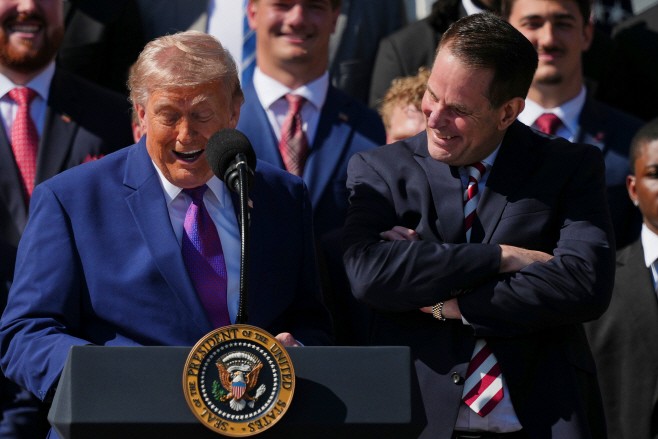 |
| U.S. President Donald Trump speaks during an event welcoming the 2026 College Football Playoff national champion Indiana University team on the South Lawn of the White House in Washington, D.C., on May 11. At right is head coach Curt Cignetti. / AP-Yonhap |
US President Donald Trump on May 11 sharply criticized Iran’s counterproposal for ending hostilities, calling it “garbage” and warning that the ceasefire was surviving only on “massive life support,” underscoring growing fragility in the U.S.-Iran truce.
The remarks came as the Trump administration reportedly reviewed whether to resume “Project Freedom,” a U.S.-led operation aimed at securing maritime passage through the Strait of Hormuz, raising concerns over renewed military escalation ahead of Trump’s planned visit to China later this week.
Speaking to reporters at the White House, Trump said he “didn’t even finish reading” Iran’s response after seeing what it contained.
Trump also claimed Iran had previously agreed to allow the recovery of highly enriched uranium-related materials but later removed the provision from its written counterproposal. Tehran has denied that any agreement on nuclear issues had been reached.
In an interview with Fox News, Trump said the administration was considering restarting Project Freedom and suggested that renewed escort operations in the Strait of Hormuz could become part of a broader military campaign.
According to Axios, Trump met with his national security team on May 11 to discuss possible next steps in the conflict, including the potential resumption of military operations.
Trump initially launched Project Freedom on May 4 but suspended it roughly 36 hours later after Pakistan-mediated ceasefire talks appeared to make progress.
 |
| Iranian women and a child sit at a cafe in Tehran on May 11. / Reuters-Yonhap |
Meanwhile, Iran defended its counterproposal as “reasonable and responsible.” Iranian Foreign Ministry spokesperson Esmail Baghaei said during a weekly briefing in Tehran that Tehran’s demands included the withdrawal of U.S. naval vessels enforcing the blockade, sanctions relief, guarantees for safe passage through the Strait of Hormuz, an effective ceasefire in Lebanon, and U.S. war reparations.
According to reports by The Washington Post and Reuters, Iran also sought to postpone nuclear negotiations until after sanctions relief and blockade measures were addressed.
Military signaling by both sides intensified further as Iran reportedly deployed Ghadir-class mini submarines to the Strait of Hormuz. Iran’s semi-official Tasnim News Agency said the submarines were capable of carrying torpedoes or Chinese-made C-704 anti-ship cruise missiles.
Bloomberg, citing sources, reported that the submarines were developed based on North Korean designs and that Iran is believed to possess at least 16 of them. However, analysts noted that the submarines are relatively noisy compared to modern systems and face operational limits in the shallow waters of the Hormuz Strait.
Security experts warned that Iran’s biggest threat may lie in mine-laying operations or coordinated swarm attacks combining drones, fast attack boats and mini submarines against U.S. naval vessels.
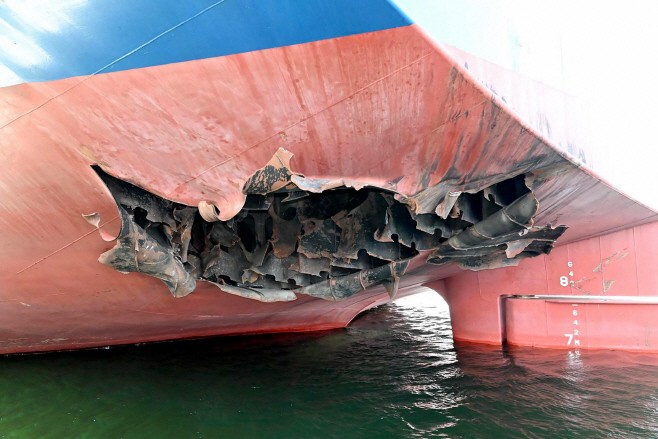 |
| Damage to the South Korean cargo ship HMM Namu docked at a port in Dubai is seen in a photo released by South Korea’s Foreign Ministry on May 10. The ministry said the vessel, which was struck in the Strait of Hormuz on May 6, had been attacked by an unidentified aircraft. / AFP-Yonhap |
At the same time, the U.S. Defense Department disclosed that an Ohio-class ballistic missile submarine capable of carrying nuclear weapons had docked in Gibraltar on May 10 — an unusually public announcement regarding the location of a strategic submarine.
The U.S. Navy said the visit demonstrated America’s “capability, flexibility and enduring commitment” to NATO allies, describing the Ohio-class submarine as one of the most survivable components of the U.S. nuclear triad.
The Wall Street Journal noted that the disclosure came only hours after Trump described Iran’s counterproposal on Truth Social as “completely unacceptable.”
Reuters reported that recent clashes between U.S. naval forces and Iranian coastal positions, along with drone attacks targeting the United Arab Emirates, have exposed the vulnerability of the ceasefire that took effect on April 8.
#Donald Trump #Iran #Hormuz Strait #Project Freedom #ceasefire
Copyright by Asiatoday
Most Read
-
1
Celltrion’s Omlyclo gains ground in major European..

-
2
Trump demands rates fall below 1% as Fed hikes for..

-
3
Trump makes $1 trillion bet ahead of midterm elect..

-
4
Iran resumes ballistic missile production, assembl..

-
5
Samsung Electronics, Mistral AI to jointly develop..

-
6
Trump warns countries not helping U.S. must pay re..

-
7
Apple launches first foldable, 1 million won prici..

PEOPLE






HEADLINE NEWS
- Trump to roll out ‘unprecedented welcome’ for Xi with B-2 bombers, F-22 fighters
- S. Korea, U.S., and Japan form united front on Taiwan and economic coercion..
- Trump administration moves to impose sweeping sanctions on International Cr..
- Xi to make state visit to U.S. Sept. 23-25, dispelling rumors over his heal..

-
Address : In-Young Bldg., 34, Uisadang-daero 1-gil, Yeongdeungpo-gu, Seoul
Copyright by ASIATODAY CO., LTD. All rights resereved