



Judge shortage worsens in lower courts
Mar 18, 2026, 08:29 am


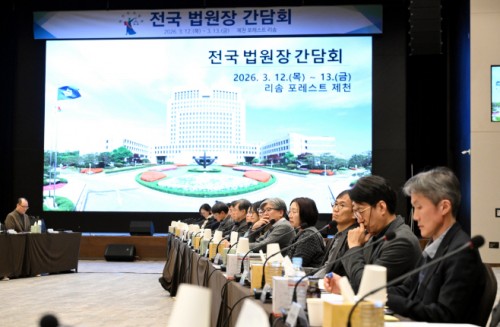 |
| A meeting of chief judges from courts nationwide is held in Jecheon, North Chungcheong Province, on March 12. / Yonhap News |
South Korea’s judiciary is facing a growing staffing crisis in lower courts, as an expansion of Supreme Court justices and the introduction of a new constitutional complaint system place additional strain on already limited judicial resources.
Under a revised Court Organization Act, the number of Supreme Court justices will increase from 14 to 26 in phases starting March 2028. The expansion will require a significant increase in research judges who assist with case reviews, potentially pulling around 100 judges away from trial courts.
Concerns over the resulting manpower gap were raised during a recent nationwide meeting of chief judges, where officials discussed measures such as increasing the number of judges and research staff to offset shortages in trial-level courts.
The introduction of the constitutional complaint system—effectively creating a fourth level of trial—has further intensified pressure. Within just five days of its implementation, 68 cases were filed. The Constitutional Court expects between 10,000 and 15,000 cases annually under the new system.
This represents a sharp increase compared with the roughly 2,700 cases handled each year between 2021 and 2025. With about 101 research officers currently in place, the average caseload per officer could increase more than fivefold.
Meanwhile, a steady outflow of judges continues to exacerbate the problem. As of March this year, 62 judges have already resigned, compared with 90 for all of last year. Over the past five years, annual departures have consistently ranged between 80 and 90 judges.
Although the total number of judges has gradually increased—from 3,214 between 2021 and 2024 to 3,384 this year—ongoing attrition has offset much of the expansion, leaving frontline courts under sustained pressure.
Surveys indicate broad consensus among judges on the need for more personnel. In a 2024 study by the Judicial Policy Research Institute, about 90% of respondents said additional judges were necessary, with many suggesting an increase of around 600 positions and some calling for up to 1,000.
Experts point to structural issues behind the staffing shortage. Jang Young-soo, an emeritus professor at Korea University Law School, noted that higher salaries in private law firms are drawing judges away from the bench.
“With significantly better pay in law firms, many judges no longer see a long-term future in the judiciary,” Jang said, adding that declining professional prestige has also contributed to the trend.
Analysts warn that without substantial improvements in working conditions and compensation, staffing shortages in lower courts are likely to persist despite ongoing reforms.
#judicial reform #Supreme Court justices #court staffing
Copyright by Asiatoday
Most Read
-
1
Celltrion’s Omlyclo gains ground in major European..

-
2
Trump demands rates fall below 1% as Fed hikes for..

-
3
Hyundai Motor Group breaks ground on integrated st..

-
4
U.S. strikes 3 Iranian oil tankers, Iran vows reta..

-
5
Trump makes $1 trillion bet ahead of midterm elect..

-
6
Iran resumes ballistic missile production, assembl..

-
7
Samsung Electronics, Mistral AI to jointly develop..

PEOPLE






-
Address : In-Young Bldg., 34, Uisadang-daero 1-gil, Yeongdeungpo-gu, Seoul
Copyright by ASIATODAY CO., LTD. All rights resereved