



Yoon couple face court over bribery claims
Mar 18, 2026, 08:25 am


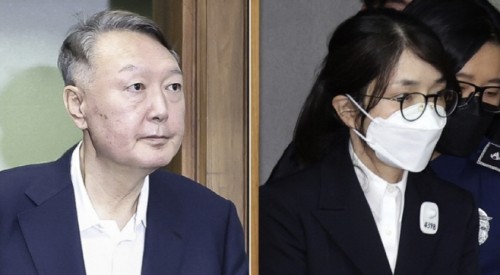 |
| Former President Yoon Suk Yeol and First Lady Kim Keon Hee appear in court on March 17. / Yonhap News |
Former President Yoon Suk Yeol and his wife Kim Keon Hee appeared in court on Tuesday as separate trials against the couple began simultaneously, with prosecutors facing the critical challenge of proving alleged quid pro quo arrangements.
The Seoul Central District Court opened the first hearing in Yoon’s case on charges of violating political funding laws. He is accused of conspiring with his wife to receive 58 opinion polls worth 270 million won free of charge between June 2021 and March 2022.
The key issue is whether the polls constituted financial or political benefits provided in exchange for specific favors. Prosecutors argue that Yoon promised a party nomination to former lawmaker Kim Young-sun in a 2022 by-election in return.
However, related cases have already resulted in acquittals. A lower court previously ruled that while financial transactions took place, they did not sufficiently prove that they were in exchange for a nomination, citing a lack of evidence beyond reasonable doubt.
A separate trial involving Kim Keon Hee on charges of influence peddling also began the same day.
Her case centers on allegations that she accepted luxury items, including a Chanel bag worth about 8 million won, in exchange for facilitating business-related favors. Courts have issued conflicting rulings in related cases—one acknowledging receipt of the item but finding no awareness of any quid pro quo, while another suggested it could be seen as an implicit request tied to business interests.
During the hearing, the court noted that the indictment alone did not clearly establish a transactional relationship between favors and benefits.
“Even for a first lady, receiving valuables may be inappropriate, but influence peddling requires proof of a quid pro quo,” the presiding judge said, describing the current charges as somewhat insufficient and calling for more detailed evidence.
Kim’s legal team admitted that some items were received but strongly denied any connection to lobbying or illicit mediation.
Legal analysts say both cases will hinge on whether prosecutors can demonstrate a clear exchange of favors for benefits—an evidentiary standard that has proven difficult to meet in earlier rulings involving the same allegations.
#Yoon Suk Yeol #Kim Keon Hee #South Korea politics #corruption trial #bribery allegations
Copyright by Asiatoday
Most Read
-
1
Celltrion’s Omlyclo gains ground in major European..

-
2
Trump demands rates fall below 1% as Fed hikes for..

-
3
Hyundai Motor Group breaks ground on integrated st..

-
4
U.S. strikes 3 Iranian oil tankers, Iran vows reta..

-
5
Trump makes $1 trillion bet ahead of midterm elect..

-
6
Iran resumes ballistic missile production, assembl..

-
7
Samsung Electronics, Mistral AI to jointly develop..

PEOPLE







-
Address : In-Young Bldg., 34, Uisadang-daero 1-gil, Yeongdeungpo-gu, Seoul
Copyright by ASIATODAY CO., LTD. All rights resereved