



President Lee to review Middle East response measures
Mar 05, 2026, 09:47 am


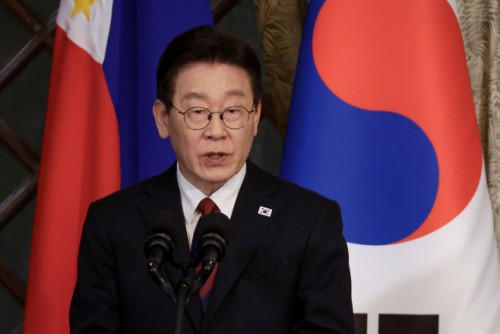 |
| President Lee Jae-myung speaks during a joint press conference with Philippine President Ferdinand Marcos Jr. following their summit at Malacañang Palace in Manila on March 3. / Yonhap |
President Lee Jae-myung will convene an extraordinary Cabinet meeting on March 5 to assess the government’s response to the escalating conflict in the Middle East and its potential impact on South Korea’s economy and security.
According to the presidential office, the meeting will focus on evaluating how rising tensions following U.S. and Israeli strikes on Iran could affect South Korea’s economy, diplomacy and national security.
The session will include briefings from several ministries, including the Ministry of Economy and Finance, the Foreign Ministry and the Financial Services Commission.
Earlier in the day, presidential chief of staff for policy Kim Yong-beom held a separate emergency meeting with senior officials from key government agencies to review the situation. Participants included representatives from the Finance Ministry, the Financial Services Commission, the Bank of Korea, the Financial Supervisory Service, and the ministries of trade, oceans, land and SMEs.
Global oil prices are under increasing upward pressure as tensions in the Middle East intensify. The Korean won also weakened during the trading session, with the dollar–won exchange rate briefly surpassing the 1,500 won mark, signaling heightened financial market volatility.
The government is closely monitoring the potential ripple effects on the real economy, including rising energy prices, inflationary pressure and disruptions to global supply chains.
The Middle East remains a critical source of South Korea’s crude oil imports. Analysts warn that if Iran moves to block the Strait of Hormuz, global oil supply chains could face severe disruption, pushing international oil prices even higher.
The government said it is closely tracking developments in energy supply and maritime logistics while preparing contingency plans to address possible supply chain disruptions.
Separately, Prime Minister Kim Min-seok has been leading interministerial meetings to coordinate the government’s response, with officials maintaining a 24-hour monitoring system to respond to the evolving crisis.
#Lee Jae-myung #emergency cabinet meeting #Middle East crisis
Copyright by Asiatoday
Most Read
-
1
Trump shares map on social media labeling Strait o..

-
2
Kia Sportage outperforms Mazda CX-5 in German auto..

-
3
Houthis launch successive attacks on Saudi airport..

-
4
U.S. deploys carrier, 10,000 more troops to Middle..

-
5
Trump rejects Iran's offer to open Strait of Hormu..

-
6
N. Korea conducts first swarm attack drill with dr..

-
7
U.S.-China summit falls short on substance as Trum..

PEOPLE






HEADLINE NEWS
- Seoul dismisses Ukraine's claim of 'S. Korean support for Russia' as "inaccurate and inappropriate"
- S. Korea, Japan race to develop nuclear-powered submarines
- Henri Kagan, Kenso Soai win Nobel Prize in Chemistry for uncovering how mol..
- Vance says Alaska LNG cooperation will move forward with Seoul's current or..

-
Address : In-Young Bldg., 34, Uisadang-daero 1-gil, Yeongdeungpo-gu, Seoul
Copyright by ASIATODAY CO., LTD. All rights resereved