



AI-driven rally lifts Korea into global top 10 markets
Jan 29, 2026, 10:39 am


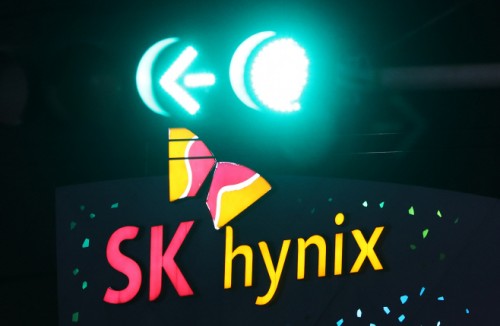 |
| The headquarters of SK hynix in Icheon, Gyeonggi Province, photographed on Jan. 28. SK hynix posted record-high revenue and operating profit last year on the back of a surge in demand for AI semiconductors. /Yonhap |
South Korea’s stock market has climbed to 10th place globally by market capitalization, overtaking Germany as an artificial intelligence–driven rally reshapes the global equity landscape.
According to Bloomberg, South Korea’s total market capitalization stood at $3.25 trillion as of Jan. 27, edging past Germany’s $3.22 trillion. The gain reflects a rally of roughly $1.7 trillion since early 2025, fueled by surging valuations of technology heavyweights and growing recognition of Korea’s strategic position in the global AI supply chain.
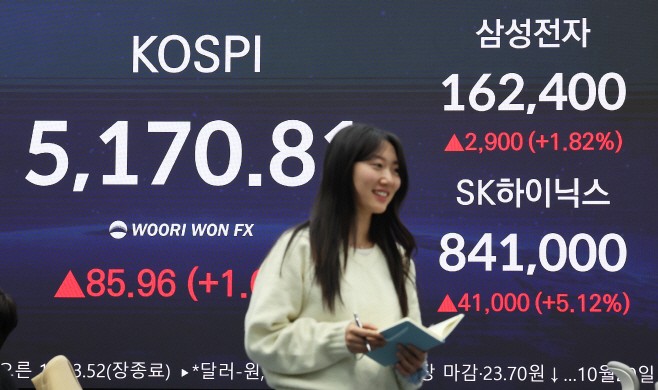 |
| Electronic boards display the KOSPI index along with Samsung Electronics and SK hynix share prices at a dealing room in central Seoul on Jan. 28, as both stocks hit fresh record highs. /Yonhap |
The milestone was driven by the twin engines of Samsung Electronics and SK hynix. Samsung shares surged past the symbolic 160,000-won level for the first time, while SK hynix delivered record-breaking earnings that eclipsed even Samsung’s annual operating profit.
The KOSPI index underscored the shift, hitting an intraday high of 5,183.44 on Jan. 28 and closing at a record 5,170.81. The rally spilled over into the KOSDAQ, which jumped 4.7 percent to 1,133.52, pushing its market capitalization to an all-time high of more than 620 trillion won.
Market participants say the advance reflects more than a liquidity-driven surge. “Korea is no longer a proxy for global trade,” said Keith Bortoluzzi, managing director at Singapore-based Impactful Partners, in an interview with Bloomberg. “It is the only market sitting at the bottleneck of the three most important megatrends of the 2020s—AI, electrification and defense.”
 |
| The Samsung logo is seen at Samsung Electronics’ “First Look” event during the Consumer Electronics Show (CES) in Las Vegas, Nevada, on Jan. 4. /AFP-Yonhap |
Bloomberg noted that Korea’s gains represent a structural revaluation tied to its dominance in key AI bottlenecks such as advanced memory, robotics and semiconductor supply chains, reinforced by shareholder-friendly governance reforms. By contrast, Germany has been weighed down by structural challenges in traditional industries such as autos and chemicals, as well as geopolitical uncertainty and subdued stimulus.
The divergence is reflected in performance this year, with the KOSPI up 23 percent in 2026, compared with a 1.7 percent rise in Germany’s DAX index.
Despite the leap in market rankings, analysts point to a gap between capital markets and the real economy. Germany’s GDP in 2024, at $4.69 trillion, was about 2.5 times larger than Korea’s $1.88 trillion, according to Bloomberg and World Bank data. Nomura economist Park Jung-woo described this as a “structural divide” between export-led corporate profits and weaker domestic demand.
Even so, investors are betting on future growth. Korea’s forward price-to-earnings ratio stands at 10.6, well below Germany’s 16.5, suggesting room for further inflows of global capital.
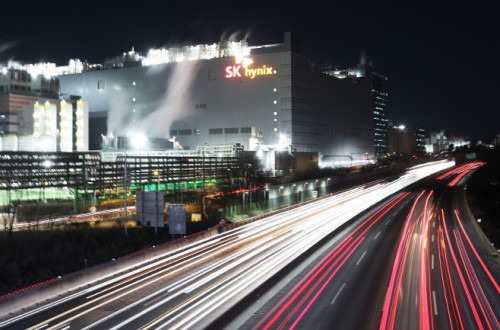 |
| The headquarters of SK hynix in Icheon, Gyeonggi Province, photographed on Jan. 28. /Yonhap |
At the heart of the rally is SK hynix, which reported record revenue of 97.1 trillion won and operating profit of 47.2 trillion won last year, driven by explosive demand for high-bandwidth memory used in AI chips. Its annual operating profit surpassed Samsung Electronics’ company-wide figure for the first time. In the fourth quarter alone, SK hynix posted an operating margin of 58 percent, exceeding that of Taiwan’s TSMC.
Bloomberg said leadership in the HBM market has elevated SK hynix to a core AI infrastructure player. The company also announced plans to establish a dedicated AI solutions unit in the United States, committing at least $10 billion in investment, a move seen as both a growth strategy and a hedge against geopolitical risks.
Korea’s rise past Germany, analysts say, signals not just a numerical reshuffle but a broader reassessment by global capital of who controls the critical inputs of the AI era—marking Korea’s shift from a fast follower to a core supplier of next-generation infrastructure.
#Korean stock market #market capitalization #AI semiconductors #SK hynix #Samsung Electronics
Copyright by Asiatoday
Most Read
-
1
Celltrion’s Omlyclo gains ground in major European..

-
2
Trump demands rates fall below 1% as Fed hikes for..

-
3
Trump makes $1 trillion bet ahead of midterm elect..

-
4
Iran resumes ballistic missile production, assembl..

-
5
Trump warns countries not helping U.S. must pay re..

-
6
Apple launches first foldable, 1 million won prici..

-
7
Turkish Airlines named main club partner of Liverp..

PEOPLE






-
Address : In-Young Bldg., 34, Uisadang-daero 1-gil, Yeongdeungpo-gu, Seoul
Copyright by ASIATODAY CO., LTD. All rights resereved