



Hormuz crisis pushes crude toward $100
Mar 09, 2026, 10:10 am


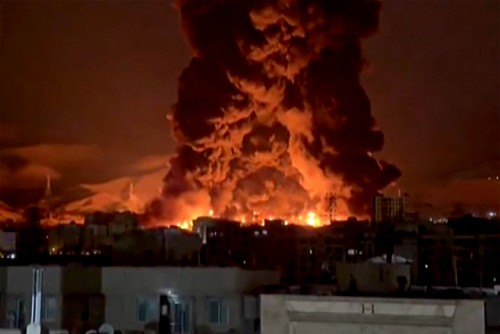 |
| A fire burns at an oil storage facility in Tehran after U.S. and Israeli airstrikes, in footage shared on social media on March 7 and 8. / AFP-Yonhap |
Global oil prices are approaching $100 per barrel as the Strait of Hormuz, a critical corridor for global energy shipments, has effectively halted commercial traffic amid escalating military conflict between Iran, the United States and Israel.
Attacks on civilian vessels, production cuts by oil-exporting nations and disruptions to liquefied natural gas (LNG) supplies are occurring simultaneously as shipping through the strait slows to a near standstill.
The disruption in one of the world’s most important oil transport routes has pushed crude prices sharply higher. On March 8, oil futures were nearing the $100 mark, while refined fuel prices including gasoline, diesel and jet fuel surged.
The White House said the spike reflects a temporary “fear premium” in the market and predicted conditions would normalize within weeks even in the worst-case scenario. However, international media outlets warn that a prolonged blockade and continued attacks on energy infrastructure could fuel global inflation and market volatility.
Recent incidents illustrate the escalating risks. An UAE-flagged tugboat, Musaffa 2, was hit by missiles and sank in the Strait of Hormuz. According to Indonesia’s foreign ministry, the vessel carried seven crew members including five Indonesians; four survived while three Indonesian sailors remain missing.
Security firm Vanguard said the tugboat was assisting the Malta-flagged container ship Safin Prestige, which had previously come under missile attack, when it was struck by two missiles.
Data tracking from Bloomberg, based on Automatic Identification System (AIS) signals, show that almost no commercial vessels have passed through the strait in the past 24 hours except ships linked to Iran. The last non-Iranian vessel was the Chinese-owned bulk carrier Sino Ocean.
Shipping activity has dropped dramatically. From about 40 to 50 vessels per day in late February, traffic has fallen to nearly zero in both directions in early March, according to Bloomberg.
The Financial Times reported similar findings using MarineTraffic data, noting that vessel movements dropped sharply after U.S. and Israeli strikes on Iran began on Feb. 28.
The disruption has also forced oil-producing countries in the Middle East to cut output as export routes become blocked and storage tanks fill.
According to Bloomberg, Iraq’s oil production has fallen from about 4.3 million barrels per day to roughly 1.7–1.8 million barrels, a decline of about 60 percent. The United Arab Emirates and Kuwait have also begun reducing production.
The Financial Times reported that Saudi Arabia, the UAE, Iraq and Kuwait may further reduce production or temporarily shut down some oil fields. Kuwait Petroleum Corp. has declared force majeure on crude exports, while Abu Dhabi’s state oil company ADNOC signaled potential production cuts at offshore fields.
As a result, crude prices have surged. U.S. benchmark West Texas Intermediate (WTI) rose about 36 percent last week to $90.90 per barrel, while Brent crude climbed to $92.69.
Bloomberg reported that Murban crude futures reached $103, Oman crude hit $107, and crude futures on the Shanghai International Energy Exchange closed at $109.
Energy consultancy Energy Aspects warned that Brent crude could reach triple-digit prices within days if the situation does not improve quickly.
Refined fuel prices are also climbing rapidly. Goldman Sachs warned that gasoline and diesel prices could reach record highs if reduced traffic through the Strait of Hormuz continues throughout March.
Energy storage capacity in oil-producing nations is also shrinking quickly. JPMorgan estimates that if exports remain blocked, production shutdowns could occur within about five days in Iraq, 12 days in Kuwait, 14–17 days in the UAE, and around 20 days in Qatar.
Saudi Arabia could maintain production for about 60 days if it reroutes shipments through the Red Sea using the east–west pipeline, though without the rerouting capacity it could face production pressure within about 33 days.
Meanwhile, attacks on energy infrastructure continue across the region. The Financial Times reported that Saudi Arabia intercepted 21 drones targeting the Shaybah and Berri oil fields, which together produce about 1 million barrels per day.
Despite the escalating risks, the Trump administration maintains that the market reaction is temporary. Energy Secretary Chris Wright said in a CNN interview that the world is not facing an actual shortage of oil or natural gas and that market disruption would last only a few weeks at worst.
Still, fuel prices in the United States are rising rapidly. According to the American Automobile Association (AAA), the national average gasoline price has climbed 19 percent over the past month and about 16 percent in the past week, reaching $3.45 per gallon.
The administration is reportedly considering measures such as maritime insurance support and naval escorts to reopen shipping lanes in the Strait of Hormuz.
The crisis is also beginning to affect the broader U.S. economy. February’s employment report showed a loss of 92,000 jobs, while the unemployment rate among U.S.-born workers rose from 4.4 percent to 4.7 percent.
Rising fuel costs are intensifying inflation concerns. Goldman Sachs estimates that if high oil prices persist, U.S. inflation could rise from 2.4 percent in January to around 3 percent by the end of the year.
The Wall Street Journal warned that the Middle East conflict could trigger an oil supply shock similar to the one caused by Russia’s invasion of Ukraine in February 2022.
However, the newspaper noted that the United States — now the world’s largest oil producer and a net exporter — may experience a smaller economic impact than energy-import-dependent economies such as Europe, Japan and South Korea.
#Hormuz Strait #global oil prices #Brent crude #WTI #Iran Israel conflict
Copyright by Asiatoday
Most Read
-
1
Trump shares map on social media labeling Strait o..

-
2
Kia Sportage outperforms Mazda CX-5 in German auto..

-
3
Houthis launch successive attacks on Saudi airport..

-
4
U.S. deploys carrier, 10,000 more troops to Middle..

-
5
Trump rejects Iran's offer to open Strait of Hormu..

-
6
N. Korea conducts first swarm attack drill with dr..

-
7
U.S.-China summit falls short on substance as Trum..

PEOPLE






HEADLINE NEWS
- Seoul dismisses Ukraine's claim of 'S. Korean support for Russia' as "inaccurate and inappropriate"
- S. Korea, Japan race to develop nuclear-powered submarines
- Henri Kagan, Kenso Soai win Nobel Prize in Chemistry for uncovering how mol..
- Vance says Alaska LNG cooperation will move forward with Seoul's current or..

-
Address : In-Young Bldg., 34, Uisadang-daero 1-gil, Yeongdeungpo-gu, Seoul
Copyright by ASIATODAY CO., LTD. All rights resereved