



Trump urges allies and China to send warships
Mar 16, 2026, 09:47 am


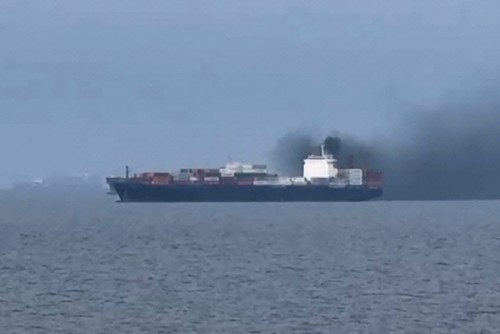 |
| A cargo ship, Source Blessing, is seen stranded in Gulf waters north of Dubai after failing to pass through the Strait of Hormuz. The image is captured from a video filmed by a crew member and released by AFPTV. /AFP-Yonhap |
The White House is considering announcing a multinational coalition to escort oil tankers through the Strait of Hormuz, the Wall Street Journal reported on March 15, citing U.S. officials.
The plan follows growing tensions in the Middle East as the war involving Iran has entered its third week. Officials said the Trump administration has been discussing the formation of a coalition to protect shipping lanes along Iran’s coastline in the strategically vital strait.
According to the report, the White House is weighing an announcement as early as this week, though details such as when escort operations would begin — either before or after hostilities ease — are still under discussion.
The proposal comes after President Donald Trump urged several countries, including South Korea, Japan, the United Kingdom, France and China, to send warships to help keep the waterway open and safe.
Former White House national security adviser Mike Waltz, now the U.S. ambassador to the United Nations, emphasized the global stakes in an interview with CNN.
“The entire world is affected,” he said, adding that Iran cannot be allowed to “hold the global economy hostage.”
However, countries asked to contribute naval forces have responded cautiously, The New York Times reported.
South Korea’s presidential office said it would closely consult with the United States but stopped short of committing to deploy naval vessels.
Japan also faces legal constraints under its pacifist constitution. A senior Japanese official warned that sending warships could face “a high hurdle.” The issue is expected to be discussed during a planned summit between Trump and Japanese Prime Minister Sanae Takaichi at the White House on March 19.
The United Kingdom said it is reviewing all options to help reopen the strait. Energy Security Secretary Ed Miliband told the BBC that coordination with allies is underway but stressed that easing hostilities would be the most effective solution.
France has indicated that it may participate in naval escort missions only after the Iran conflict stabilizes, while China has so far refrained from making a public commitment and instead called for de-escalation.
Experts have also warned about the risks of a military deployment in the narrow waterway. Michael Horowitz, a geopolitical and security analyst, described placing military assets in the strait as “a big gamble.”
Iran has warned that foreign intervention could escalate the conflict further. Iranian Foreign Minister Abbas Araghchi reportedly urged restraint in a phone call with French Foreign Minister Jean-Noël Barrot.
The crisis has already begun disrupting global energy flows. After U.S. strikes on Iran’s Kharg Island oil export terminal and a subsequent Iranian attack near the UAE port of Fujairah, some oil shipments have been halted.
Energy industry leaders, including the CEOs of ExxonMobil, Chevron and ConocoPhillips, recently warned the White House that the situation could trigger a broader energy crisis.
About 20 percent of the world’s oil and liquefied natural gas shipments pass through the Strait of Hormuz. Roughly 3,000 vessels transit the waterway each month, which narrows to about 39 kilometers at its tightest point.
According to the UK Maritime Trade Operations agency, 16 ship attacks and four suspicious incidents have recently been reported in the region. Oil prices have already risen about 40 percent since the strait’s disruption.
The International Energy Agency has approved the release of a record 400 million barrels from emergency reserves, while the U.S. Department of Energy plans to release 172 million barrels from the Strategic Petroleum Reserve.
Despite these measures, industry officials say around 9 to 10 million barrels of oil per day remain effectively trapped behind the strait, warning that energy market instability could persist unless the waterway reopens.
#Strait of Hormuz #tanker escort coalition #Trump administration #US Navy #Iran conflict
Copyright by Asiatoday
Most Read
-
1
Trump shares map on social media labeling Strait o..

-
2
Kia Sportage outperforms Mazda CX-5 in German auto..

-
3
Houthis launch successive attacks on Saudi airport..

-
4
U.S. deploys carrier, 10,000 more troops to Middle..

-
5
Trump rejects Iran's offer to open Strait of Hormu..

-
6
N. Korea conducts first swarm attack drill with dr..

-
7
U.S.-China summit falls short on substance as Trum..

PEOPLE






HEADLINE NEWS
- Seoul dismisses Ukraine's claim of 'S. Korean support for Russia' as "inaccurate and inappropriate"
- S. Korea, Japan race to develop nuclear-powered submarines
- Henri Kagan, Kenso Soai win Nobel Prize in Chemistry for uncovering how mol..
- Vance says Alaska LNG cooperation will move forward with Seoul's current or..

-
Address : In-Young Bldg., 34, Uisadang-daero 1-gil, Yeongdeungpo-gu, Seoul
Copyright by ASIATODAY CO., LTD. All rights resereved