



Korean air defense draws Middle East interest
Mar 10, 2026, 09:02 am


 |
Hundreds of missiles and drones launched across the Middle East have been intercepted simultaneously, drawing growing attention to South Korea’s defense systems and prompting renewed interest from regional countries.
As tensions escalate following U.S. and Israeli strikes on Iran, demand for air defense networks among Gulf states has surged. In particular, South Korea’s air defense system has reportedly demonstrated strong performance in real combat conditions, increasing expectations for further exports of Korean weapons systems.
According to defense industry sources on March 9, Iran has expanded missile and drone attacks against Middle Eastern countries in retaliation for military operations by the United States and Israel. The targets include U.S. military bases and allied countries in the Gulf region, placing nations such as the United Arab Emirates and Saudi Arabia under direct threat.
The UAE Ministry of Defense said its air defense systems intercepted hundreds of ballistic missiles and drones during a series of attacks that began on Feb. 28. More than 200 missiles were detected during that period, most of which were shot down. In addition, more than 1,000 drones were identified, with many successfully intercepted by air defense systems.
The UAE currently operates a layered air defense network combining the U.S.-made Patriot system, Israel’s Arrow missile defense system and South Korea’s Cheongung-II (M-SAM) medium-range surface-to-air missile.
Among them, Cheongung-II is believed to have intercepted missiles and drones approaching at low altitude during the attacks. The interception success rate is estimated to have exceeded 90 percent.
Cheongung-II is a medium-range air defense system developed with South Korean technology. It uses a hit-to-kill method capable of intercepting ballistic missiles at altitudes of about 15 to 20 kilometers. The system can track and engage multiple targets simultaneously, allowing it to respond to coordinated attacks involving both missiles and drones.
The missile is produced by LIG Nex1, while Hanwha Aerospace and Hanwha Systems developed key components such as the launchers and radar.
The system’s combat performance in the UAE has rapidly increased interest from Middle Eastern countries. Reports indicate that the UAE recently requested an accelerated additional delivery of Cheongung-II systems.
Although some media outlets reported that around 30 Cheongung-II interceptor missiles have already been supplied to the UAE, LIG Nex1 said it could not confirm details, noting that government-to-government arms export agreements cannot be publicly disclosed.
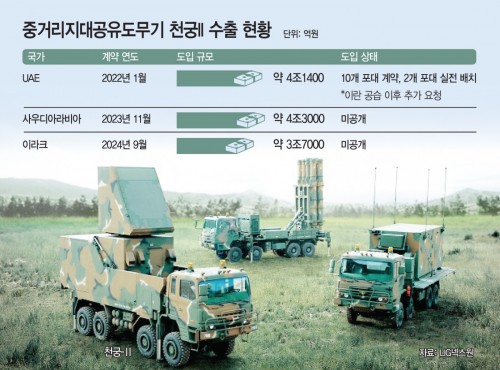
The UAE previously signed a contract worth about $3.5 billion in 2022 to acquire 10 Cheongung-II batteries, with two already deployed in the country.
Saudi Arabia also signed a contract with LIG Nex1 in 2023 worth about 4.3 trillion won for the system, while Iraq concluded a deal in 2024 valued at roughly 3.7 trillion won.
In addition, Saudi Arabia signed a contract with Hanwha Aerospace last September worth about 402.4 billion won for the Chunmoo (K-239) multiple rocket launcher system.
Middle Eastern countries including the UAE are also reportedly interested in South Korea’s long-range surface-to-air missile system L-SAM and potential future joint development. The L-SAM system was declared combat-suitable in May 2024.
Defense experts say the changing geopolitical situation in the Middle East could present new opportunities for South Korea’s defense industry.
“The real combat experience of the Cheongung-II air defense system in responding to Iran’s attacks in the region is highly encouraging,” said Chae Woo-seok, a director at the Korean Association of Defense Industry Studies. “Adoption of Korean defense systems in the Middle East is likely to accelerate.”
#K-defense industry #Cheongung-II #M-SAM #UAE air defense #Middle East missile attacks
Copyright by Asiatoday
Most Read
-
1
Celltrion’s Omlyclo gains ground in major European..

-
2
Hyundai Motor Group breaks ground on integrated st..

-
3
U.S. strikes 3 Iranian oil tankers, Iran vows reta..

-
4
S. Korea seeks redemption from World Cup setback w..

-
5
Trump makes $1 trillion bet ahead of midterm elect..

-
6
Iran resumes ballistic missile production, assembl..

-
7
Samsung Electronics, Mistral AI to jointly develop..

PEOPLE







-
Address : In-Young Bldg., 34, Uisadang-daero 1-gil, Yeongdeungpo-gu, Seoul
Copyright by ASIATODAY CO., LTD. All rights resereved