



Korea eyes supplementary budget amid Middle East risks
Mar 12, 2026, 09:01 am


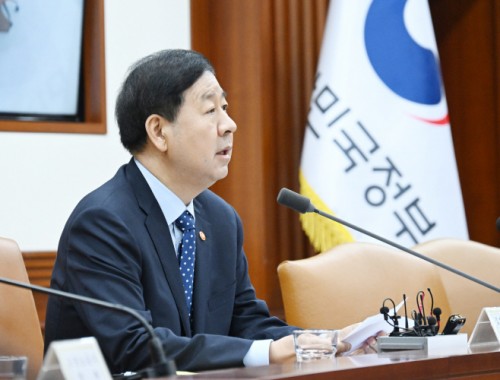 |
| Deputy Prime Minister and Finance Minister Koo Yun-cheol speaks during an emergency economic ministers’ meeting at the Government Complex Seoul on March 11. /Courtesy of the Finance Ministry |
The South Korean government has officially signaled plans to prepare a supplementary budget as rising geopolitical risks in the Middle East threaten to push up energy prices and increase the burden on households.
The extra budget is expected to range between 10 trillion won and 20 trillion won ($7.5 billion–$15 billion), according to market estimates.
Deputy Prime Minister and Finance Minister Koo Yun-cheol made the announcement March 11 during an emergency economic ministers’ meeting at the Government Complex Seoul.
“We will use all available policy tools, including a supplementary budget, to provide sufficient support and minimize the impact of the Middle East situation on people’s livelihoods as well as the broader economy and industry,” Koo said.
The planned budget is expected to focus on stabilizing consumer prices and easing pressure on households caused by rising global oil prices.
Possible measures under discussion include expanding fuel tax cuts, introducing a gasoline price cap, and providing additional support for vulnerable groups.
Economists expect the supplementary budget to fall within the 10 trillion to 20 trillion won range.
Park Jung-woo, an economist at Nomura, said in a report that around 10 trillion to 20 trillion won could be mobilized by reallocating existing government funds without issuing additional government bonds.
Kim Jin-wook, an economist at Citi, also predicted that the government could prepare a supplementary budget of up to 15 trillion won between March and April.
Attention is also focused on how the government will finance the extra spending.
Analysts believe the government is more likely to rely on improved tax revenues rather than issuing a large amount of deficit-financing bonds.
Corporate tax revenue is expected to increase this year due to strong earnings by semiconductor giants Samsung Electronics and SK hynix last year. In addition, higher stock trading activity could boost tax revenues from securities transaction taxes and related sources.
Koo also hinted at this possibility during a Cabinet meeting the previous day.
“Recent improvements in the semiconductor market and increased tax revenues from stock trading have expanded fiscal resources,” he said. “It seems possible to prepare the supplementary budget without issuing government bonds.”
#supplementary budget #South Korea economy #Middle East risk #energy prices #fiscal stimulus
Copyright by Asiatoday
Most Read
-
1
Celltrion’s Omlyclo gains ground in major European..

-
2
Trump demands rates fall below 1% as Fed hikes for..

-
3
Trump makes $1 trillion bet ahead of midterm elect..

-
4
Iran resumes ballistic missile production, assembl..

-
5
Trump warns countries not helping U.S. must pay re..

-
6
Apple launches first foldable, 1 million won prici..

-
7
Turkish Airlines named main club partner of Liverp..

PEOPLE







-
Address : In-Young Bldg., 34, Uisadang-daero 1-gil, Yeongdeungpo-gu, Seoul
Copyright by ASIATODAY CO., LTD. All rights resereved