



Trump blasts allies, shifts toward unilateral defense
Mar 18, 2026, 09:26 am


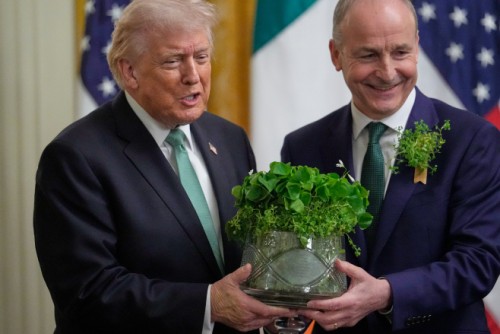 |
| U.S. President Donald Trump receives a shamrock bowl from Irish Prime Minister Micheál Martin during a St. Patrick’s Day event at the White House on March 17. / AP-Yonhap |
Donald Trump signaled a shift toward a unilateral security approach, openly criticizing allies for refusing to support U.S. naval operations in the Strait of Hormuz and declaring that Washington no longer needs their assistance.
“We don’t need anybody’s help,” Trump said, expressing frustration toward allies including NATO as well as South Korea and Japan.
In a post on his social media platform, Trump accused NATO members of benefiting from U.S. protection without reciprocating.
“We protect them, but they do nothing for us when we need it. It’s a one-way street,” he wrote, adding, “We no longer need or want support from NATO countries. The same goes for Japan, Australia and South Korea.”
Trump also claimed that U.S. military operations had effectively crippled Iran’s capabilities.
“We have essentially wiped out Iran’s military — their navy, air force, air defenses and radar are gone, and leadership has been taken out at almost every level,” he said.
Despite Washington’s push for support, European and Asian allies have largely declined to participate, viewing the conflict as a U.S.-initiated war launched without sufficient consultation.
Reports from Reuters and Bloomberg indicated that Trump described NATO’s refusal as “a very foolish mistake,” while criticizing allies for failing to stand alongside the United States.
U.S. Senator Lindsey Graham said Trump was deeply angered by the lack of support, remarking, “I’ve never seen him this upset.”
Analysts say the situation highlights a broader fracture in the global security order, as allies weigh the risks of involvement in a conflict centered on one of the world’s most volatile chokepoints.
European and Asian governments reportedly believe that deploying a small number of naval vessels would do little to counter threats such as Iranian mines, drones and fast attack craft. Many also argue that without a ceasefire, reopening the Strait of Hormuz remains unlikely.
In Asia, responses have been cautious despite Trump’s direct mention of countries such as South Korea and Japan. China, heavily dependent on oil shipments through the strait, has also refrained from direct involvement, opting instead to observe developments.
While Western allies remain hesitant, the Trump administration has reportedly sought support from Gulf states. Some regional countries, facing direct security threats, appear open to limited cooperation but are reluctant to commit to full-scale military involvement.
The United Arab Emirates, for instance, has signaled willingness to take necessary measures for its own security while avoiding deeper entanglement in the conflict.
The crisis has already had significant economic repercussions. Brent crude prices have surged by about 40% since the outbreak of conflict, at one point nearing $105 per barrel, with U.S. gasoline prices also rising.
White House National Economic Council Director Kevin Hassett warned that a prolonged conflict could place additional burdens on consumers.
As tensions persist, analysts warn that the combination of allied reluctance and U.S. unilateralism could mark a turning point in the global security framework—raising the prospect of a “go-it-alone” era in international defense policy.
#Donald Trump #NATO #US alliances #Hormuz Strait #Middle East conflict
Copyright by Asiatoday
Most Read
-
1
Celltrion’s Omlyclo gains ground in major European..

-
2
Trump demands rates fall below 1% as Fed hikes for..

-
3
Trump makes $1 trillion bet ahead of midterm elect..

-
4
Iran resumes ballistic missile production, assembl..

-
5
Samsung Electronics, Mistral AI to jointly develop..

-
6
Trump warns countries not helping U.S. must pay re..

-
7
Apple launches first foldable, 1 million won prici..

PEOPLE






HEADLINE NEWS
- Trump to roll out ‘unprecedented welcome’ for Xi with B-2 bombers, F-22 fighters
- S. Korea, U.S., and Japan form united front on Taiwan and economic coercion..
- Trump administration moves to impose sweeping sanctions on International Cr..
- Xi to make state visit to U.S. Sept. 23-25, dispelling rumors over his heal..

-
Address : In-Young Bldg., 34, Uisadang-daero 1-gil, Yeongdeungpo-gu, Seoul
Copyright by ASIATODAY CO., LTD. All rights resereved