



Trump launches Section 301 probe on 16 economies
Mar 12, 2026, 09:40 am


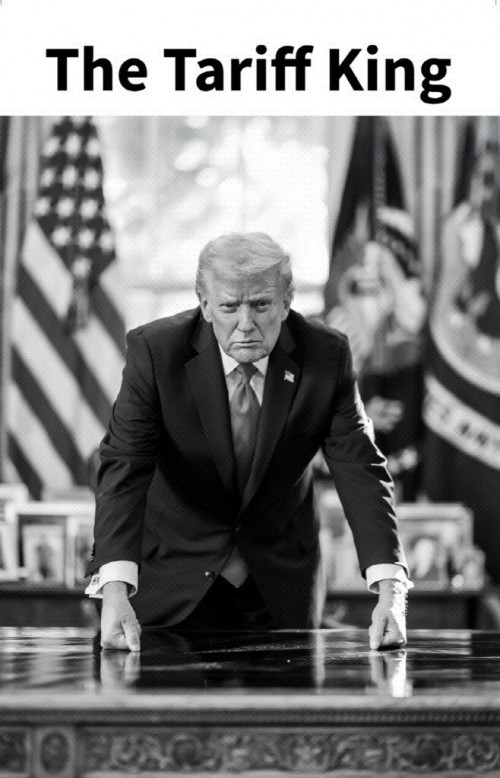 |
| U.S. President Donald Trump poses in the Oval Office in a photo posted on Truth Social with the phrase “Tariff King” written on it. /Trump Truth Social |
The administration of U.S. President Donald Trump has launched a Section 301 investigation into 16 economies, including South Korea, China, Japan and the European Union, as it prepares possible new tariffs to replace trade measures invalidated by the U.S. Supreme Court.
The Office of the United States Trade Representative (USTR) announced March 11 that the probe will examine trade practices of 16 economic entities: South Korea, China, Japan, the EU, Singapore, Switzerland, Norway, Indonesia, Malaysia, Cambodia, Thailand, Vietnam, Taiwan, Bangladesh, Mexico and India.
Section 301 of the U.S. Trade Act of 1974 allows the U.S. government to impose tariffs or other trade restrictions against foreign policies or practices deemed unfair, discriminatory or burdensome to American commerce.
The investigation comes after the U.S. Supreme Court on Feb. 20 invalidated certain tariffs imposed under the International Emergency Economic Powers Act (IEEPA), prompting the Trump administration to seek an alternative legal framework for new trade measures.
Move to rebuild tariff framework
The new probe is widely viewed as part of Washington’s effort to restore a tariff system following the court ruling.
The Trump administration aims to use Section 301 as the legal basis for imposing new tariffs after completing investigative procedures, consultations and public hearings.
Currently, the United States has imposed a temporary global tariff of 10 percent for a 150-day period. Officials hope to conclude the investigation before that measure expires in mid-July.
Focus on manufacturing overcapacity
According to international media reports, the investigation will focus heavily on “excess production capacity” in foreign manufacturing sectors.
The Trump administration argues that export-driven production and large manufacturing capacity in major trading partners have contributed to the United States’ persistent and sizable trade deficits.
The probe will also examine alleged unfair trade practices including government subsidies, wage suppression policies, the role of state-owned enterprises, barriers to market access for foreign products, insufficient labor and environmental protections, subsidized loans and potential currency manipulation.
Officials indicated that the scope of the review may vary depending on each country’s trade policies.
Most targets run trade surpluses with the U.S.
Most of the 16 economies targeted in the probe record significant goods trade surpluses with the United States.
According to 2025 U.S. trade data, the EU recorded the largest goods trade surplus with the United States at $218.75 billion, followed by China with $202.07 billion, Mexico with $196.91 billion, Vietnam with $178.18 billion and Taiwan with $146.76 billion.
Other countries on the list include Thailand with $71.86 billion, Japan with $63.88 billion, India with $58.22 billion and South Korea with $56.42 billion.
Singapore was the only economy on the list that posted a goods trade deficit with the United States, at $3.55 billion.
Hearings set for May as more probes expected
Under Section 301 procedures, the U.S. government must conduct investigations, consultations with foreign governments and public hearings before imposing tariffs.
A public hearing related to the overcapacity investigation is expected in early May, while companies may submit written opinions until mid-April.
Although such investigations typically take several months, the Trump administration aims to conclude the process before mid-July, when the current temporary tariffs are set to expire.
Washington has also signaled that additional trade investigations may follow.
Later this week, the administration is expected to announce a separate probe related to imports produced with forced labor, potentially targeting about 60 countries.
Other possible investigation areas include digital services taxes, pharmaceutical pricing policies, and trade issues involving products such as rice and seafood. Concerns over currency manipulation could also be included in future reviews.
The new investigations could spark tensions with trading partners that already reached trade agreements or concessions with the United States.
Mexico, for instance, is a member of the U.S.-Mexico-Canada Agreement (USMCA), while the EU has been engaged in ongoing trade negotiations with Washington. Observers say it remains to be seen how the new Section 301 probes will interact with existing trade arrangements.
#Donald Trump #Section 301 investigation #USTR #US trade policy #tariffs
Copyright by Asiatoday
Most Read
-
1
Trump shares map on social media labeling Strait o..

-
2
Kia Sportage outperforms Mazda CX-5 in German auto..

-
3
Houthis launch successive attacks on Saudi airport..

-
4
U.S. deploys carrier, 10,000 more troops to Middle..

-
5
Trump rejects Iran's offer to open Strait of Hormu..

-
6
N. Korea conducts first swarm attack drill with dr..

-
7
U.S.-China summit falls short on substance as Trum..

PEOPLE






HEADLINE NEWS
- Seoul dismisses Ukraine's claim of 'S. Korean support for Russia' as "inaccurate and inappropriate"
- S. Korea, Japan race to develop nuclear-powered submarines
- Henri Kagan, Kenso Soai win Nobel Prize in Chemistry for uncovering how mol..
- Vance says Alaska LNG cooperation will move forward with Seoul's current or..

-
Address : In-Young Bldg., 34, Uisadang-daero 1-gil, Yeongdeungpo-gu, Seoul
Copyright by ASIATODAY CO., LTD. All rights resereved