



Trump declares early victory in Iran conflict
Mar 10, 2026, 08:58 am


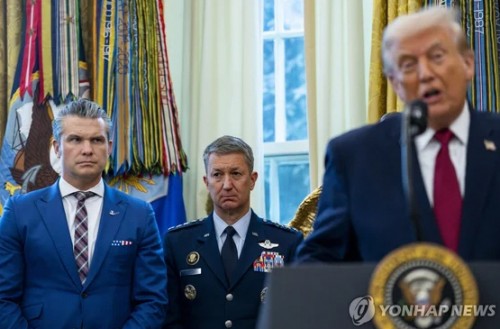 |
| U.S. President Donald Trump (right), Chairman of the Joint Chiefs of Staff Dan Caine (center), and Defense Secretary Pete Hegseth (left). /EPA–Yonhap News |
U.S. President Donald Trump claimed that the war with Iran is nearing its end, suggesting that the conflict has already reached a decisive stage.
The remark came on March 9 during a phone interview with CBS News in Florida, about 10 days after the United States and Israel began military operations against Iran on Feb. 28.
“I think the war is very complete, pretty much,” Trump said, describing the conflict as nearly finished.
He also argued that Iran’s military capability had effectively collapsed.
“They have no navy, no communications, they've got no air force,” Trump said, adding that the battlefield situation is “very far ahead of schedule” compared with the initial expectation of four to five weeks.
Since the start of the operation, U.S. and Israeli forces have carried out intensive strikes on Iranian air bases, missile facilities, communications networks, air defense systems and naval bases, aiming to disable the country’s military infrastructure through rapid and concentrated attacks.
Trump’s comments were reported by CBS White House correspondent Weijia Jiang and quickly carried by major international media outlets including Reuters, AP, The Times of Israel and the Hindustan Times.
His statement has been widely interpreted as signaling that the outcome of the war has already been determined.
Trump also mentioned the possibility of controlling the Strait of Hormuz, a key maritime passage through which about 20 percent of the world’s seaborne oil supply passes.
However, officials within the U.S. Department of Defense have taken a more cautious tone. Some military officials said that although Iran’s military capabilities have been significantly weakened, it is too early to conclude that the war is over.
They noted that the current situation could still represent the early stage of operations.
Pentagon officials emphasized that while Iran’s conventional military assets have suffered heavy damage, threats from asymmetric forces such as militias, underground networks and remaining units still remain.
The contrast between the White House’s optimistic message and the Pentagon’s more cautious assessment has created uncertainty about how the battlefield situation should be interpreted.
Some analysts say Trump’s remarks may be part of a strategic psychological campaign aimed at increasing pressure on Iran.
By demonstrating overwhelming air power in the early phase of the war and disrupting Iran’s command and communication systems, the strategy could be intended to push Tehran toward an early end to the conflict while securing a political victory.
Nevertheless, several uncertainties remain.
If Iran’s hard-line leadership, including Supreme Leader Mojtaba Khamenei and the Islamic Revolutionary Guard Corps, chooses to pursue a prolonged confrontation with the United States, the conflict could expand across the Middle East.
Possible escalation scenarios include attacks by Iran-aligned militias, disruptions to maritime routes and shocks to global energy markets.
As a result, international attention is now focused on whether Trump’s declaration that “the war is nearly over” signals a genuine path toward the end of the conflict or a political message ahead of a potentially longer and more complex phase of the war.
#Donald Trump #Iran war #U.S. military #Strait of Hormuz #Middle East conflict
Copyright by Asiatoday
Most Read
-
1
Trump shares map on social media labeling Strait o..

-
2
Kia Sportage outperforms Mazda CX-5 in German auto..

-
3
Houthis launch successive attacks on Saudi airport..

-
4
U.S. deploys carrier, 10,000 more troops to Middle..

-
5
Trump rejects Iran's offer to open Strait of Hormu..

-
6
N. Korea conducts first swarm attack drill with dr..

-
7
U.S.-China summit falls short on substance as Trum..

PEOPLE






HEADLINE NEWS
- Seoul dismisses Ukraine's claim of 'S. Korean support for Russia' as "inaccurate and inappropriate"
- S. Korea, Japan race to develop nuclear-powered submarines
- Henri Kagan, Kenso Soai win Nobel Prize in Chemistry for uncovering how mol..
- Vance says Alaska LNG cooperation will move forward with Seoul's current or..

-
Address : In-Young Bldg., 34, Uisadang-daero 1-gil, Yeongdeungpo-gu, Seoul
Copyright by ASIATODAY CO., LTD. All rights resereved