



Bipartisan talks stall over bills and probes
Jan 28, 2026, 09:26 am


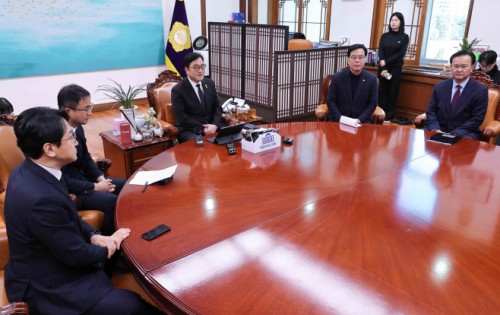 |
| National Assembly Speaker Woo Won-shik speaks during a meeting with floor leaders of the ruling and opposition parties at the National Assembly on Jan. 27. / Lee Byung-hwa |
South Korea’s ruling and opposition parties failed to reach an agreement on which bills to place on the agenda for the Jan. 29 plenary session, officials said Tuesday, deciding instead to continue negotiations.
After meeting under the chairmanship of Woo Won-shik, Yoo Sang-bum, senior deputy floor leader of the People Power Party, told reporters that the two sides differed over how many noncontroversial bills should be brought to the floor.
“Because there were differences between the parties on the number of bills to be submitted, we were unable to agree on the total today,” Yoo said, adding that further talks between senior floor leaders would be held Wednesday to seek a compromise.
According to both sides, the People Power Party strongly raised discussions on the so-called “dual special prosecutor” issue—probes related to allegations involving the Unification Church and nomination bribery—while the Democratic Party of Korea said additional consultations were needed.
The parties also failed to reach agreement on demands for parliamentary investigations into Coupang and the decision to drop an appeal in the Daejang-dong case. Yoo said both parties have already submitted requests for such probes but stressed that no clear response had yet been received from the Democratic Party.
Cheon Jun-ho, senior deputy floor leader of the Democratic Party, said the two sides agreed in principle to hold the Jan. 29 plenary session and make every effort to pass bills related to people’s livelihoods, while noting that specific items and numbers would require further talks. “We will work to ensure that as many bills as possible are processed,” he said.
Cheon added that Speaker Woo urged swift discussions on revisions to the National Referendum Act, and that talks would also proceed on legislation related to social dialogue and reforms to the National Assembly’s internal security system.
On U.S.–South Korea tariff negotiations, both parties agreed to proceed with consultations after fully hearing the government’s position and clarifying the facts. They also said further discussion would be needed on parliamentary consent for any tariff agreement.
The two sides decided to continue negotiations on strategic investment-related legislation, amendments to the National Assembly Act, and issues surrounding the filibuster.
#National Assembly #plenary session #ruling party #opposition party #special prosecutors
Copyright by Asiatoday
Most Read
-
1
Trump shares map on social media labeling Strait o..

-
2
Kia Sportage outperforms Mazda CX-5 in German auto..

-
3
Houthis launch successive attacks on Saudi airport..

-
4
U.S. deploys carrier, 10,000 more troops to Middle..

-
5
Trump rejects Iran's offer to open Strait of Hormu..

-
6
N. Korea conducts first swarm attack drill with dr..

-
7
U.S.-China summit falls short on substance as Trum..

PEOPLE





HEADLINE NEWS
- Seoul dismisses Ukraine's claim of 'S. Korean support for Russia' as "inaccurate and inappropriate"
- S. Korea, Japan race to develop nuclear-powered submarines
- Henri Kagan, Kenso Soai win Nobel Prize in Chemistry for uncovering how mol..
- Vance says Alaska LNG cooperation will move forward with Seoul's current or..

-
Address : In-Young Bldg., 34, Uisadang-daero 1-gil, Yeongdeungpo-gu, Seoul
Copyright by ASIATODAY CO., LTD. All rights resereved