



New reactors proceed, but energy diversity urged
Jan 27, 2026, 11:02 am


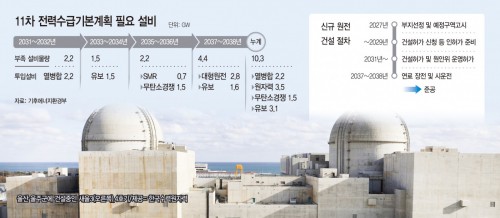 |
The government has reaffirmed plans to build two new nuclear power plants under the 11th Basic Plan for Power Supply and Demand, but analysts stress that diversifying energy sources is essential to address the structural weaknesses of both nuclear and renewable energy.
While the government intends to rely on pumped-storage hydropower and energy storage systems (ESS) to mitigate these shortcomings, experts say a gradual expansion of renewables that accounts for technical limits and physical timelines remains a major challenge.
On Jan. 26, Climate, Energy and Environment Minister Kim Sung-hwan said the government would proceed as scheduled with the construction of the two new reactors outlined in the 11th plan. “To cut carbon emissions in the power sector, coal- and LNG-fired generation must be reduced, and electricity should be supplied mainly through renewables and nuclear power,” Kim said. “We plan to offset renewable intermittency through ESS and pumped-storage hydropower, and ease nuclear rigidity through flexible operation.”
Renewable energy suffers from intermittent output due to irregular sunlight and wind conditions, while nuclear power plants are limited in their ability to rapidly adjust output. The intermittency of renewables poses a serious challenge to advanced industries such as artificial intelligence and semiconductors, which require stable, 24-hour power supplies. At the same time, the rigidity of nuclear plants makes them ill-suited to compensating for renewable fluctuations through output adjustments.
As a countermeasure, the ministry has proposed using pumped-storage hydropower to manage emergency demand and storing surplus renewable power in ESS for later use. However, experts warn that unresolved safety issues surrounding ESS and the long construction period required for pumped-storage facilities could trigger power supply risks if LNG and other backup sources are scaled back too quickly.
Yu Seung-hoon, a professor at Seoul National University of Science and Technology, said ESS remains constrained by cost and safety concerns, while pumped-storage plants, which can take nearly a decade to build, rely on surplus electricity to pump water and therefore are not suitable as immediate backup for renewables. “Even the Saeul Unit 3 project took 25 years from site acquisition to operation,” he said, adding that securing industrial competitiveness through combined-cycle power generation is a more urgent task.
Most existing nuclear plants in South Korea already have technologies that allow for flexible operation when necessary. However, experts say additional safety verification is required for automated output control using artificial intelligence rather than manual systems. Such systems would need approval from the Nuclear Safety and Security Commission, but no domestic precedent exists, making it necessary to establish a regulatory framework.
Professor Jung Bum-jin of Kyung Hee University said reactors are already equipped with governors that enable output adjustments, making flexible operation technically feasible. “The key issue is whether the regulator will approve automated control,” he said, noting that countries with advanced nuclear programs, such as France, already operate such technologies and that it is time to discuss verification methods.
Responding to these concerns at the briefing, Kim said LNG could be partially converted to hydrogen, designated as emergency power, or otherwise supplemented within a balanced energy mix. He added that while the APR1400 reactor design already allows flexible operation, the government plans to proceed cautiously with demonstrations due to potential safety implications.
Regarding site selection for the new reactors, a nuclear industry official said that construction would be confirmed following an open call for candidate sites, evaluation by a site selection committee, and official designation of planned zones. “The call for proposals could come as early as late January, or by early February at the latest,” the official said.
#nuclear power plants #energy mix #renewable energy #ESS #pumped-storage hydropower
Copyright by Asiatoday
Most Read
-
1
Celltrion’s Omlyclo gains ground in major European..

-
2
Trump demands rates fall below 1% as Fed hikes for..

-
3
Hyundai Motor Group breaks ground on integrated st..

-
4
U.S. strikes 3 Iranian oil tankers, Iran vows reta..

-
5
Trump makes $1 trillion bet ahead of midterm elect..

-
6
Iran resumes ballistic missile production, assembl..

-
7
Samsung Electronics, Mistral AI to jointly develop..

PEOPLE




-
Address : In-Young Bldg., 34, Uisadang-daero 1-gil, Yeongdeungpo-gu, Seoul
Copyright by ASIATODAY CO., LTD. All rights resereved